
- Home
- Live Blog
- Breaking News
- Top Headlines
- Cities
- NE News
- Sentinel Media
- Sports
- Education
- Jobs
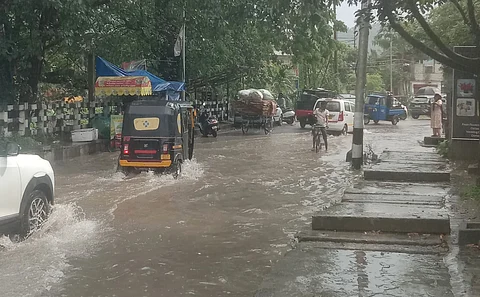
The overnight deluge triggered by very heavy to extremely heavy rain in Guwahati on Sunday, which also claimed one life, has rung the alarm bell for entire Assam that must not go unheard – flood preparedness must be elevated to the highest tier before the monsoon sets in next month. Integrating community preparedness with preparation by the state and district disaster management authorities is crucial to save lives and reduce damage to public and private properties. An early morning moderate earthquake jolt on Tuesday is also a reminder for the authorities to check the preparedness of the district disaster management authorities for twin disasters striking simultaneously. There is no escape from multiple waves of recurring annual floods because of the unique geographical location that shapes the dynamic behaviour of the monsoon regime in the state. Climate change impact has added to the erratic behaviour of monsoons, which calls for upgrading the preparedness and mitigation measures so that episodes of very heavy to extremely heavy rain cannot overwhelm the response mechanism. Estimates of the Assam State Disaster Management Authority (ASDMA) highlight that about 40% of the area of the state is affected every year in three to four waves of deluge. A flood-free Assam is only rhetoric, but the extent of flood damage can be reduced to a great extent through the application of structural and non-structural mitigation measures and by upgrading the preparedness of administration and communities. While the official flood season starts on May 1 every year and ends on October 31, the India Meteorological Department forecast, IMD, considers June to September as the period for the southwest monsoon seasonal rainfall. The IMD issues two operational long-range forecasts for the southwest monsoon. The first-stage forecast issued in the middle of April consists of quantitative and probabilistic forecasts for the country as a whole and the spatial distribution of probabilistic forecasts for different categories (above normal, normal, and below normal) of the seasonal rainfall over the country. The second stage forecast issued around the end of May consists of an update for the seasonal rainfall forecast issued in April along with the probabilistic forecasts for the seasonal rainfall over the four homogenous regions of India – northwest India, central India, the south Peninsula and northeast India – and the monsoon core zone, according to an IMD release. For the first stage forecast for this year, IMD predicts that the 2026 southwest monsoon seasonal rainfall over the country as a whole is most likely to be below normal (95-90% of the Long Period Average (LPA)), and quantitatively, the seasonal rainfall over the country as a whole is likely to be 92% of LPA. The IMD forecast, however, indicates that in some areas over Northeast, Northwest and South Peninsular India, normal to above-normal rainfall is likely, which will range between 105 and 110% of LPA. The LPA of the seasonal rainfall, according to IMD, over the country as a whole for the period 1971-2020 is 87 cm, which implies that some areas of the Northeast are expected to receive seasonal monsoon rainfall in the range of 91 cm to 96 cm. Erratic behaviour of rain due to climate change impact, marked by large deficits or large excess rainfall occurring over a narrow time window, has brought new challenges to flood preparedness and response in the state. This demands a more adaptive preparedness framework, leaving no room for any surprises of extreme rain during the seasonal monsoon rainfall. As these climate-induced weather extremes are known to disaster management authorities, the public is no longer ready to accept an explanation of “unprecedented rainfall” when a response mechanism fails to work. Disaster risk communication plays a crucial role in integrating communities in raising the level of flood preparedness. Ironically, the communities still being caught unprepared for a sudden heavy downpour or a breach in flood embankment in the state reveals a persistent gap in community preparedness and inadequate risk communication which needs to be addressed as a priority. Disaster risk communication should not only focus on one-way communication of flood alerts and advisories, but also encourage communities to take proactive measures. A pragmatic approach can be imparting training to the general public in flood-affected and flood-prone areas to develop their own checklists depending on their past first-hand experiences of flood situations, alerts and advisories issued by ASDMA and local administration. Access to digital technology has now made the generation of such checklists much easier. Introducing disaster preparedness checklists as a classroom activity in schools, colleges, and universities can significantly enhance community preparedness by encouraging direct youth participation in the preparedness process and highlighting their crucial role in the response mechanism. Creating a mobile app that connects the community preparedness checklist data to the ASDMA’s central databases can make it possible to track vulnerabilities and gaps in local and community-level readiness in real time.
