
- Home
- Live Blog
- Breaking News
- Top Headlines
- Cities
- NE News
- Sentinel Media
- Sports
- Education
- Jobs
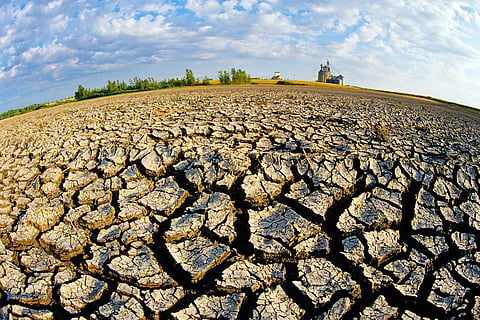
Bad news for the Northeast: desertification has emerged as a major environmental problem, and over 38.42 lakh hectares of land in the region have already gone into a state of desertification. This figure has been released by the government of India itself, with Kirti Vardhan Singh, Minister of State in the Ministry of Environment, Forest, and Climate Change in the Union government, providing this alarming data in Parliament during the ongoing Budget Session. According to the minister, the country as a whole today has a total of 978,485,851 hectares of land under desertification. Of this total, the Northeastern region has 38,421,13 hectares of land facing desertification, with Assam heading the list with 834,530 hectares. The other states of the region are also not lagging in this dangerous development, one that can cause several environmental disasters in the days to come. The unprecedented urban flood that the people of Guwahati City had experienced on August 5 last year was a direct outcome of contiguous desertification in Meghalaya and Assam along the inter-state boundary in the Khanapara-Baridua stretch. Increasing desertification in Arunachal Pradesh, on the other hand, has been causing massive topsoil erosion in the Himalayan state, with the runoff coming down to the Assam plains to raise the bed of the Brahmaputra River, thus leading to increased incidence of floods. According to the Union minister, the Space Applications Centre of the Indian Space Research Organisation (Ahmedabad) has published a Desertification and Land Degradation Atlas of India, which provides the state-wise extent of land degradation and desertification in India. This Atlas, which serves as an important tool in the planning and implementation of schemes aimed at the restoration of land, is considered to be a very valuable document and reference resource that ought to be discussed in detail in the respective Legislative Assemblies of the states in an environmentally precarious region like the Northeast. While deforestation has been identified as the most important reason behind increased desertification in the country, precious little has been done on the ground to check deforestation and green cover loss, as well as to increase the green cover. This has been happening despite the much-publicised Van Mahotsavas and record-creating plantation drives across the Northeast. The much-touted Compensatory Afforestation Fund under the Compensatory Afforestation Fund Management and Planning Authority (CAMPA), which is supposed to contribute to afforestation and consequently to combat desertification, does not appear to have created any significant impact on the ground. Combating desertification and land degradation is a dynamic process. However, government efforts alone cannot bring about the desired results. It needs a massive community push, and leaders from all segments, including religious and spiritual leaders, should put afforestation in their respective agendas.