
- Home
- Live Blog
- Breaking News
- Top Headlines
- Cities
- NE News
- Sentinel Media
- Sports
- Education
- Jobs
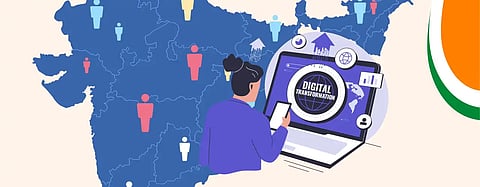
Digital India has brought an unprecedented transformation to our society. At present, from government operations to every level of daily life, the impact of information technology has become immense, significantly narrowing the distance between villages and cities. The number of internet users in the country has now crossed one billion, with nearly seventy percent of the population having access to these services. Nevertheless, the real picture is not that simple. Although direct benefit transfers of government schemes into beneficiaries' bank accounts and the convenience of conducting banking transactions from home have provided relief to ordinary working-class people, the reality in remote villages remains somewhat distinct. According to statistics, out of every six households in villages, one household still lacks any internet facility, whereas in urban areas, this figure stands at just one out of twelve households. This highlights a deep disparity. Among the rural population who do not use the internet, nearly half know nothing about this new technology or are completely ignorant about how to operate it. Another major problem is the lack of devices. While ninety-five percent of households in the country possess mobile phones, the proportion of families owning computers or laptops is under eight percent, forcing people to rely solely on mobile phones. Although using mobile phones for listening to music, watching movies, or browsing social media is easy, it is not convenient for educational pursuits. The core goal of Digital India was all-inclusive development. Emphasis was placed on enabling rural farmers and students to shape their futures through this technology; however, in reality, most rural people use it merely for entertainment. For the optimal utilization of new technology, a mobile phone and a small data package are not enough. People need proper education. To keep pace with these rapid technological shifts, it is crucial to move beyond government statistics, eliminate grassroots barriers, and mentally prepare rural citizens. Life today comes to a standstill without the internet. Therefore, unless technical education and awareness are provided to the rural masses, the dream of Digital India will remain incomplete, posing a major challenge to the nation's overall economy. Bridging technology across villages just like cities has emerged as the most critical demand of the present era. Measures must be taken so that rural citizens do not remain mere consumers, but actively engage in productive endeavors with the help of technology.
Under the government's BharatNet project, over two hundred and fifteen thousand Gram Panchayats across the country have already been connected via optical fiber to deliver high-speed internet services. Connecting rural panchayats, schools, and hospitals to the digital framework through this initiative is a positive step. Yet, these services have not reached ordinary households. Statistics indicate that while fifteen point three percent of urban households have optical fiber connections, only three point eight percent of rural families enjoy this high-speed facility. Nearly 99 percent of people in rural areas rely entirely on mobile networks for the internet. Mobile network speeds are not consistently reliable. Inclement weather or technical glitches cause network outages, causing significant hardship for students attending online classes or individuals working remotely. Due to the high cost of laying optical fiber across vast rural expanses, private companies are reluctant to extend their reach there. The setup cost for Wi-Fi systems is also exceptionally high. The initial outlay required to install Wi-Fi at home is difficult for many rural families to afford, leading them to depend on lower-cost mobile data instead. Since mobile data comes with daily usage caps, downloading large files poses a challenge. Telemedicine services have commenced in hospitals. However, low internet speeds often make communicating with doctors difficult, and even filling out simple government forms forces people to make repeated visits to digital service centers. Flaws in infrastructure continually delay the delivery of benefits under government schemes to true beneficiaries. Uninterrupted power supply is absent in many areas. During rainy days, power cuts leave digital service centers non-functional; resolving this technological divide between villages and cities will require more than just laying cables. Infrastructure expansion tailored to rural environments and conditions urgently calls for fresh thinking. The lack of reliable communication channels keeps rural residents isolated from the mainstream.
An examination of internet usage across different sections of society reveals that women and elderly citizens lag furthest behind in this digital journey. Only thirty-five point six percent of working-age women in the country use the internet, compared to over fifty-seven percent of men. The situation for elderly individuals is even more critical. Only nine percent of people over sixty years of age can navigate the internet independently, forcing a substantial number of rural families to seek outside help to access government benefits. Among farmers benefiting from crucial programs like PM-Kisan, only twenty-seven percent are active digital users. This presents a disappointing reality. Today, as recruitment processes have shifted entirely online, applying for jobs or taking examinations makes digital literacy a matter of vital importance for students. Due to a lack of digital literacy, many qualified rural youths fail to receive timely job notifications or submit applications. Cybercrime poses another major concern.
Exploiting the lack of awareness among the population, fraudsters frequently send fake messages or links to mobile phones, looting money from the bank accounts of simple rural folk in an instant. The absence of cyber security education in villages makes people fearful of conducting financial transactions online. Language barriers also present a significant obstacle. Most information available on the internet is in English, preventing ordinary Assamese speakers in villages from reading and understanding it, which ultimately keeps them at a distance. The government must take swift action to dismantle these social and demographic hurdles within rural society. Without addressing gender disparities within households, women will continue to be deprived of their rights.
What do people actually do on the internet? A recent survey revealed that approximately sixty-six percent of internet usage is spent on entertainment, with another fifty-three percent spent on social media. Conversely, only sixteen percent of the time is used for education and eleven percent for accessing government services. These statistics serve as a wake-up call. The primary objective of information technology was to elevate the living standards of ordinary people and spread the light of knowledge across society, yet it has turned into a medium for passing time. If the rural youth utilize their time to acquire new skills instead of spending the day playing mobile games or watching short videos, it will truly benefit society. The internet is a vast repository of information. Through this medium, rural farmers can access agricultural advice, weather forecasts, advanced farming methods, and accurate market prices for crops right from their homes. However, it is essential that government websites are simplified and made available in local languages. Content in local languages naturally attracts users. Only when people find information in their mother tongue will they take an interest in the internet, paving the way for digital services to transform the rural economy. If startup companies introduce voice-search capabilities in Assamese or other regional languages, even illiterate individuals in villages will reap the benefits. People who cannot read can still speak. Harnessing voice-recognition technology will allow farmers to inquire about necessary government schemes or crop treatments simply by speaking into their phones, making their daily lives significantly easier. The success of Digital India lies not merely in establishing connectivity, but in empowering people. The free flow of knowledge and information is what genuinely strengthens a society.
Empowering rural communities remains the primary task. To ensure the proper and secure use of the internet in rural areas, the government must organize regular training camps at every panchayat to provide hands-on instruction in the practical aspects of technology. Integrating digital education into the school curriculum from an early age will enable the new generation to adopt it effectively. The internet is not the exclusive domain of cities. To ensure that ordinary people gain access to high-speed internet at home at minimal cost, the government needs to offer special subsidies to private entities for building rural infrastructure. Alongside this, strong legal frameworks must be strictly enforced to prosecute offenders while raising public awareness to guard against cybercrime. Special provisions are necessary for senior citizens. Setting up support centers across villages for elderly residents and employing trained local youth to assist them in receiving government pensions or allowances will greatly alleviate these difficulties. To build a balanced society, access to smartphones and the internet must also be ensured for women so they can advance independently. Awareness is essential across every level of society. Rather than relying solely on the government, if conscious rural youth step forward to educate people in their regions about the benefits of digital tools, these endeavors will bear fruit. The correct application of technology holds the power to completely alter the economic and social landscape of a village. There is no time left to brush these issues aside. Without sincere efforts to bridge this technological divide between villages and cities, the gap between the rich and the poor will widen alarmingly in the future. Entrusting the power of technology into the hands of ordinary rural citizens is the sole pathway to building a truly developed and strong nation. If digital systems are to transform the quality of life for rural citizens, supplying devices alone will not suffice-an environment conducive to their effective use must also be created.
