
- Home
- Live Blog
- Breaking News
- Top Headlines
- Cities
- NE News
- Sentinel Media
- Sports
- Education
- Jobs
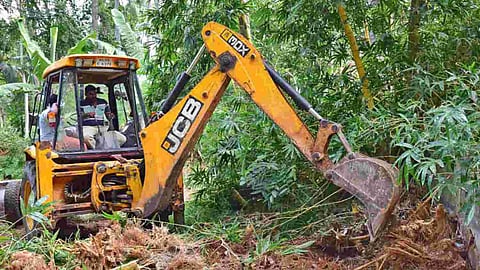
Even as the world community is struggling to find ways to tackle the twin problem of climate change and global warming, it is sad that Assam lost 11.76 sq km of forest cover between 2021 and 2023. Additionally, the state has witnessed diversion of 1,879.59 hectares of forest land for non-forest use in five years. In its Saturday edition, this newspaper prominently reported on the front page, citing the India State Forest Report (ISFR) of 2023, that Assam’s total forest cover decreased from 28,325.31 sq km in 2021 to 28,313.55 sq km in 2023, out of a total geographical area of 78,438 sq km. It is worth noting that the ISFR is published every two years. While the report for 2025 is still not available due to the time-consuming nature of the study, it is feared that the state has likely lost more forest cover in the two years since 2023. According to the Food and Agricultural Organization (FAO), an arm of the United Nations, there is an inextricable link between forest cover and climate. It is also now common knowledge that forests act as vital carbon sinks that contribute to mitigating global warming. Likewise, shifting climatic patterns—including temperature and rainfall—directly dictate forest health, species distribution, and the risk of severe disturbances like wildfires, disturbances to wildlife, and so on. Today, children at the high school level know that as forests grow, they naturally extract carbon dioxide from the atmosphere, storing it in wood, leaves, and underlying soil. The UN has been repeatedly saying that globally, intact forests absorb roughly 30% of all carbon emissions generated by human activity. Conversely, as pointed out by environmental scientists, every act of clearing or burning forests rapidly releases the carbon that was previously stored or absorbed. This accounts for about 13-21% of global greenhouse gas emissions. While one cannot deny that development is a must for a state like Assam, the sad part of the development story is that it is causing the diversion of forest areas for various kinds of development work, particularly infrastructure projects. During 2020-2021, for instance, 1,157.35 hectares of forest area in Assam were approved for diversion for various development projects. In 2021-2022, the forest area diverted was 133.43 hectares; in 2022-2023, it stood at 45.42 hectares; in 2023-24, it was 363 hectares; and in 2024-25, it was 180.40 hectares. Together, 1879.59 hectares were diverted for non-forest use in Assam over five years. Preserving Assam’s fast-depleting forest cover requires massive grassroots public awareness. Unfortunately, in Assam, there is a general tendency among organizations to spend more energy on non-productive areas or, sometimes, even on non-issues.
