
- Home
- Live Blog
- Breaking News
- Top Headlines
- Cities
- NE News
- Sentinel Media
- Sports
- Education
- Jobs
Bishaldeep Kakati
(deep.kakati99@gmail.com)
Cultural diversity and aspirations go beyond the traditional geographical boundaries of countries to create exchange of ideas, mutual understanding, and enhance ties between countries. Human beings since time immemorial have always been appreciative of vivid culture, traditions, and practices, and a trend has been observed that beings love to explore and embrace cultural ideas and practices that more often than not attract them. This notion of cultural exchange has also augmented mutual love and respect for the traditions, practices, and beliefs of a community residing in one country by a community residing in another country, and this has ultimately led to countries strengthening and solidifying their diplomatic relations. The very concept of using culture and expressions as means to enhance relations amongst people living in different parts of the world and amongst countries as a whole can be broadly defined as ‘Cultural Diplomacy. In fact, American political scientist and author Milton C. Cummings defined cultural diplomacy as “the exchange of ideas, information, values, systems, traditions, beliefs, and other aspects of culture with the intention of fostering mutual understanding.”
The concept of cultural diplomacy is not a new one; it has existed since ancient times. However, it is only in recent years that countries have researched and emphasised more and more the need to enhance mutualism amongst countries. Cultural diplomacy can be simply understood by taking into account the example of the very famous ‘Silk Route’. This route not only led to the inflow and outflow of ideas, information, and cultural interactions between Europe and Asia but also fostered commercial marketing and networking by holding numerous fairs, festivals, and markets across the Silk Route countries. Moreover, human beings have also displayed immense love and appreciation for vivid music, dance, drama, food, wardrobes, and other forms of art, and this has significantly led to the establishment of universal brotherhood and harmony, love for mankind, celebration of humanity, and the promotion of pluralism. The establishment and promotion of the aforesaid ideals have further strengthened the very pillars of cultural diplomacy. In fact, the nation of India too believes in the policies of cultural diplomacy to enjoy its fruitful benefits.
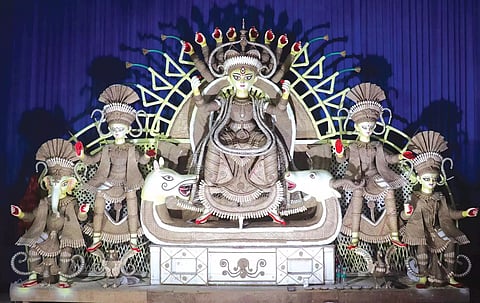
Different communities, tribes, and races residing in different parts of India enjoy and celebrate vivid festivals and traditions, with each having a unique and distinctive characteristic attached to it. India’s cultural dynamics are so vivid that they encourage people from different countries to visit the country and embrace its sui generis traditions, ideas, and beliefs. This has indeed helped the country in many different ways to substantiate its diplomatic ties and relations with countries across the globe. In this regard, one of the major festivals of India, i.e., the Durga Puja, can be considered one of the driving forces behind India’s growing cultural diplomacy.
In India, the season of autumn marks the celebration of one of the most anticipated festivals, i.e., the Durga Puja. The Puja celebrations don’t only have spiritual and mythological aspects related to them but also witness cultural assimilation in the form of music, food, wardrobe, traditional practices and beliefs, and the exchange of pleasantries to foster unity in diversity. People from different races and communities are found enjoying the festival with fun, gaiety, and fervour, and even people of different origins residing in different countries visit India during the festival. In reality, India has always been successful in using the Durga Puja celebrations as a means to enhance its cultural diplomacy.
Not going way too back in history, back in 2018 itself, former US Ambassador to India, Kenneth I. Juster, visited the city of Kolkata to inaugurate a Durga Puja pandal. His visit to the city and his decision to involve himself in the cultural extravaganza of Durga Puja were seen as a strong medium to enhance cultural ties between the two countries. According to the US Consulate, Durga Puja was a way to reinforce the importance of connecting with people irrespective of caste, creed, and religion. Alongside Kenneth, the Consul General of France, major officials from Bangladesh and representatives from the UK also became part of the Durga Puja celebration in Kolkata in 2018. The year 2018 also witnessed the association of the Chinese Consulate with Durga Puja Celebrations as well as the performance of 39 artists from China in the ‘City of Joy’. In fact, the growing stature of Durga Puja has also led to its inclusion in UNESCO’s intangible cultural heritage list in 2021. Moreover, reports suggest that for this year’s celebration, the city of Kolkata is expected to host a staggering 17,000 foreign tourists, which is 5000 more than the count of foreigners who visited the city during Durga Puja celebrations last year. Tourists are expected to visit the city mostly from the US, Australia, France, Germany, the UK, Italy, and Bangladesh. In reality, these facts and figures actually portray the growth of India’s cultural diplomacy with the help of Durga Puja celebrations.
Furthermore, food items and dishes that are enjoyed by people also remain an important aspect of the Durga Puja celebration. Often, people, especially the Bengali community, relish the taste of a Bengali thali with hilsa fish. It is presumed that the Hilsa fish of the Padma and Meghna rivers of Bangladesh are among the tastiest; as such, people like to consume the same no matter how high the cost is. Therefore, in order to meet the demands of Hilsa Fish, Dhaka’s Chief Controller of Imports and Exports has already issued licences to 79 exporters, and each is supposed to supply 50 metric tonnes of Hilsa Fish to India ahead of the Durga Puja celebrations. This prospect of demand for Hilsa fish directly or indirectly enhances the trade relations between India and Bangladesh and, more so, its diplomatic ties.
Apart from these, the ritual of immersion of the idols after the puja ends also connects the people of the town of Taki in West Bengal and the people of the district of Satkhira in Bangladesh. The people of both areas first place the idols to be immersed in the boats and then sail up to border security boats that float in the middle of the river along the international boundary. While doing so, people from both areas are just separated by a dozen metres, and as such, they wave hands and greet each other to celebrate a shared heritage.
Thus, Durga Puja has not just remained a festival celebrated in India, but it has indeed become a strong tool to further enhance India’s growing cultural diplomacy.
