
- Home
- Live Blog
- Breaking News
- Top Headlines
- Cities
- NE News
- Sentinel Media
- Sports
- Education
- Jobs
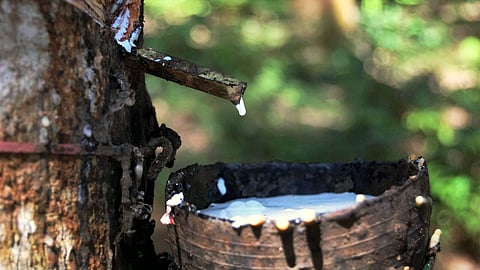
Assam has emerged as the third largest rubber producer in the country, after Kerala and Tripura, marking a landmark achievement in rubber production in the northeast region. The achievement also represents an important step forward towards India's goal of attaining self-sufficiency in natural rubber production by bridging the demand-supply gap. The expansion of area and increase in production in the state can be attributed to the collaborative project INROAD (Indian Natural Rubber Operations for Assisted Development), initiated by the Rubber Board and funded by the Automotive Tyre Manufacturers' Association (ATMA). The project envisages the development of rubber plantations on an additional 2 lakh hectares during the period 2021-2016 in the Northeast region. The region currently has 1.8 lakh hectares under rubber cultivation, with Assam accounting for about 50,000 hectares. The ATMA pushed for the expansion of rubber cultivation in the region, as Kerala, despite continuing to be the largest rubber-producing state, has reached its peak in both area and output due to declining productivity. An increase in output in the northeast region has contributed to the overall rise in rubber production in the country. As the tyre industry consumes about 70% of domestic production, a surge in automobile sales has led to a widening of the demand-supply gap, compelling the industry to fall back on imported rubber from highly competitive global markets to meet the rising demand for tyres. Tapping from newly planted rubber trees typically starts in their seventh year. The region, therefore, is poised to witness a spectacular jump in rubber production over the next four to five years and become a key hub of natural rubber in the country. For the over two lakh households currently engaged in rubber cultivation in the region, a surge in production represents a pivotal moment for the overall rubber economy and a boost to the household economies of growers. Linking the increase in rubber production in the region to the tyre industry's demand is expected to ensure stable demand and a reliable market for growers, provided that processing units are established near farm gates. As the tyre industry collaborates with the Rubber Board to increase the raw material base in the region, Assam and other NE states can leverage their strengths in rubber production to attract investment in tyre manufacturing and set up production units there. Rapid progress in connectivity, availability of clean energy and the presence of export markets in ASEAN and South Asian countries lying next door have made the region a compelling proposition to the tyre industry to set up manufacturing units in Assam and neighbouring states. ATMA estimates show that the Indian tyre industry has demonstrated its global competitiveness and resilience despite the geopolitical crisis gripping markets worldwide, with "exports reaching Rs 27,312 crore in 2025-26, marking a consistent upward trend over the past five years." Adequate training and skill development for different stakeholders in the natural rubber value chain in the region, as outlined in the objectives of the INROAD project, will be crucial to increasing productivity and improving quality. Industry estimates show that India will require 20 lakh tonnes of rubber annually from 2030 onwards. Therefore, increasing production in the region will position it as a key hub in India's rubber economy. After tapping begins, a rubber plant continues to provide an optimal yield for the next 25 years, which means that for nearly two and a half decades, several lakhs of rubber growers will continue to derive benefits from an assured livelihood from cash crops. Nevertheless, we must not overlook the challenges of climate change that drastically change rainfall in the region, and timely scientific intervention will be crucial for sustainable production. Erratic rainfall patterns, leading to large deficits or excesses of rain within short periods, impact latex production. Introduction of the world's first genetically The modified rubber plant in Assam generated hopes of growing rubber in the region in a climate-resilient way, but the final verdict must rest with the scientific evaluation of this experiment. High cash returns that follow a seven-year wait for tapping offer a strong incentive for those engaged in growing food grains and other food crops to take to rubber cultivation for augmenting household income. It must be ensured that the farmers do not convert their existing cropland into rubber plantations, as it would adversely affect food security, and only wasteland or long-fallow land should be allowed for growing the cash crop. Furthermore, profits from monocropping a cash crop risk diminishing the ecological diversity, which, in turn, can only precipitate the climate change impact in the Northeast. We cannot allow the tyre industry's demand-supply dynamics to solely determine the growth of the rubber economy in the region. The long-term sustainability of rubber cultivation in the region hinges on a calibrated approach of balancing ecological needs with the cash-crop economy.
