
- Home
- Live Blog
- Breaking News
- Top Headlines
- Cities
- NE News
- Sentinel Media
- Sports
- Education
- Jobs
Arup Saikia
(arupsaikia07@gmail.com)
Bhaona is the cultural backbone of Assam. The motion of the Assamese ethnic Community was about to stop in mediaeval Assam. Political unrest and religious malpractice gripped society, resulting in internecine discord among its own people. Meanwhile, Assamese polymath Sankerdev, born in the fifteenth century, initiated the Bhakti (Devotion) Movement in the state. Simply put, the Bhakti movement is the promulgation of equality and fraternity. This has awakened the Assamese people to embrace the Renaissance.
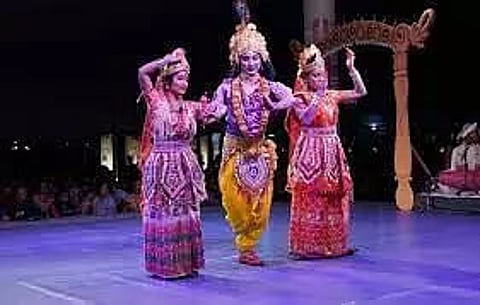
Bhaona is a socio-religio-cultural product of the Bhakti movement, or Vaishnavite revolution. After the de-mise of Sankerdev, various other monasteries (Xatra), Namghars (Assamese prayer houses), and individuals played pioneering roles in giving different forms of the original Ankiya Bhaona. Through many upheavals and transitions, Dhura, Fouzi, Matribhasha (mother tongue), Buka, Hazari, Baresohoria, and many more Bhaonas are appearing. The Bhaona in English, popularly known as English Bhaona, is the latest addition of this kind.
Concept: English Bhaona is the product of the culturally rich Jamugurihat of the Sonitpur district. It is the brainchild of the famous Baresohoria Bhaona. One of the progeny of Sankerdev, Hukai Dekagiri, started the first Baresohoria Bhaona (People’s Bhaona) at Jamugurihat in 1797. The enthusiasm of people and the high-quality performance propelled the chief executive of Prajanmya Unmesh, Arup Saikia, to think globally. It is noteworthy to say that Prajanmya Unmesh is a reputed socio-cultural organisation or troupe performing English Bhaona in India and abroad. But initially, how and where will it be performed? Will non-Assamese, even non-Indians, com-prehend Brajawali properly?
Singapore Connection: Way back in early 2017, we visited Singapore to attend a cultural seminar. Apart from the seminar, roaming around the famous landmark Merlion Park in Singapore, a Chinese troupe was performing a traditional drama in Assamese Bhaona-like attire. The crown and outer loose garment have much in common with those of Ankiya Bhaona of Assam. Female actors were wearing Bodo-Kachari-type dresses with a deep Mon-golian look. Unlike Bhaona, their drama theme wasn’t religious but purely social. The story was going ahead while one co-actor hid the belongings of a female counterpart. The drama was a little bit funny and smooth. Evil characters are less demonic than those of our Bhaona.
The cultural and biological uniformity between Northeast India and Southeast Asian countries is visible in all aspects. Saint Sankerdev used many locally available ingredients while creating Bhaona, such as dressing, vocal tune, orchestra, etc. Notwithstanding being in a foreign land (Southeast Asia), we were mentally not far away from Assam, India.
LANGUAGE FACTOR: The actors were throwing dialogue in their vernacular Chinese language. Simultaneous-ly, interpretation was also going on, but only of substance. As we keenly observed, the non-Chinese spectators were equally unenthusiastic while enjoying the drama. Virtually every interpretation can’t equally sustain the origin tempo of a drama. Curiously, we were compelled to ask fellow Chinese spectators about the theme and suspense of the drama.
This is a mini version of Bhaona done by the people of our Assamese Mongolian ancestors’ land (China and others also), which we enjoyed. But language was posing a barrier between us.
ENGLISH LANGUAGE: The original striking feature of Bhaona is the Brajawali language. Brajawali is an ad-mixture of many eastern Indian languages like Maithali, Oriya, Prakrit, Bengali, etc. Sankerdev’s effort was to syn-thesise a common language that would be easily understood by all linguistic groups in eastern India. Thus, to reach out intensively beyond the borders of Assam, imitating the footsteps of Sankerdev, we have selected the English language. On the other hand, it can greatly enhance the extent of its reach across the globe. Not only Eng-lish but also other languages, including Russian, were taken later in a very short show. This way, after Brajawali and Matribhashar Bhaona, English Bhaona was born.
SCRIPT AND PREPARATION: “Udyog Parva”, the fifth epic of the Mahabharata, was selected for the first per-formance. As the capital of our country, New Delhi was chosen for wider publicity, and Arup Saikia, director of Bhaona himself, translated the script. Ms. Girimallika Saikia and Ms. Gitimallika Baidya discharged their respon-sibilities as joint coordinators. Artists were obtained from senior schools and colleges with brilliant academic careers. Selecting artists of the new generation with cultural backgrounds is really a tough job.
Rehearsal had been done for almost two and a-half months. Being the first Bhaona in the English language by local artists, people, including media houses, were very excited. Almost all regional and national media exten-sively covered the Bhaona news. Mediapersons named it English Bhaona.
PERFORMANCE: On September 15, 2018, Srimanta Sankerdev Bhawan, New Delhi, was selected as the venue for our show. Dr. Kapila Vatshayan, a renowned scholar of international fame, inaugurated the event. She is also a Rockefeller, Padma Vibhushan, and Sankerdev awardee, among many more to mention. The venue was bustling in the evening. Back home, people were watching the live broadcast. Dr. Kapila Vatshayan, in her brief speech after the end of the show, said, It’s an English adaptation of the Mahabharata. Not only the dialogue but also the songs and laments (Bilap) were all in English. It’s an extraordinary feature of Bhaona—the entry and exit of ac-tors’ footsteps synchronising to the tune of English-rendered songs. This is really amazing, and it’s emphasised to preserve the roles of Bhaona in sequence. I have seen that only the language is different. But other ingredients of Bhaona, like Aria, Agnigarh, Purbaranga (orchestra), Sutradhar, and at the end, Mukti Mangalam or Kalyan Kharman, all rituals are practised. It’s really hard to find proper synonyms in other languages. The English syno-nyms match the unique dialogue-throwing styles of this Bhaona”.
Dr. Malaya Khound, then associate professor at JNU, termed the translation work of Bhaona a milestone in As-samese literature. Initially, she has immense anxiety about listening to some age-old, prevalent poetic narrative of Bhaona in the English language.
Regional media houses in Assam—News Live, Dy365, News18, Prag, Assam Talk, The Sentinel, the Assam Tribune, and many more—unanimously declared the unique event a “Pride moment for the theatrical history of Assam.”
After Delhi, no looking back Coordinator Ms. Gitimallika Baidya stressed the necessity of Bhaona penetrating the metros to reach the elite classes. Everything was done as planned. Many top Indian metros, including Mum-bai, tested the devotional stream of the sublime Assamese event.
Foreign Debut: Coordinator Ms. Girimallika is pursuing the mission to establish the pristine beauty of As-samese Indian culture everywhere. Traditional play, namely, Bhaona, is a unique example of mediaeval Indian rich culture. We call Sankerdev ‘Jagat Guru “(Mentor of the World or Universe). Therefore, wider public ac-ceptance will open the floodgates of the world. Ms. Baidya initially consulted with the Assamese diaspora around the globe. After much consultation and energetic efforts, we were capable of performing in many developed coun-tries. The prominent countries or places were Moscow, St. Petersburg, Finland, Singapore, Macau, Dubai, Abu Dhabi, etc. The government of Assam cooperated with us and partially sponsored almost all the programmes. Apart from previous Udyog Parva, other plays are also performed by Ramayan and Ankiya Keligopal (the playful lord). Keli Gopal is known as Rasleela in other parts of India. So far, we know we may be the first, even from In-dia, to perform Rasleela in the English language as Keli Gopal. Representatives (MPs, MLAs, ministers, and offic-ers) from the Government of Assam and India attended some of our events.
EFFECTS
1. Every country has its own traditional drama or culture. The speciality and uniqueness of Assamese Bhaona are not less than those of others. Even some of the dramaturgy and repertoire of gestures are more amusing. En-try and exit of Sutradhar (anchor), crying tune (Bilap), and Gayan Bayan (orchestra) dramatically enthralled the people a lot. Bhaona is neither a dance nor a dialogue-based drama. It is really a melodrama interspersed with songs, dance, dialogue, and music. World drama started in Greece nearly 2500 years ago with the ancient drama-tists Aeschylus, Sophocles, Euripides, etc. All were born before 450 BC. Sankerdev’s plays have undoubtedly had an influence on Sanskrit drama. But some features are neither taken from Europe nor from the earliest Sanskrit dramatists like Bhasa or Bhavbhuti. Bhaona is the confluence of Arayan, local Assamese, and immigrant South-east Asians. Sankerdev’s exclusive contribution to integrating all makes Bhaona-genius the difference. Finally, the few non-Indian people present in our show at least partially understood the rich cultural treasure of Assam and Assamese.
2. Bhaona converting its ideals or look to be more artistic than previously prevalent religious Artistic accept-ability always prevails over that of religion. This is another striking transformation or feature of English Bhaona.
Criticism and Obstacles:
The mindsets of people reflect the culture of the said location. Bhaona from Chinha Jatra to the present day, a lot of changes have occurred. People are accepting Bhaona in various languages, including Assamese. But some sections of Assamese people are getting bizarre English. Critics perceived the theme and presentation of Bhaona as getting distorted if presented in other languages except Brajawali. Location-wise, sporadic protest meetings are also held. The director defended multi-lingual Bhaona, saying, Language can’t be a barrier to culture. Even the creator, Sankerdev, had not presented Bhaona in his mother tongue, Assamese. He used the composite language Brajawali for wider publicity. Director Arup Saikia added more to his riposte: Only feeling and dramatic appeal matter most in any play.”
Financial scarcity, visa and immigration difficulties for minor students, and venue and location arrangements abroad are the most common problematic issues.
To attain revolutionary success, an artist has to be wealthy, courageous, intelligent, and healthy. First As-samese film maker Rupkonwar Jyoti Prasad Aggarwal is a good example of this genre.
FUTURE PLAN:
We will continue the performance in more countries and in more languages. Inter-country languages connect the minds of humans. The need of the hour is translation bearing more relevance and closeness to the heart. To establish Saint Sankerdev as a cultural maestro on par with Leonardo Da Vinci and Michael Angelo, Sankerdev’s tag of religious preacher has to be diversified into multiple dimensions as the mission of Assamese.