
- Home
- Live Blog
- Breaking News
- Top Headlines
- Cities
- NE News
- Sentinel Media
- Sports
- Education
- Jobs
Bagmita Borthakur
&
Bishaldeep Kakati
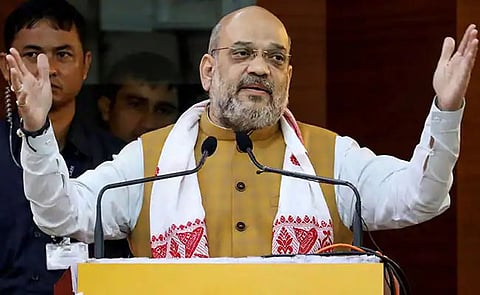
Union Home Minister Amit Shah’s recent visit to Assam, concluding on March 29, 2026, marks a significant moment in the state’s evolving political narrative. More than a routine election campaign, his speeches collectively outline a structured transition, from a decade defined by stabilisation and peace-building to an impending phase centred on protection, consolidation, and demographic control. At the heart of this shift lies a powerful and politically significant phrase: “ghuspetiya mukt Assam”—an infiltration-free Assam.
Shah’s articulation of the past ten years is grounded in a narrative of restoration. He foregrounds the establishment of internal peace as a key achievement, citing the decline in insurgency and the integration of militant groups through a series of accords, including the Bodo Accord (2020) and agreements with ULFA’s pro-talk faction. Thousands of militants across groups such as ULFA and NDFB have surrendered over the past decade, contributing to a sharp decline in insurgency-related violence. In this framing, Assam has transitioned from a conflict-prone frontier to a stable political space.
This narrative serves a clear purpose, establishing the Home Ministry as the architect of a ‘post-conflict Assam’. However, this visit moved decisively beyond these parameters, outlining a forward-looking agenda rooted in protection rather than stability.
Central to this future vision is the issue of infiltration. Shah argued that no new infiltration has taken place in Assam over the past decade, attributing the decline to improved border management, fencing, and security measures. Government data does indicate a significant strengthening of border management over the past decade, lending support to claims of tighter control over infiltration. According to data presented in Parliament, detected infiltration along the India-Bangladesh border declined by over 60 per cent between 2015 and 2019, reflecting enhanced surveillance and enforcement mechanisms. At the same time, the Ministry of Home Affairs has reported that nearly 79 per cent of the India-Bangladesh border has now been fenced, alongside increased deployment of security forces and the use of technological monitoring systems. These measures, combined with intensified border vigilance and pushback operations over the past few years, have significantly improved control over cross-border movement.
Within this context, Shah’s assertion that infiltration has been effectively curbed over the past decade is attributed to sustained institutional and infrastructural interventions along the border. This claim performs an important function, as it marks the completion of what may be termed Phase I, i.e., control. Followed by Phases II and III, i.e., identification and removal, as argued by the Home Minister in his visit.
It is in this context that Shah invokes the doctrine of the “three Ds”, detect, debar, and deport, rooted in the principles of the Assam Accord. This threefold framework becomes the operational core of the next decade, aligning historical commitments with contemporary enforcement. The slogan of an “infiltration-free Assam” thus represents not merely an aspiration but a structured policy trajectory.
The second pillar of Shah’s argument lies in land and territorial control. The government has claimed to have freed between 1.25 lakh and 1.5 lakh bighas of land from alleged encroachment over two terms, with official figures citing approximately 1.45 lakh bighas recovered, including large tracts from national parks, wildlife sanctuaries, and reserved forests. These drives have extended to culturally significant spaces, including xatras, where over 4,400 acres of land linked to more than 900 xatras have been identified as encroached.
This emphasis on land reclamation by the Home Minister serves a dual narrative. On one hand, it is presented as an administrative exercise in restoring government and ecological land. On the other hand, it is framed as a civilizational project that protects indigenous identity, heritage institutions, and demographic balance. The targeting of char areas, forest reserves, and religious-cultural sites reinforces this convergence of governance and identity politics.
A third, more complex dimension of the discourse is the emphasis on demographic change and its implications for Assam’s socio-political landscape. Shah pointed to significant shifts in population patterns across districts such as Dhubri, Barpeta, Nagaon, and Goalpara, framing them within the broader discourse on migration and identity. Political debates frequently cite figures such as 64 lakh infiltrators. The NRC excluded around 19 lakh individuals statewide, underscoring the layered and contested nature of citizenship, documentation, and migration in Assam. This complexity continues to shape both policy debates and public discourse in the state.
Taken together, the Home Minister’s visit outlines a structured three-phase political project that maps Assam’s trajectory over the past decade and into the future. The first phase (2016-2021) is framed around peace-building and the prevention of fresh infiltration, establishing a foundation of internal stability after decades of insurgency. The second phase (2021-2026) shifts toward consolidation, marked by extensive eviction drives and large-scale land reclamation across forests, sar areas, and culturally significant sites. Looking ahead, Shah proposes a third phase (2026-2031) centred on the full implementation of the Assam Accord’s core principles of detect, debar, and deport, aimed at systematically identifying and removing those deemed illegal infiltrators. Within this continuum, the idea of “an infiltration-free Assam” emerges not merely as a political slogan but as the culmination of a phased governance strategy.
In many ways, Shah’s Assam visit crystallises a broader governance model: from conflict resolution to identity consolidation. The first decade delivered relative peace; the next promises protection of borders, land, and identity. The doctrine of detect, debar, and deport provides the mechanism, while the vision of an infiltration-free Assam provides the political vocabulary.
As Assam approaches a crucial electoral moment, this shift from peace to protection is likely to define its political discourse. Whether it results in durable governance or deepens existing fault lines will depend on how effectively the state navigates the balance between security imperatives and its historically layered social fabric.
(About the authors: Bagmita Borthakur is a PhD Research Scholar at BITS Pilani and Bishaldeep Kakati is an Advocate at Gauhati High Court).
