
- Home
- Live Blog
- Breaking News
- Top Headlines
- Cities
- NE News
- Sentinel Media
- Sports
- Education
- Jobs
Himangshu Ranjan Bhuyan
(himangshur1989@gmail.com)
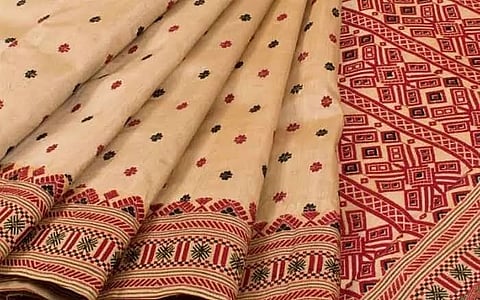
The golden glow of Muga silk has represented Assam's cultural identity for centuries, yet its future now depends on economic choices rather than historical pride alone. Across the villages of Upper and Lower Assam, generations of families have nurtured silkworms, cultivated Som and Soalu plants, reeled delicate fibres, and woven fabrics that remain unmatched for their natural lustre and remarkable durability. A few textile traditions anywhere in the world possess such a distinctive geographical identity. Muga silk is not merely another luxury fabric. It is produced only from the endemic 'Antheraea assamensis' silkworm, making Assam the sole natural home for this extraordinary fibre. This exclusive character gives the state a rare economic advantage in an increasingly competitive global textile market where authenticity carries significant commercial value. Consumers across the world no longer purchase premium textiles solely for appearance. They also seek products with verified origins, sustainable production methods, environmental responsibility and cultural significance. Muga silk naturally satisfies these expectations. Its golden colour emerges without artificial dyeing, its strength increases with age, and its production remains deeply connected to the traditional ecological knowledge that local communities have preserved for generations. These qualities should place Assam in a commanding position within the international luxury textile sector. Yet the economic reality presents a more complex picture. Although Assam accounts for almost all of India's Muga silk production and enjoys Geographical Indication protection, the benefits reaching rearers and weavers often remain far below the product's true market value. Small-scale production, fragmented supply chains, limited branding, counterfeit products and inadequate market access continue to reduce earnings. Many young people from traditional weaving families increasingly search for alternative occupations because they perceive greater financial security elsewhere. This trend threatens household incomes and jeopardises the survival of specialised skills that are difficult to replace once they vanish. The future of the Muga silk economy therefore requires a shift in thinking. Preservation alone cannot support livelihoods. Assam must treat Muga silk as a globally competitive knowledge-based industry supported by scientific research, modern business practices and strong international marketing. Such an approach would allow traditional craftsmanship and contemporary enterprise to strengthen one another rather than exist as separate worlds.
Recent policy initiatives indicate that governments have begun to recognise both the economic and cultural importance of this unique industry. The launch of Mission Muga Silk "Senehjori", supported jointly by the Government of India, the Government of Assam, the Ministry of Development of the North Eastern Region and the Central Silk Board, reflects a broader vision for transforming the sector into a modern rural enterprise. With an investment exceeding Rs 400 crore, the programme seeks to improve every stage of production, from host plant cultivation and silkworm rearing to reeling, weaving, marketing and exports. Such comprehensive intervention acknowledges an important economic fact. High-value industries cannot succeed when only one segment receives attention while others remain neglected. Every participant in the production chain contributes to the final quality that consumers ultimately recognise and reward. Scientific improvements in disease management, better planting material, expanded Som plantations, modern reeling technology and stronger extension services can substantially improve both productivity and quality. Digital traceability also offers new possibilities. International buyers increasingly demand proof of authenticity before paying premium prices. Secure certification systems can protect genuine Muga silk from imitation while strengthening consumer confidence across global markets. The same technological tools can help producers monitor quality, improve logistics and establish direct relationships with buyers without relying entirely on multiple intermediaries. Such changes become even more important as climate variability introduces fresh challenges. Changes in the weather, such as less rain, higher temperatures, and changes in the environment, have a direct effect on the health of silkworms and the plants they live on. Research institutions therefore need sustained financial support to develop improved breeds, strengthen disease resistance and recommend adaptive cultivation practices suitable for changing climatic conditions. Investment in scientific research should not replace traditional knowledge. Instead, both systems must complement each other. Experienced rearers possess generations of practical understanding regarding seasonal cycles, host plants and silkworm management. Modern science can refine these practices through improved technology and evidence-based innovations. This partnership between indigenous knowledge and contemporary research offers perhaps the strongest foundation for securing the industry's long-term future.
The future of Muga silk also depends upon how successfully Assam integrates the industry with changing consumer preferences and emerging economic opportunities. Global luxury markets increasingly reward products that combine craftsmanship with compelling narratives of origin, sustainability and cultural authenticity. Muga silk already possesses these characteristics. What it lacks is sufficiently strong international visibility. Strategic branding can transform perception and increase value without expanding production dramatically. Luxury consumers often purchase stories as much as products. Assam therefore needs coordinated branding that highlights the ecological uniqueness of Muga silk, the skill of its artisans and the centuries-old traditions that continue to shape every stage of production. Fashion designers, research institutions, exporters and tourism agencies should collaborate more actively to introduce Muga into new product categories beyond traditional garments. Premium scarves, ties, handbags, home furnishings, ceremonial gifts, luxury interiors and contemporary fashion collections can all expand demand while preserving the fibre's distinctive identity. Digital commerce provides rural producers more chances to sell their goods than they had before, when they only had small local markets to sell to. Today, even small weaving clusters can present authentic products directly to customers across India and overseas through reliable online platforms. Rural tourism can also become an important economic partner. Visitors increasingly seek meaningful cultural experiences instead of conventional sightseeing. Sericulture villages, weaving workshops, textile museums and live demonstrations can create supplementary income while strengthening public appreciation of Assam's cultural heritage. Educational institutions should contribute by encouraging entrepreneurship, textile design, fashion technology and business management within sericulture education so that younger generations recognise Muga silk as a promising professional sector rather than an occupation of necessity. Financial institutions must also provide accessible credit to small producers seeking to modernise their equipment or expand their operations. Better insurance coverage can reduce the risks associated with climatic uncertainty and biological losses. Market intelligence services should regularly inform producers about domestic and international demand trends, enabling them to make better commercial decisions.
Assam is currently at a pivotal juncture in the evolution of its Muga silk economy. The state possesses resources that no competing region can replicate, yet natural exclusivity alone cannot guarantee economic success. Every stage of the value chain requires stronger institutional support, scientific innovation, financial inclusion and global market integration. Rural livelihoods depend upon these improvements, but the implications extend far beyond employment. Muga silk represents one of the few industries where environmental conservation, cultural heritage and economic development naturally reinforce each other. Expanding Som plantations strengthens ecological sustainability. Protecting traditional weaving preserves intangible cultural heritage. Increasing exports generates higher rural incomes while enhancing India's reputation within premium textile markets. These objectives need not compete with one another if policy remains consistent and long-term. Public investment should encourage private entrepreneurship rather than replace it. Cooperatives, farmer-producer organisations and women-led self-help groups deserve greater participation because they strengthen local ownership and improve bargaining power. International exhibitions, designer collaborations and trade agreements should actively promote authentic Muga silk as a luxury product rather than an ordinary textile. Counterfeit products must face stricter enforcement under geographical indication regulations to protect both producers and consumers. The success of the industry will ultimately depend upon confidence. Farmers must believe that sericulture offers reliable incomes. Young entrepreneurs must recognise profitable business opportunities. Designers must trust consistent quality. International buyers must associate the Muga name with authenticity and excellence. Consumers must understand why genuine Muga silk deserves its premium price. When these conditions develop together, Assam will not merely preserve an ancient tradition. It will establish one of India's strongest examples of how cultural heritage can drive sustainable economic growth in the twenty-first century. The future of the Muga silk economy therefore lies not in protecting the past from change but in using centuries of accumulated knowledge to build a modern industry capable of competing confidently in the world's most demanding markets.
