
- Home
- Live Blog
- Breaking News
- Top Headlines
- Cities
- NE News
- Sentinel Media
- Sports
- Education
- Jobs
Kaustov Kashyap
(pragatigroup08@gmail.com)
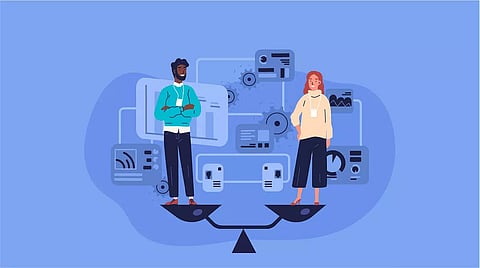
Why do you think gender diversity is important in the workplace? How can gender-balanced teams help boost productivity? How can HR managers work towards addressing the misconceptions held strongly about women in certain technically-skilled job roles? What should you do about it? How can you create gender-diverse teams? How can you propagate the need for gender-balanced teams in every organization? This piece has some interesting trivia for you.
You will agree with the fact that certain fields have long been viewed as male-dominated industries such as IT, mining, mechanics, and surgeon to be represented by men in the workforce at large, leaving no opportunities for women to seek a breakthrough and prove their mettle. However, a recent study contra-dicts the past trends and showcases that the gap between men's and women's participation in technically skilled job roles will be closing soon.
As organizations take small steps toward building gender-diverse teams in sync with the pace of change, recruiting more women into certain job roles should no longer be taboo or seen as a mere formality to fulfilling the clauses of employment law; on the contrary, it should be seen as a challenge to find the next great talents.
Talking about gender-balanced recruitment in workplaces means offering equal opportunity for every individual regardless of their gender background to contribute toward the company's development goals.
From entry-level staff to those in the managerial cadre strongly rely on the decision-making capabilities of talent, and hence gender-diverse teams have a lot to offer in terms of advantages to the company. They help:
1. Boost performance
Gender diversity encourages employees with different perspectives to engage proactively, such that they can see a particular thing as a whole, rather than viewing it partially. Bringing together different perspectives helps in better decision making towards particular issues and performs great efforts as well. Good cooperation between men and women could certainly make for a killer squad.
2. Increase profits
Once the performance of an employee shows significant improvements, the company's profits will also increase with time. Gender balance will provide the team with a diverse set of skills, such that the company can perform better. A study shows that shifting from an all-male or all-female office to a balanced one can actually increase the company's revenue by 41 per cent.
3. Improve reputation
In an era where image and reputation play a crucial role, a gender-balanced workforce could be a great strategy to drive the business. According to a recent study, women tend to seek careers in companies that demonstrate significant gender diversity rather than those with none. Thus, having a reputation as a gender-friendly business will bring in more pluses than the opposite for your future talent pool.
4. Widen talent scope
Gender cannot be used to define one's excellence. Even for highly-stereotyped jobs dominated by males such as IT workers, women can do a better job than men if given a chance to perform because of their keen eye for details. Men and women both have different traits and personalities.
However, instead of viewing the differences in a negative light and as an unfavourable condition, they should be viewed and recognized as a powerful asset for your company. Without including more women in the workforce, the company will likely end up eliminating half of the available strong talent in the market, while losing out on the unique qualities they can bring.
5. Support retention
Allowing many workers to quit within a short period of time is not good news for any company. Not only are you required to spend more money on hiring new talents, but the company's project schedule will also be disrupted as well.
Nobody wants to stay long in a rigid workplace that does not allow flexibility. Thus, gender diversity in a workplace that allows for flexible working arrangements between men and women is a key to talent retention in the long run.