
- Home
- Live Blog
- Breaking News
- Top Headlines
- Cities
- NE News
- Sentinel Media
- Sports
- Education
- Jobs
Heramba Nath
(herambanath2222@gmail.com)
Guwahati, the largest city in the Northeast and the gateway to the region, has entered a new era where the simple act of breathing cannot be taken for granted. Once known for its open skies, lush hills, the wide Brahmaputra, and a climate that felt distinct from the dense pollution of metropolitan India, Guwahati today stands at the edge of an environmental crisis that whispers warnings each morning in the form of a hazy skyline and a lingering heaviness in the air. The Air Quality Index (AQI) of the city has become a recurring subject of worry among health experts, environmentalists, journalists, policymakers, and ordinary residents who now follow pollution readings with the same urgency as weather forecasts. The crisis did not appear overnight; it has crept in slowly but persistently, transforming the city’s natural character and affecting the lives of its people. Yet, the full scale of the challenge becomes clearer only when one begins to trace how the city’s air has changed, why it has changed, how it continues to affect every breath taken by its residents, and what it truly means for the city’s future.
Guwahati’s air quality problem is not an isolated or sudden development; it is a cumulative outcome of rapid urbanisation, population expansion, unplanned growth, increased motorisation, industrial influence, construction activity, and behavioural practices that collectively push the city’s air into dangerous zones. Over the last decade, Guwahati has expanded in all directions, swallowing surrounding villages, wetlands, agricultural areas, and forest patches that once functioned as natural air purifiers. The constant construction of roads, flyovers, multi-storey buildings, commercial complexes, apartment clusters, and urban utilities has released enormous quantities of dust and particulate matter into the atmosphere. The pace of development, though aligned with the aspirations of a growing city, has outstripped the capacity of the environment to absorb or disperse the pollutants generated every day.
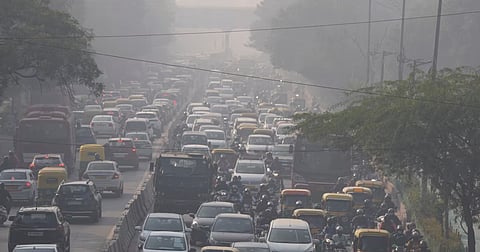
One of the primary culprits of Guwahati’s deteriorating air is the alarming increase in particulate matter, particularly PM2.5, the microscopic particles that are 30 times smaller than the width of human hair. These tiny particles enter the lungs, travel through the bloodstream, and cause profound damage to the respiratory, cardiovascular, and nervous systems. Guwahati’s PM2.5 concentration has frequently exceeded safe levels of international standards. During dry seasons, the city’s air often carries the appearance of mild fog, but in reality it is a blanket of suspended particles and emissions that settle slowly, affecting visibility and health. The haze becomes more noticeable at dawn and dusk when sunlight interacts with pollutants, casting an unsettling orange glow across the horizon.
There is a strong geographical element to the crisis. Guwahati is situated between hills and the Brahmaputra, forming a semi-valley-like basin. The city’s topography affects airflow and pollutant dispersion. During cooler months, temperature inversions trap pollutants near the ground, preventing them from rising into upper atmospheric layers. As a result, air contaminated with dust, smoke, vehicular emissions, and industrial release stays close to breathing level, affecting millions of residents. On days with low wind speed, pollutants accumulate without dispersal, allowing AQI levels to climb through the morning and only settle marginally at night.
Guwahati’s traffic conditions contribute significantly to the problem. The number of vehicles on the city’s roads has grown dramatically, far outpacing the expansion of road infrastructure or improvements in public transport. Long queues of cars, buses, autos, and two-wheelers dominate junctions such as Jalukbari, Ganeshguri, Khanapara, Lokhra, Beltola, Uzan Bazar, Maligaon, Panjabari, Chandmari, Silpukhuri, Six Mile, and Zoo Road Tiniali. Vehicles stuck in traffic or crawling at low speeds release continuous emissions. One of the major reasons for rising PM2.5 pollution in Guwahati is vehicular exhaust mixed with dust from roads that are either under construction, repaired repeatedly, or structurally worn out from overuse. Each time a large truck accelerates on a dusty surface, a cloud of particles is thrown back into the air, blending with tailpipe emissions and suspended for hours.
Urban waste management practices have worsened the situation. Despite numerous awareness campaigns, warnings, and regulations, the burning of waste continues across different parts of Guwahati. The burning of plastics, rubber, organic waste, construction debris, and mixed household materials emits a complex mixture of toxic gases, including carbon monoxide, dioxins, and volatile organic compounds. Waste burning typically occurs early in the morning or in the evening when visibility is lower, making it easier for the activity to go unnoticed or unchallenged. However, the impact lingers for hours, drifting through residential areas and settling in the lungs of both children and adults.
Construction activity across the city has unleashed a persistent layer of dust that coats roads, settles on leaves, fills drains, and remains suspended in the air whenever wind blows. Many construction sites lack proper barriers, dust-control mats, or water-sprinkling mechanisms. Lorries transporting sand, cement, bricks, soil, and other materials often travel uncovered, scattering dust along long stretches of road. The city’s air during peak construction periods feels visibly denser, particularly in neighbourhoods such as Kahilipara, Hengrabari, Bamunimaidan, Azara, Basistha, Noonmati, Narengi, Bharalumukh, and the rapidly developing outskirts of the city. Construction dust does not merely add to pollution; it interacts with vehicular emissions and moisture to create chemical reactions that amplify the toxicity of the atmospheric mix.
Industrial pollution also plays a role, even if indirectly. While Guwahati does not house large industrial belts within the heart of the city, its outskirts and neighbouring areas include industries, factories, brick kilns, and small manufacturing units that contribute to the problem. Pollutants from these industrial activities travel with the wind and combine with urban pollution, creating cumulative layers of contamination. Brick kilns, in particular, emit heavy dust, sulphur compounds, and soot that rise into the air and drift towards the city, especially during winter and drier periods.
Climate conditions further complicate the crisis. Rainfall acts as a natural air purifier, washing away pollutants and settling dust. However, during prolonged dry spells, especially between November and March, the absence of rain allows pollutants to accumulate. Guwahati often experiences days of still air during winter, causing pollution to remain stagnant. The city also suffers from increased dust levels during post-monsoon and early-winter months when soil becomes dry and loose. All these factors together create an environment where the AQI fluctuates regularly between “Moderate”, “Poor”, and sometimes “Very Poor”, depending on the season, time of day, and weather conditions. On certain days, the AQI readings in specific locations have reached levels comparable to highly polluted metropolitan cities of the country. These spikes draw attention on social media and news platforms, but the underlying causes remain consistent and structural.
The health impacts of this air quality decline are becoming increasingly visible. Doctors across Guwahati have reported a rise in respiratory problems, asthma attacks, bronchitis cases, and persistent cough among adults and children. Paediatricians frequently observe poor lung function among school-going children exposed to dusty playgrounds and outdoor pollution during school commutes. Elderly residents often experience worsened breathing, chest congestion, and heightened vulnerability to heart-related complications. For people with pre-existing conditions like hypertension, asthma, chronic bronchitis, sinusitis, or cardiovascular disease, days of poor air quality pose significant risks. The city’s hospitals witness seasonal surges in respiratory complaints, correlating directly with periods of high AQI readings.
Beyond health issues, the air pollution crisis has begun to affect the city’s psychological and emotional well-being. Waking up to a polluted sunrise each day creates a subdued atmosphere, where the beauty of Guwahati’s natural surroundings is overshadowed by an undeniable sense of environmental decline. Many residents express concern about their children’s future, wondering whether the city they grew up in is becoming unsafe for the coming generations. People who once cherished morning walks along the river or the forest edges now worry about breathing difficulties and eye irritation. Students travelling long distances to school inhale polluted air during peak traffic hours, returning home tired and uneasy. Even the simple joy of opening a window and feeling a breeze has diminished, replaced by the fear that the incoming air might carry dust, fumes, or burning smells.
Environmental consequences stretch beyond human concerns. The lush greenery that once defined Guwahati is struggling under the weight of dust that settles on leaves, reducing the ability of plants to photosynthesise. Trees lining roads become greyish and unhealthy. Birds and small animals living in urban pockets are affected by the decline in plant health, disrupted food availability, and reduced air quality. Pollution also eventually settles in water bodies, affecting aquatic life in ponds, wetlands, and even connected streams. The Brahmaputra, though vast, is not untouched by this accumulation of pollutants. Particulates settling on its surface or entering through runoff gradually affect water chemistry and the health of riverine ecosystems.
Yet, despite the enormity of the challenge, there have been visible attempts to combat the problem. The introduction of electric buses is one of the most encouraging steps towards cleaner urban transport. CNG-powered buses and auto-rickshaws have begun replacing older, more polluting vehicles. Efforts to broaden the public transport network, though still insufficient, indicate a shift in the right direction. Authorities have initiated awareness programmes discouraging open waste burning, and some construction sites have begun following dust-control measures more responsibly. Monitoring stations have increased, offering more reliable AQI readings. Urban renewal projects include components of green landscaping, plantation drives, and the development of open spaces that can improve air quality over time.
Despite these initiatives, the pace of improvement remains slow in comparison to the speed at which pollution sources expand. Guwahati requires a stronger, more integrated and futuristic strategy to reclaim its air. Improving public transport must become a priority for reducing private vehicle use. Strict enforcement is essential to curb uncovered trucks, illegal waste burning, and construction-site violations. Urban planning must incorporate green buffers, vertical gardens, roadside plantations, and preservation of wetlands and hills that provide natural filtration. Awareness among citizens must deepen beyond social media outrage into consistent behavioural change. Pollution control cannot be achieved merely through announcements and short-term operations; it requires long-term commitment, strict monitoring, and cross-departmental coordination.
The political implications of Guwahati’s AQI crisis are equally significant. Air pollution is not simply an environmental problem; it is an issue of governance, public health, urban planning, and social justice. It affects every resident, regardless of class, profession, or neighbourhood. Clean air is a fundamental right, and ensuring it is a responsibility that falls on elected representatives, administrators, urban planners, and enforcement agencies. Beyond policies, what Guwahati requires is political will — the readiness to challenge deep-rooted urban habits, regulate powerful economic interests, and invest in sustainable alternatives.
The future of Guwahati depends heavily on how effectively the city responds to its air crisis. If current trends continue without intervention, the city risks sliding into a state where pollution becomes normalised, health risks escalate, and quality of life deteriorates. Children growing up in the city may inherit weakened lungs, reduced immunity, and chronic respiratory ailments. The elderly may face increased medical vulnerability. The city’s environment — from trees to wildlife to water bodies — may continue to degrade, losing the natural richness that once defined Guwahati’s charm.
Yet, the crisis also presents an opportunity. Guwahati still retains many natural advantages: expansive water bodies, green hillocks, forest patches, strong monsoon patterns, and open landscapes around its perimeter. With the right measures, the city can still reclaim its air. Strategic urban planning, strict pollution regulation, expanded public transport, electric mobility, responsible construction practices, scientific waste management, and community engagement can collectively transform the city’s environmental trajectory. If the city embraces these changes wholeheartedly, it can rebuild a future where residents breathe easier, where mornings arrive without haze, where the Brahmaputra’s breeze feels refreshing rather than heavy, and where the next generation can enjoy a healthier urban environment.
The path ahead is not easy, but it is possible. Guwahati stands at a crucial moment, caught between the pressures of modern development and the reminders of its natural heritage. The air crisis is more than an environmental statistic; it is a call for introspection and responsibility. It is a warning that a city’s growth must not suffocate the very people who live within it. And it is also a reminder that the future of Guwahati will depend on decisions made today—decisions that determine whether the city continues to breathe through smog and uncertainty or whether it eventually finds its way back to cleaner skies and healthier days.
