
- Home
- Live Blog
- Breaking News
- Top Headlines
- Cities
- NE News
- Sentinel Media
- Sports
- Education
- Jobs
Siddharth Roy
(siddharth001.roy@gmail.com)
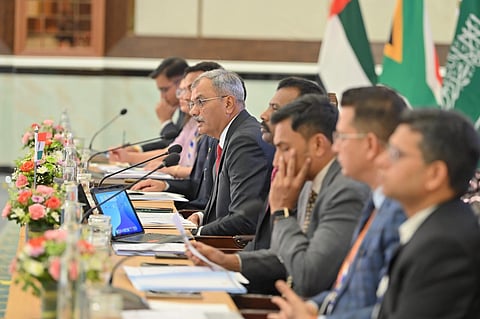
The Heads of Anti-Drug Agencies of BRICS countries have adopted the Guwahati Declaration, making it more than just another multilateral communiqué. It signals an acknowledgement by some of the world’s largest emerging economies that narcotic trafficking has evolved into a complex transnational security challenge requiring coordinated international action rather than isolated national responses. As synthetic drugs, online trafficking, and illegal money networks quickly change the global drug trade, the declaration provides a chance to create better cooperation among countries that make up a large part of the world’s population, trade, and political power.
The choice of Guwahati as the venue carries significance of its own. For decades, the lens of insurgency and border management primarily shaped perceptions of India’s Northeast. Issues related to insurgency and border management have largely shaped this perception. Today, the region is increasingly central to India’s Act East policy, cross-border connectivity initiatives and regional diplomacy. Hosting a high-level BRICS security meeting in Assam reflects growing confidence in the region’s strategic importance and underlines the need to integrate security cooperation with economic connectivity. The Northeast is no longer merely India’s frontier; it is becoming one of its principal gateways to Southeast Asia.
The urgency of such cooperation We cannot overstate the urgency of such cooperation. The global drug trade has changed dramatically over the past two decades. Traditional narcotics such as heroin and cocaine continue to threaten societies, but synthetic drugs and New Psychoactive Substances (NPS) have emerged as an even greater challenge. Unlike plant-based narcotics, synthetic drugs can be produced in clandestine laboratories with relative ease, using precursor chemicals sourced across multiple jurisdictions. Criminal syndicates have also embraced encrypted communication platforms, cryptocurrencies, artificial intelligence and the darknet to organise production, transport and financial transactions while remaining largely invisible to conventional policing.
India occupies a uniquely vulnerable position in this evolving landscape. Located between the Golden Crescent and the Golden Triangle—the world’s two historically significant narcotics-producing regions—the country has long faced the dual challenge of being both a transit corridor and a destination market. The prolonged instability in Myanmar has further complicated the situation along India’s eastern frontier, increasing the risk of trafficking through the Northeast. As infrastructure projects improve connectivity across the region, legitimate trade will undoubtedly expand, but so will too many opportunities for organised criminal networks unless security mechanisms evolve simultaneously.
It is precisely here that the Guwahati Declaration acquires practical relevance. The declaration emphasises timely exchange of intelligence, operational information and best practices among BRICS members while encouraging greater use of technology and coordinated investigations against transnational criminal organisations. It also acknowledges new threats that come from synthetic drugs, the diversion of precursor chemicals, virtual assets, digital platforms, and maritime trafficking routes. These priorities reflect an understanding that twenty-first-century drug cartels operate as sophisticated multinational enterprises rather than isolated criminal groups.
Perhaps the declaration’s greatest promise lies in strengthening real-time intelligence sharing. Drug trafficking networks are remarkably adaptive. Whenever enforcement agencies disrupt one route, traffickers rapidly establish alternatives. Delays in sharing intelligence often allow criminal organisations to stay ahead of law enforcement. Institutionalised information exchange among BRICS members could significantly improve interdiction efforts by enabling authorities to identify evolving trafficking patterns, monitor precursor chemical movements and coordinate simultaneous enforcement operations across jurisdictions.
Financial investigations deserve equal emphasis. Drug trafficking survives because it remains immensely profitable. Modern cartels depend upon complex money-laundering mechanisms involving shell companies, informal financial networks and digital currencies. Seizing narcotics without dismantling these financial structures merely treats the symptoms rather than the disease. Greater cooperation among financial intelligence units, customs authorities and banking regulators within BRICS could substantially weaken the economic foundations of organised crime.
Technology should become another pillar of cooperation. The same digital innovations exploited by traffickers can strengthen enforcement. Artificial intelligence can identify suspicious financial transactions and trafficking patterns; satellite imagery can monitor remote border regions; blockchain analytics can trace cryptocurrency flows; and integrated databases can improve risk profiling at ports and airports. Collaborative technological development would be particularly valuable for developing countries that often face resource constraints in acquiring advanced investigative capabilities.
Yet the declaration must not encourage an enforcement-only approach. Experience from around the world shows that drug abuse cannot be effectively addressed solely through arrests and seizures. Experience from around the world shows that solely relying on arrests and seizures will not effectively address drug abuse. solely through arrests and seizures. Addiction is simultaneously a public health challenge, a social problem and an economic issue. Prevention, education, treatment and rehabilitation remain essential components of any effective anti-drug strategy. India’s own emphasis on combining enforcement with awareness campaigns and de-addiction initiatives reflects this broader understanding. The Guwahati meeting therefore presents an opportunity for BRICS members to exchange successful models of rehabilitation and community-based prevention alongside law enforcement strategies.
The meeting also illustrates the expanding agenda of BRICS. Originally conceived as an economic grouping, BRICS has steadily broadened cooperation into areas including health, technology, counter-terrorism and security. Tackling drug trafficking shows that growing economies are more open to working together on security issues that impact governance, public health, and sustainable development. This kind of cooperation works with, not against, the UN and other international organisations’ existing multilateral systems.
However, declarations alone do not dismantle criminal networks. Their value depends entirely on implementation. The Guwahati Declaration should therefore be followed by institutional mechanisms that ensure continuity beyond annual meetings. Secure communication channels, dedicated working groups, joint training exercises, harmonised forensic standards and periodic operational reviews would help translate political commitments into measurable outcomes. The proposal for a BRICS Virtual Working Group and expanded cross-border capacity building merits serious consideration, particularly as trafficking networks become increasingly digital and decentralised.
Ultimately, the significance of the Guwahati Declaration extends beyond drug enforcement. It reflects a broader recognition that the security challenges of the twenty-first century do not respect national boundaries. Organised crime, cybercrime, terrorism, illicit financial flows and narcotics trafficking are interconnected phenomena that demand equally interconnected responses. For India, hosting this meeting in Guwahati also reinforces the Northeast’s emergence as a strategic hub where diplomacy, connectivity and security converge.
Whether the declaration becomes a milestone or merely another diplomatic statement will depend on the political will of BRICS members to institutionalise cooperation, share sensitive intelligence and build mutual trust. If these commitments are honoured, the Guwahati Declaration could evolve into one of the most consequential outcomes of India’s BRICS presidency—not simply because it addresses the global drug menace but because it demonstrates how emerging powers can work collectively to confront transnational threats that no nation can overcome alone.
