
- Home
- Live Blog
- Breaking News
- Top Headlines
- Cities
- NE News
- Sentinel Media
- Sports
- Education
- Jobs
In simple terms, water can make a slope behave as though it has lost part of its internal strength. Cutting a hill steepens the slope and removes
the natural toe support; leakage and poorly designed drainage add
water; and vegetation loss reduces root reinforcement. A rainfall event then becomes the final trigger in a chain of failures – Siddharth Roy
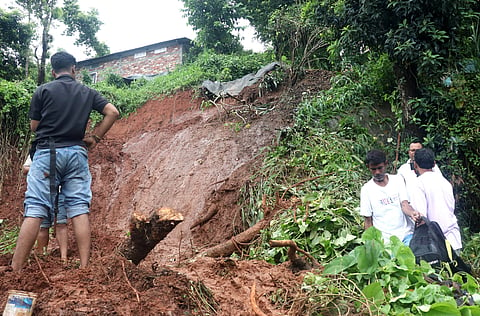
The four deaths in Guwahati’s latest landslide tragedy are a reminder that the city’s hills are no longer merely geological features; they are becoming zones of engineered vulnerability. On September 1, incessant rain triggered a landslide in Mathgharia that buried three members of a family inside their home. A separate rockfall in the Satgaon area killed another woman. The tragedy was sudden, but the risk was not. Assam has been known for years for its unstable slopes. What has been missing is the political and engineering resolve to act before the monsoon turns instability into mortality.
Official data presented in the Assam Legislative Assembly show that 93 people died in landslides across the state between 2016 and 2025. Kamrup Metropolitan, which includes Guwahati, has repeatedly recorded the highest number of landslide fatalities. These numbers should end the habit of describing every landslide as an unavoidable natural calamity.
Guwahati’s vulnerability is unusually well documented. A rapid visual screening conducted with the Assam State Disaster Management Authority and Assam Engineering College identified 366 landslide-vulnerable sites across 20 hillocks. The fact that the same number of vulnerable locations continues to figure in official advisories years after the original assessment raises a fundamental question: what has actually been done at these sites?
A landslide occurs when the resisting forces within a slope become smaller than the forces driving its movement. Rainfall is often the trigger, but slope geometry, soil properties, geology, vegetation, drainage and human loading determine whether failure occurs. Prolonged or intense rain infiltrates soil, raises pore-water pressure and reduces effective stress. In simple terms, water can make a slope behave as though it has lost part of its internal strength. Cutting a hill steepens the slope and removes the natural toe support; leakage and poorly designed drainage add water; and vegetation loss reduces root reinforcement. A rainfall event then becomes the final trigger in a chain of failures.
This distinction is crucial for policy. Guwahati’s own studies and expert assessments repeatedly point to hill cutting, encroachment, deforestation, unplanned construction and inadequate drainage as major contributors. The city’s growth significantly contributes to disaster risk.
The first requirement is therefore a citywide landslide risk atlas. The existing inventory should be updated using LiDAR, satellite imagery, drone surveys and geological mapping. Every vulnerable slope should be classified according to susceptibility, exposure and consequence. A steep uninhabited slope and a steep slope carrying fifty houses should not receive the same priority. The latter is a risk-management emergency.
Second, Guwahati needs an early landslide warning. Rain gauges should be combined with soil-moisture sensors, piezometers and slope-movement instruments. Thresholds can be developed using antecedent rainfall and short-duration intensity. If rainfall crosses a scientifically established threshold while pore pressure or ground movement rises, residents should receive automatic warnings through cell broadcast, sirens and local networks. India’s Geological Survey already operates the National Landslide Forecasting Centre and has developed landslide inventories, susceptibility maps and forecasting tools. Assam should integrate these capabilities into municipal decision-making rather than treating them as specialist information.
Third, slope engineering must become more scientific. Retaining walls are not universal cures. Depending on geology and failure mechanism, solutions may include reinforced-earth structures, gabions, rock bolts, shotcrete, toe protection, horizontal drains, surface drains, subsurface drainage and bioengineering. A retaining wall without adequate drainage can become a liability because hydrostatic pressure accumulates behind it. Every major slope intervention should therefore follow a geotechnical investigation and stability analysis, including factor-of-safety calculations under saturated conditions.
Drainage deserves special emphasis. On a hill, water should be controlled before it enters the slope, conveyed safely across it and discharged without eroding the toe. Intercepting drains above vulnerable cuts, lined chutes, properly sized cross-drainage structures and routine desilting can reduce infiltration and surface erosion. Guwahati’s landslide problem is closely connected to its urban-flood problem: debris from failed slopes can choke drains, while poorly managed runoff can saturate slopes. The two hazards must be planned together.
Land-use regulation is the harder test. No building permission should be granted on identified high-susceptibility slopes without a site-specific geotechnical assessment. Existing settlements in extremely hazardous locations require a transparent, humane relocation policy, not periodic eviction drives followed by political reversals. Development controls must also prohibit indiscriminate hill cutting and require compensatory slope stabilisation wherever excavation is unavoidable.
The State should establish a multidisciplinary Guwahati Slope Safety Cell involving geologists, geotechnical engineers, civil engineers, hydrologists, urban planners, foresters and disaster managers. Its mandate should include inspection, monitoring, design review and enforcement. A public dashboard could show vulnerable sites, mitigation status and rainfall alerts, making accountability measurable.
Climate variability makes inaction even more expensive. Assam’s disaster risk is shaped by intense monsoon rainfall, and future infrastructure cannot be designed solely from historical averages. Engineers must increasingly consider rainfall intensity-duration-frequency relationships, changing drainage loads and uncertainty in slope response. Resilience means designing for the plausible extreme, not merely the historical normal.
The costs of inaction will compound with every monsoon. The latest deaths should therefore not produce another cycle of condolences, debris clearance and forgotten recommendations. Guwahati already possesses inventories, technical institutions and scientific expertise. What it needs is implementation. A hill does not collapse because an engineer failed to predict the exact minute of failure. It often collapses because warning signs were known, slopes were altered, drainage was neglected and vulnerable people were allowed to remain in harm’s way.
Guwahati’s hills cannot be flattened into safety, nor can monsoon rainfall be stopped. But slopes can be mapped, water can be controlled, construction can be regulated and communities can be warned.
The choice before Assam is no longer between development and safety. It is whether development itself will be engineered safely.
(The author is a consultant to Rashtriya Raksha University under the Ministry of Home Affairs, a civil engineer and a columnist. The views are personal. He can be reached at siddharth001.roy@gmail.com.)
