
- Home
- Live Blog
- Breaking News
- Top Headlines
- Cities
- NE News
- Sentinel Media
- Sports
- Education
- Jobs
Lalit Garg
(The writer can be reached at lalitgarg11@gmail.com)
Hanuman Jayanti is not merely a religious festival; it is a great occasion that inspires character-building, inner strength, self-discipline, service, and dedication in human life. This day gives us a message that is far greater than lighting lamps in temples—it teaches us to remove the darkness within ourselves. Hanuman is not only a symbol of power; he represents the right use of power, the humility of knowledge, the height of devotion, and the tradition of selfless service. Therefore, the true meaning of celebrating Hanuman Jayanti is to awaken the Hanuman within us. Hanuman is known as the remover of obstacles and the bringer of auspiciousness. But he does not remove only external obstacles; he also destroys the inner obstacles of human beings—ego, fear, laziness, anger, greed, and attachment. Modern man suffers less from external problems and more from inner weaknesses. That is why the relevance of Hanuman today is greater than ever before.
Hanuman is a symbol of strength, but his greatest quality was that he never displayed his strength. He dedicated his power to service. Today’s world has become a world of display—display of wealth, position, knowledge, and power. Hanuman teaches us that greatness lies not in the display of power and knowledge but in their preservation and proper use. Despite being immensely powerful, he called himself “the servant of Lord Rama.” What could be a greater example of humility? Hanuman teaches us that knowledge without humility is ignorance, and power without service becomes destruction. Thus, Hanuman represents not only strength and knowledge, but also humility and service.
Hanuman is described as the foremost among the wise—“Gyaninam Agraganyam.” He was not only strong but also a great scholar, grammarian, logician, musician, and master of statecraft. Yet, despite such vast knowledge, he remained humble and simple. Today education is increasing, but humility is decreasing. Degrees are increasing, but character is declining. In such times, Hanuman’s character teaches us the balance between knowledge and humility.
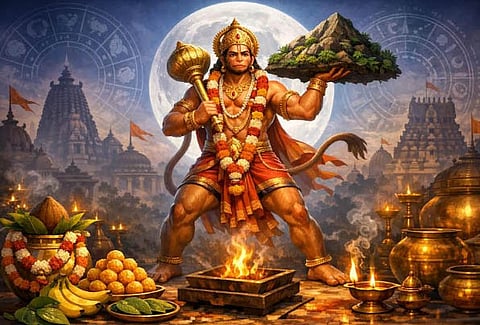
Hanuman is considered one of the most powerful deities in Hindu tradition and an important figure in the great epic Ramayana. He is believed to be the eleventh Rudra incarnation of Lord Shiva, born in the Treta Yuga to serve and assist Lord Rama. He is known by many names—Bajrang Bali, Marutinandan, Pavanputra, and Kesarinandan. He is also called Vayuputra and is considered one of the seven Chiranjeevis (immortal beings). He was skilled in all arts and sciences—the bravest among the brave and the wisest among the intellectuals. Through his strength and wisdom, he accomplished many difficult tasks effortlessly. He is a symbol of courage, bravery, leadership, devotion, and dedication. Hanuman is regarded as the ocean of strength, intelligence, and knowledge, the giver of the eight spiritual powers and nine treasures, and a great scholar of astrology.
Three great elements are visible in Hanuman’s life—Knowledge, Devotion, and Action. Knowledge gives direction, devotion gives inspiration, and action makes a person (great). If a person has knowledge but no action, life is incomplete. If there is action but no devotion, there will be no sensitivity. If there is devotion but no knowledge, it may become blind faith. The perfect balance of these three elements is seen in Hanuman’s character. Hanuman lived a life of discipline and self-control. He was powerful but celibate, knowledgeable but humble, brave but calm, strong but a servant. This balance made him great. Today humans have resources but no restraint, knowledge but no direction, power but no service. Therefore, unrest is increasing in society. Hanuman’s life teaches us the message of balance and self-discipline.
The childhood story of Hanuman is also very inspiring. As a child, Hanuman tried to catch the sun, thinking it was a fruit. This is not merely a mythological story; it carries a profound message. It symbolizes the limitless curiosity, enthusiasm, and energy of children. It teaches society that children’s curiosity should not be suppressed but guided in the right direction. With proper guidance, every child can become like Hanuman—energetic, curious, courageous, and creative. The responsibility of parents and society is to cultivate qualities like courage, curiosity, discipline, service, humility, and devotion in children. If such values are instilled in childhood, the future of society will be bright. It is also important to understand the true meaning of Hanuman devotion. Hanuman devotion does not mean merely reciting Hanuman Chalisa; it means adopting Hanuman’s qualities in life. Hanuman devotion means giving up ego, serving others, standing for truth, practising self-discipline, fulfilling one’s duties, and connecting one’s life to a higher purpose. As long as devotion remains limited to temples, God and the devotee remain separate. When devotion becomes life, then God and the devotee become one.
Hanuman’s devotion is not a display; it is a process of self-transformation. It transforms a person from within—replacing ego with humility, anger with forgiveness, fear with courage, and despair with hope. Today society’s biggest problem is not lack of power but lack of character; not lack of knowledge but lack of direction; not lack of resources but lack of restraint. Therefore, society needs Hanuman today—not in temples, but in life; not in idols, but in personalities. There is a Hanuman sleeping within every person—Hanuman of courage, Hanuman of service, Hanuman of knowledge, Hanuman of devotion. The need is only to awaken him.
Awakening the Hanuman within means defeating our inner fears, removing our ego, dedicating our strength to service, using our knowledge for society, and connecting our lives to a noble purpose. If on Hanuman Jayanti we only perform rituals but do not transform our lives, the festival remains incomplete. But if we adopt even one quality—courage, service, discipline, humility, or devotion—Hanuman Jayanti will become meaningful. Hanuman Jayanti gives us the message that greatness lies not in power but in the right use of power; not in knowledge but in the humility of knowledge; not in devotion but in surrender. On this Hanuman Jayanti, we should take a pledge: we will not display power, we will preserve and use it for good. We will not be arrogant about knowledge, we will remain humble. We will not display devotion, we will live a life of dedication. Let us awaken the Hanuman within. If every individual awakens the Hanuman within, families will improve, society will improve, the nation will improve, and the future of humanity will become bright. This is the true message of Hanuman Jayanti—Awaken the Hanuman within and make life a confluence of strength, knowledge, devotion, and service.
