
- Home
- Live Blog
- Breaking News
- Top Headlines
- Cities
- NE News
- Sentinel Media
- Sports
- Education
- Jobs
Siddharth Roy
(siddharth001.roy@gmail.com)
The echo of language and culture is at the heart of every society. It binds generations, preserves heritage, and strengthens identity. In Assam, this bond finds expression every year on December 10, when we remember one of our most illustrious sons, Hemchandra Barua, affectionately known as Bhaxar Oja. This year, Sivasagar wore a festive yet reverent air as the historic town celebrated the 190th birth anniversary of the eminent Assamese linguist and creator of the Hemkosh dictionary with great enthusiasm and respect.
Born in 1835 in Rajabahor village of what was then undivided Sivasagar district, Hemchandra Barua grew up in an era when the Assamese language was struggling to find its rightful place. Under colonial rule, Bengali was often preferred for administration and education, and Assamese thinkers had to fight hard to restore pride in their mother tongue. In those challenging times, Barua emerged not only as a scholar but also as a defender of our linguistic heritage.
The anniversary programme in Sivasagar was organized jointly by several local associations, including the Sivasagar District Newspaper Distributors’ Association, Elora Science Forum (Sivasagar branch), and the Amolapatty Traders’ Association. The day began with the hoisting of the flag by the presidents of these organizations, followed by lighting the ceremonial lamp, which is a ritual that symbolized enlightenment, learning, and the everlasting glow of Barua’s legacy. Young students recited poems highlighting his life and work, bringing to life the spirit of Barua’s dedication to language and learning.
In the keynote address, former principal Dilip Phukan spoke with deep admiration about Barua’s role in strengthening Assamese language and literature. He emphasized that Barua was not just a lexicographer or writer but a visionary whose work laid the foundations of modern Assamese linguistic thought. Indeed, Assam’s literary landscape would be vastly different today without his sustained efforts.
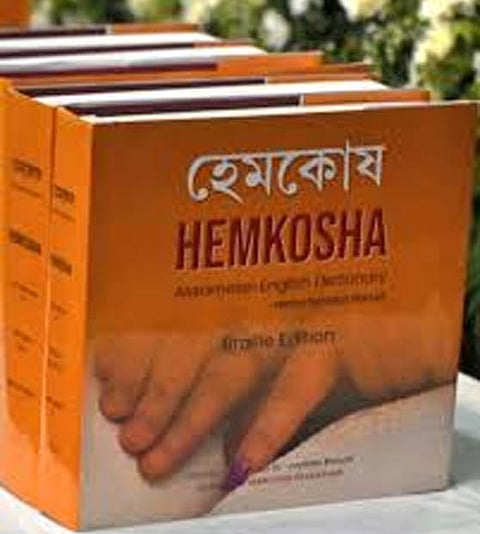
At the core of Barua’s contribution lies Hemkosh, the dictionary that still stands as the definitive reference for Assamese orthography. Compiled by Barua, this was the first etymological dictionary of the Assamese language, introducing spellings based on Sanskrit, a significant step in standardising Assamese words and usage. Although published posthumously in 1900 under the guidance of others after his death, Hemkosh remains a cornerstone of Assamese language studies even today.
To understand the importance of this achievement, we must remember that dictionaries are more than mere collections of words. They represent the soul of a language i.e. its sounds, meanings, roots, and cultural depth. Barua’s Hemkosh did this for Assamese at a time when its future seemed uncertain. For scholars, students, writers, and common speakers alike, Hemkosh became a guiding book, strengthening confidence in Assamese as a rich and independent language. Beyond Hemkosh, Barua’s contributions extend to grammar, prose, satire, social critique, and education. His works such as Oxomiya Byakoron (Assamese Grammar), Adipath, Pathmala, and Oxomiya Lorar Byakoron (Grammar for Children) were widely used as school textbooks and were respected even by the British administration of that era. These books were not academic exercises alone; they helped generations of students learn Assamese systematically.
Barua was also one of the earliest Assamese writers to adopt satire and social criticism as tools of expression. His works Kaniyar Kirtan and Bahire Rong Song, Bhitore Kuwabhaturi wield humour and irony to expose social follies and rigid customs. Such writing was unprecedented in Assamese literature, and it opened doors for creative literary exploration that went beyond conventional storytelling. Even his work in journalism left a mark on Assamese literary history. Barua edited Assam News, a bilingual newspaper published in Assamese and English, during the 1880s. This endeavour reflected his belief in accessible communication and the power of the written word to educate and uplift society.
Barua was not only a literary figure but a social reformer with a progressive mindset. He stood against superstition and blind beliefs, advocating for rational thought and scientific understanding in his community, an outlook that resonates with modern aspirations for social progress. His legacy in this sphere was also highlighted in discussions and programmes around his anniversary, where speakers remembered him as a thinker who championed change beyond books and scripts.
In the evening, tributes were paid at the Lakshminath Bezbaruah Children’s Park in Amolapatty, where his bust is installed. Candle lighting and floral offerings reflected the deep respect that people from all walks of life hold for Barua, not only as a scholar but as a beacon of Assamese intellectual and cultural life.
This year’s celebration also coincides with renewed recognition of Hemkosh in various cultural forums across the state. Literary organisations have released special editions, songs, and programmes to mark the dictionary’s continuing relevance. These tributes remind us that Barua’s work is not confined to the past but lives on in classrooms, libraries, and the hearts of Assamese speakers everywhere.
As we reflect on this occasion, it is important to recognise that Barua’s legacy asks not just for remembrance but for responsibility. In a world where languages face the threat of decline under global pressures, Assamese too needs active efforts from each one of us to thrive. Learning our language, reading our literature, and celebrating our writers are small but powerful ways to honour that legacy.
The 190th birth anniversary of Hemchandra Barua in Sivasagar was more than a commemorative event; it was a renewal of our commitment to the language that shapes our collective identity. Through his scholarship, Barua taught us that language is more than speech; it is memory, culture, and the lens through which we perceive the world. As we remember Bhaxar Oja with reverence, we also renew our pledge to uphold and enrich Assamese language and literature for future generations.
