
- Home
- Live Blog
- Breaking News
- Top Headlines
- Cities
- NE News
- Sentinel Media
- Sports
- Education
- Jobs
Jaideep Saikia
(jdpsaikia@gmail.com)
I recently received a recording of an episode of The Ezra Klein Show from Lt Gen Gautam Moorthy, former Director General Ordnance Services of the Indian army and a sharp strategic thinker. The episode featured an illuminating interview with Kevin Rudd, the former Australian Prime Minister and leading scholar on Chinese politics.
Rudd's articulate breakdown of Beijing's internal dynamics in the podcast episode, "What Xi Jinping Wants," thoroughly whetted my appetite for a deeper strategic dive. Listening to his insights has compelled me to not only examine the nuances of Xi's political persona and domestic actions more closely, but also to crystal-gaze into the high-stakes geopolitical implications of his forthcoming visit to the United States.
Kevin Rudd's doctoral thesis at the University of Oxford-Rudd enrolled for his PhD four years after he completely stepped away from Australian domestic politics, it must be stressed-offers a rigorous, text-based dissection of China's contemporary governance, framing Xi Jinping's worldview through a specific ideological paradigm. Moving beyond Western realist models that often misinterpret Beijing's actions as purely pragmatic, Rudd demonstrates that ideology has returned to the absolute "core of China's decision-making." He explicitly characterises this paradigm shift as a distinct synthesis of "Marxist-Leninist Nationalism."
Rudd's structural analysis details a precise ideological reallocation across three distinct vectors. First, he argues that Xi's "Leninism has taken the party and Chinese politics to the left," revitalising institutional control and party discipline. Second, his "Marxism has taken the centre of gravity of Chinese economic thought to the left," pivoting away from private sector dynamism toward state-directed, statist economic policies. Finally, Rudd posits that Xi has simultaneously "taken Chinese nationalism to the right," resulting in a far more assertive, high-risk approach to foreign policy and global power projection.
This precise "left-left-right" triad is the exact intellectual signature of Rudd's structural analysis of Xi's worldview.
Crucially, Rudd distinguishes Xi's era by illustrating how he has broken the post-1978 consensus established by Deng Xiaoping, Jiang Zemin, and Hu Jintao. While those intermediate leaders prioritised pragmatic economic growth, decentralised consensus decision-making, and a low-profile foreign policy under the maxim of "hide your strength and bide your time," Xi marks a profound historical pivot back toward Mao Tse Tung's ideological orthodoxy. Rudd argues that Xi views the market-friendly reforms of his immediate predecessors as necessary but highly corrupting deviations that endangered the party's survival. By centralising all executive control, enforcing strict social compliance, and cultivating a personalistic style of governance, Xi effectively bypasses the collective leadership structures of the last forty years to align himself directly with the revolutionary, totalitarian ethos of the Maoist era.
Ultimately, Rudd's scholarship provides global policymakers with an indispensable roadmap. It proves that to decode China's future domestic trajectory and geopolitical ambitions, one must take Xi's ideological conviction seriously rather than dismissing it as mere rhetorical posturing.
Let me look at Xi through the lens of his forthcoming US visit.
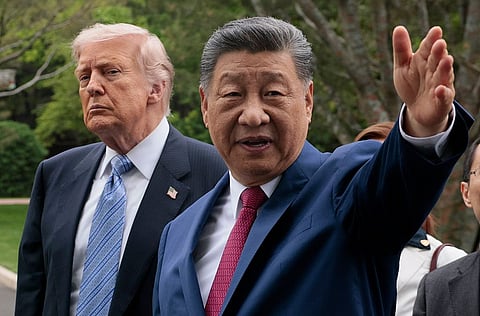
When Xi arrives in Washington this September, the global commentariat will inevitably frame the visit through the conventional prism of a transactional, "stock-taking" exercise. Coming on the heels of the May summit in Beijing-and unfolding against a backdrop of highly contentious allegations of election interference-the mainstream narrative predicts a fragile continuation of the existing trade truce.
However, a structural analysis reveals that this summit is not going to be a standard diplomatic negotiation. Instead, it will represent a profound, asymmetric recalibration of twenty-first-century economic statecraft. Beijing is executing a fundamental shift in its grand strategy toward the West, moving from defensive integration to offensive insulation.
For nearly a decade, Washington's policy toward Beijing has relied on the logic of containment and "de-risking." The US has systematically deployed export controls, tariff structures, and minilateral security frameworks like the Quad and AUKUS to circumscribe China's regional ambitions. Xi's strategic objective for this visit will challenge the core assumptions of this approach. Rather than seeking a comprehensive rollback of American tariffs, Beijing is operationalising a doctrine of asymmetric autonomy-a strategy of weaponised interdependence.
China recognises that while the US holds the upper hand in leading-edge semiconductor design, Beijing maintains a chokehold on the critical minerals and processing infrastructure essential for the global green transition and Western defence supply chains. By offering transactional concessions-such as purchasing American agricultural goods or Boeing aircraft-Beijing will create a tactical illusion of compliance. In reality, the capital outlays will buy the precise commodity Xi requires most: time to achieve absolute domestic substitution in core technologies.
Yet the true battleground of this summit will not be found in legacy trade balances, but along the algorithmic frontier. While public attention will focus on export numbers, the operational core of the visit will lie in the newly established intergovernmental artificial intelligence dialogues. This is a domain where standard geopolitical maps fail to capture the terrain of conflict. Washington's strategic framework operates on logic of physical containment, relying on top-down export controls and compute-capacity thresholds to restrict advanced silicon from crossing Chinese borders. Conversely, the algorithmic frontier is inherently borderless, weightless, and infinitely replicable. By focusing primarily on hardware chokeholds, American policy risks fighting a rearguard action against a Chinese state apparatus that has pivoted downstream toward algorithmic efficiency and open-weights exploitation.
Washington will in all probability enter these talks with the aim of limiting the proliferation of frontier AI models to non-state actors, but Xi's envoys are already executing a sophisticated counter-strategy designed to pre-empt restrictions on Western open-source architectures. China has successfully weaponised the open-source divide to leapfrog traditional research-and-development cycles. Xi will likely frame AI stability as a global safety imperative akin to nuclear non-proliferation, attempting to trade vague commitments on algorithmic governance for concrete assurances that Washington will not block open-source software pipelines.
To fully comprehend this gambit, one must analyse the precise mechanism of Beijing's asymmetric technological harvesting. By systematically harvesting and repurposing Western open-weights architectures, Chinese state-backed laboratories have effectively decoupled advanced capability from original, capital-intensive exploration. This institutional exploitation relies on a fundamental structural asymmetry: while American venture capital and corporate labs shoulder the existential financial burdens, algorithmic failure rates, and staggering compute costs required to train frontier models from scratch, China operates at the downstream vanguard. Chinese institutions treat public weights not as a shared global utility, but as a hyper-efficient R&D springboard, executing rapid, targeted fine-tuning on domestic datasets to compress multi-year developmental timelines into a matter of months.
The summit will also expose a stark divergence in how both superpowers view maritime geography. Washington views the Indo-Pacific through a conventional security lens, leaning on naval positioning to safeguard vital sea lines of communication like the Strait of Malacca. Beijing, however, approaches global geography through chokepoint arbitrage. If Washington demands an absolute enforcement of blockades against rogue actors in the Strait of Hormuz, Beijing will leverage its deep diplomatic equities with Middle Eastern energy-producing states to secure uninterrupted supply lines, positioning itself as an alternative guarantor of maritime stability. Xi aims to use this diplomatic leverage over global energy conduits as a stabilising chip, diluting Washington's appetite for aggressive military posturing in the South China Sea. Meanwhile, in the Taiwan Strait, China will continue to deploy grey-zone pressure to normalise its military presence, all the while strictly walling off economic discussions from its sovereign territorial redlines.
For the United States, a successful summit is traditionally defined by verifiable metrics: trade compliance, operational military-to-military communication hotlines, and explicit security guarantees. For Xi Jinping, the metric of success is entirely different: strategic inconclusiveness wrapped in elite pageantry.
By engineering a state of managed ambiguity, Xi will successfully neutralise Washington's ability to force structural concessions or lock China into restrictive compliance frameworks. Consequently, while American negotiators focus on the granular engineering of diplomatic guardrails, Beijing treats the entire summit as a macro-level psychological operation. Xi transforms the absence of a concrete breakthrough into a profound geopolitical victory. He demonstrates that China possesses the power to engage the global hegemon on its own terms without ever conceding its long-term trajectory toward absolute industrial and technological self-reliance.
By securing a high-profile Washington visit amid domestic economic transitions and intense external pressures, Xi will deliver a potent message to both his domestic audience and the Global South: China remains an indispensable, co-equal architect of the global order, entirely uncontained by Western encirclement.
The Washington summit will not yield a historic grand bargain; instead, it will formalise an era of calculated gridlock, where the appearance of stability masks an intense, structural race for absolute autonomy.
