
- Home
- Live Blog
- Breaking News
- Top Headlines
- Cities
- NE News
- Sentinel Media
- Sports
- Education
- Jobs
Shri Lakshman Prasad Acharya
(Governor of Assam)
Many journeys that we undertake are simple tourism, while others have cultural and spiritual significance and values. However, only a few become exceptional and leave a lasting imprint on our hearts. My recent visit to Mongolia accompanying the Holy Relics of Arhant Sariputra and Arhant Maudgalyayana, the two chief disciples of Lord Buddha, was one such experience.
As I stood in Ulaanbaatar, the capital city of Mongolia, during the inauguration of the exposition of the sacred relics at Gandantegchinlen (Ganden) Monastery, my feeling was much more than a ceremonial occasion. The occasion was the reaffirmation of a civilisational bond that has connected India and Mongolia through faith, knowledge and shared spiritual values for centuries.
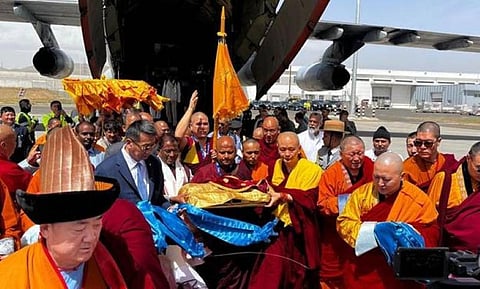
The holy relics were kept under the joint custody of the government of Madhya Pradesh and the Maha Bodhi Society at Sanchi Vihar Chaitya in Madhya Pradesh, and their arrival in Mongolia represented the transmission of a living spiritual legacy. For millions of Buddhists, the holy relics embody the wisdom, compassion and enlightenment that form the essence of Buddhism.
The emotional response of the Mongolian people was truly inspiring. The devotees gathered in large numbers to welcome the holy relics with high respect, reverence and devotion. Monks, scholars, the young and the elderly paid their respects and bowed in solemn reverence. Their veneration showcased a deep sense of spiritual kinship shared with the global Buddhist fraternity and rooted in the Buddhist holy pilgrimage sites located in India.
Mongolia occupies a special place in the Buddhist world. Buddhism remains deeply woven into the history, civilizational and cultural identity of its people. During my interactions with Buddhist leaders and devotees, I could clearly perceive the respect and affection they hold for India as the land where Lord Buddha attained Parinirvaana, the Enlightenment, and also travelled extensively, preaching his philosophy and sharing his message for all of humanity.
This visit acquired even greater significance as India and Mongolia commemorate 70 years of diplomatic relations and 10 years of strategic partnership. The India-Mongolia bilateral relationship extends well beyond contemporary diplomacy. As Prime Minister Narendra Modi had observed, India and Mongolia are spiritual neighbours, the partnership being rooted in shared values, cultural affinity and mutual respect.
As Governor of Assam, I was particularly proud to reflect upon my state’s rich Buddhist legacy during this visit. Assam has long served as a meeting point of Indian Buddhist traditions, Himalayan Buddhist cultures and the Theravada traditions of Southeast Asia. The state is also associated with Guru Padmasambhava, whose contribution to the spread of Buddhism across the Himalayan region remains unparalleled. Buddhism continues to flourish among several communities of Assam, including the Tai Phake, Tai Khamti, Tai Khamyang, Tai Aiton, Tai Turung, Singpho, Chakma and Chittagong Barua communities. In many ways, Assam remains a living bridge between India’s Buddhist heritage and the wider Buddhist world.
At a time when humanity faces conflict, uncertainty and growing divisions, the message embodied in the Buddhist Sacred Relics is especially relevant. They remind us of the eternal values of compassion, kindness, wisdom and harmony. The lives of Arhant Sariputra and Arhant Maudgalyayana demonstrate that knowledge accompanied by humility and spiritual attainment should be of service to the people.
The exposition of these sacred relics in Mongolia is, therefore, far more than a religious event. It is an expression of cultural cohesion, civilizational connect, continuity and diplomacy and a reaffirmation of humanity’s shared spiritual aspirations. It also highlights India’s role as the centre of the Buddhist universe, the custodian of the priceless Buddhist heritage and its commitment to sharing that heritage with the world in a spirit of friendship and goodwill.
During my visit, I was also pleased to interact with the members of the Indian diaspora in Mongolia, whose contribution in strengthening ties between our two nations is commendable. I visited the Chinggis Khan National Museum and the Winter Palace Museum of the Eighth Bogd Khan, gaining a deeper appreciation of Mongolia’s rich history, culture and Buddhist heritage, as well as the enduring links that connect our people.
During my visit, I had the privilege of interacting with Mongolia’s Hon’ble Minister of Education, Mr Enkh-Amgalan Luvsantseren, who inspired me with the continuous efforts of Prime Minister Shri Narendra Modi and India’s timeless philosophy of “Vasudhaiva Kutumbakam”. During our conversation, we exchanged views on the transformative changes taking place in India’s education sector and, vice versa, the enduring civilizational and spiritual links between our nations and our shared commitment to spiritual development as a guiding force for progress. I also had the privilege of spending time with the former president and prime minister of Mongolia, Mr Nambaryn Enkhbayar, and several distinguished guests as we extensively discussed our mutual interests and how the teachings of Buddha can strengthen the bond of friendship and camaraderie.
I was delighted to spend significant moments with members of the Indian delegation associated with the sacred relics and express my appreciation to the Ambassador of India to Mongolia, Shri Atul Malhari Gotsurve, who made elaborate arrangements for the Mongolian people to come out in large numbers and witness the grand spectacle of the display of the holy relics at the Gandantegchinlen Monastery in Ulaanbaatar, the central sacred locus of Buddhism in Mongolia.
I express my sincere gratitude to Prime Minister Shri Narendra Modi for entrusting me with the honour of leading and participating in this historic mission. His vision of strengthening India’s cultural and civilisational engagement with the world and his vision of Bharat playing the role of Vishwaguru have infused new momentum into people-to-people connections.
The exposition of the holy relics of two of the greatest disciples of Lord Buddha in Ulaanbaatar also gave me cherished memories of devotion, friendship and spiritual unity. Thousands of Mongolian devotees paying respects to the sacred relics will forever remain etched in my mind. It reaffirmed my belief that geography may separate nations, but faith, culture, and shared values keep them deeply connected.
May the blessings of Lord Buddha, Arhant Sariputra and Arhant Maudgalyayana continue to guide India and Mongolia towards the attainment of wisdom, which can be directed to friendship and human welfare. May this enduring friendship between our two nations grow ever stronger, and may the timeless message of peace, compassion and harmony illuminate the path of humanity for generations to come.
Namo Buddhaya!
