
- Home
- Live Blog
- Breaking News
- Top Headlines
- Cities
- NE News
- Sentinel Media
- Sports
- Education
- Jobs
Gautam Sarmah
(gautamsarmah8@gmail.com)
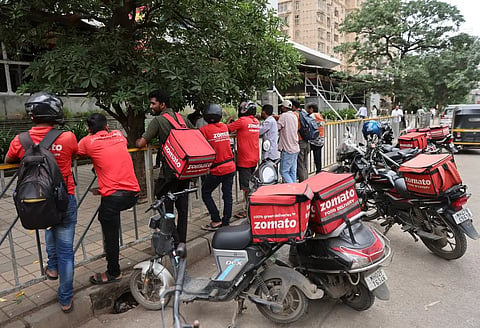
The history of human civilization is also the history of labour. From the farmer working in the field to the factory worker, labourers have always built nations with their sweat and sacrifice. In India too, workers have played a major role in shaping the country’s economy, industries, roads, railways, and cities. Today, however, India is entering a new phase of development — the age of the digital economy. In this changing world, the lives of Indian labourers are also changing rapidly. The digital economy refers to an economic system based on digital technology, internet services, smartphones, artificial intelligence, and online platforms. Recently, India has witnessed a massive digital revolution. Cheap internet, smartphones, digital payment systems like UPI, and online platforms have changed the way people work and earn money. Companies such as Swiggy, Zomato, Ola, Uber, Amazon, Flipkart, Urban Company, and many freelancing platforms have created a new form of employment called the “gig economy”.
Mobile applications and digital platforms connect millions of Indian labourers to work today. Delivery workers, cab drivers, warehouse workers, content creators, app-based service providers, and online freelancers have become common faces in modern India. According to recent reports, India’s gig workforce increased from around 77 lakh workers in 2021 to nearly 1.2 crore workers by 2025. Experts believe this number may reach more than 2 crore by 2030. This digital transformation has created many opportunities for workers. One of the biggest advantages is employment generation. In a country where unemployment remains a serious problem, digital platforms have provided work to millions of young people. Many workers who could not find permanent jobs now earn income through app-based services. A young man in a small town can now deliver food, drive a cab, sell products online, or work as a freelancer from home with only a smartphone and internet connection.
Another major advantage is flexibility. Traditional labour often requires fixed working hours and strict supervision. But in the digital economy, many workers can choose their working hours according to their convenience. Some work full-time, while others work part-time to support their families or studies. Women, students, and rural youth have also found new opportunities through online work and digital entrepreneurship. The digital economy has also helped labourers gain direct access to customers. Earlier, middlemen often controlled employment and wages. Today, many workers directly receive payments through digital platforms. Small artisans, weavers, handicraft makers, and local sellers can use social media and e-commerce websites to sell products across India and even abroad. This has increased visibility and income opportunities for many workers in rural areas. India’s digital payment revolution has further strengthened this change. The Unified Payments Interface (UPI) has made financial transactions simple and fast. Even small workers and street vendors now use QR codes and digital wallets. This has increased financial inclusion and reduced dependence on cash.
However, despite these positive changes, the condition of many labourers in the digital economy remains difficult and uncertain. The new system has created opportunities, but it has also introduced serious challenges. One of the biggest problems is job insecurity. Most digital labourers are not permanent employees. They are called “gig workers” or “platform workers.”. Companies often treat them as independent partners rather than employees. As a result, many workers do not receive regular salaries, pension benefits, paid leave, or job security. Income uncertainty is another major issue. A worker’s earning depends on customer demand, ratings, incentives, and algorithms controlled by digital companies, which can fluctuate significantly and lead to unpredictable income levels for gig workers. According to the Economic Survey 2025–26, nearly 40 per cent of gig workers in India earn below Rs 15,000 per month. Many delivery workers and drivers work for long hours every day, yet their earnings remain unstable. Fuel prices, maintenance costs, internet expenses, and commission cuts reduce their real income.
Many workers in the gig economy also face exploitation. Platforms often assign work using digital algorithms, leaving workers in the dark about the decision-making process. A small decline in ratings may reduce work opportunities. Sometimes workers are penalised for reasons beyond their control, such as traffic jams, weather conditions, or technical problems in apps. Researchers have described this phenomenon as “algorithmic management”, where machines and software control workers instead of human supervisors. Long working hours have become another serious concern. Delivery workers and drivers often work 10 to 12 hours daily without proper rest. A study in Telangana indicated that many gig workers work continuously throughout the week with little social protection. During heavy rain, extreme heat, or late-night hours, workers still continue their duties to earn incentives. Unfortunately, accidents and health problems are common among them.
Women’s labourers in the digital economy face both opportunities and difficulties. Online work has allowed many women to participate in economic activities from home. Digital platforms have opened new spaces in online teaching, tailoring, beauty services, content creation, and small business activities. However, safety concerns, unequal pay, social restrictions, and lack of maternity benefits continue to affect women workers. Another major challenge is the digital divide. Although India has made remarkable progress in internet access, many rural labourers still lack digital education and technical skills. Poor connectivity, low-quality devices, and lack of awareness prevent many workers from benefiting fully from the digital economy. Elderly labourers and uneducated workers often struggle to adapt to new technologies.
Artificial Intelligence (AI) is also changing the future of labour. Automation and AI tools are increasing productivity in many sectors. Reports suggest that more than 40 per cent of India’s IT and gig workforce now use AI-related tools in their work. While technology creates new opportunities, it may also reduce demand for some traditional jobs. Repetitive and routine work can increasingly be performed by machines and software. Therefore, labourers must continuously upgrade their skills to survive the future job market.
The COVID-19 pandemic clearly demonstrated the importance and vulnerability of digital labourers. During lockdowns, delivery workers, drivers, warehouse workers, healthcare staff, and sanitation workers continued working to support society. They became frontline workers of the digital economy. At the same time, many suffered from low income, job loss, health risks, and lack of social security. The pandemic taught India that labourers are not merely economic resources; they are the backbone of society. Recognizing this issue, the Indian government has started discussing labour reforms for gig and platform workers. The Code of Social Security, 2020, officially recognises gig workers and platform workers for the first time in Indian labour law. The government has also launched the e-Shram portal to create a national database of unorganized workers. Through this system, workers may receive social welfare benefits, insurance, and support schemes in the future.
Some Indian states have also taken important steps. Rajasthan became the first state to pass a law for platform-based gig workers. Other states such as Karnataka, Bihar, and Jharkhand have also introduced welfare measures and registration systems for gig workers. Parliamentary committees and labour organizations are demanding better protections, minimum wages, accident insurance, and healthcare benefits for digital workers. Still, much more needs to be done. Labourers’ insecurity and exploitation hinder the success of India’s digital economy. Development must be human-centred. Technology should support workers, not replace their dignity.
First, there is an urgent need for strong social security systems for all digital workers. Health insurance, pension benefits, maternity support, accident compensation, and emergency assistance should be available to every labourer, regardless of their type of employment. Second, fair wages and transparent work systems are necessary. Digital platforms should clearly explain payment structures, incentives, penalties, and algorithmic decisions. Workers must have the right to question unfair treatment. Third, skill development is essential. Government, educational institutions, and private companies should provide digital education and training programs for labourers. Rural youth, women, and marginalized communities should receive equal opportunities to learn modern technological skills. Fourth, workers must have representation and collective voice. Trade unions and worker organizations should adapt to the digital age and protect the rights of platform workers. Labour rights should not disappear simply because work has moved from factories to mobile applications. Finally, society must respect workers. Behind every online order, every cab ride, and every digital service, there is a hard-working human being. Convenience for customers should not come at the cost of human suffering.
The Labour Day is not only a celebration of workers; it is also a reminder of struggle, sacrifice, and dignity. In the age of the digital economy, Indian workers are at a historic turning point. Technology has opened new doors, but it has also created new inequalities. India’s future progress will depend not only on artificial intelligence, digital platforms, and economic growth, but also on how fairly the nation treats its workers. A truly modern India will be built not merely by digital technology but by justice, dignity, and humanity for every labourer. On this Labour Day, the country must remember that behind every digital screen stands the invisible strength of millions of workers, whose labour continues to move the nation forward.
(The author is a faculty member of History, Rabindranath Thakur Vishwavidyalaya).
