
- Home
- Live Blog
- Breaking News
- Top Headlines
- Cities
- NE News
- Sentinel Media
- Sports
- Education
- Jobs
‘In the happiness of his subjects lies the king’s happiness; in their welfare lies his welfare.’ Kautilya, Arthashastra
Bivash Modi
(modi.bivash@yahoo.in)
More than two thousand years ago, Kautilya understood a principle that modern economics continues to rediscover: the ultimate test of statecraft is not the splendour of statistics, but the welfare of the people.
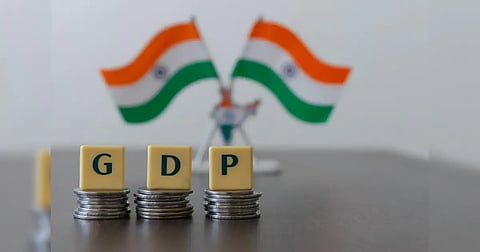
India’s latest GDP numbers, therefore, deserve both celebration and scrutiny.
The economy has scored an impressive 7.8% in the first quarter of 2026-27, beating the Reserve Bank of India’s 7% expectation and the market consensus of around 7.1%. Manufacturing grew 9.2%, financial services 12.1%, private investment accelerated sharply and private consumption remained resilient.
These are encouraging numbers
They suggest that, despite geopolitical turbulence, expensive energy, uncertain global trade and a difficult external environment, India’s domestic economic engine remains remarkably resilient. For a country aspiring to become Viksit Bharat by 2047, this is no small achievement. But economics is rarely as simple as a headline number.
The 7.8% question
The controversy surrounding the GDP figure has acquired an unnecessary political colour. Supporters of the Government have treated the number as evidence of India’s economic success, while critics have questioned whether the methodology captures the economy’s true pulse. Both sides deserve to be heard. The government’s case is technically strong on one important point. India has recently shifted its GDP series from the 2011-12 base year to 2022-23, incorporating newer data sources and a substantially more detailed system of price deflators. The Ministry of Statistics and Programme Implementation has defended the revisions as methodological improvements rather than an attempt to inflate growth. Therefore, comparing a number calculated under the old series directly with one calculated under the new series can produce misleading conclusions. The much-discussed calculation suggesting that India’s growth is actually only around 2.6% suffers from precisely this problem. It compares figures belonging to different statistical series. That cannot constitute an alternative estimate of real GDP growth. But this does not mean that every criticism of the new methodology should be dismissed.
Statistics must inspire confidence, not merely produce numbers. Former Finance Secretary Subhash Chandra Garg and other sceptics have raised questions about revisions, deflators and the interpretation of the new series. Former policymakers and economists have also asked a larger question: if the economy is growing so rapidly, why are employment, private investment and household prosperity not always appearing equally robust on the ground? This is a legitimate economic question.
A low GDP deflator, for instance, has attracted attention because it appears considerably lower than some other inflation measures. The Government’s explanation rests on the improved methodology and the greater use of producer-price information. Whether this methodology proves superior will ultimately be judged by the quality of the data accumulated over time—not by political argument. That is why the wisest response is neither blind faith nor reflexive disbelief.
The 7.8% should be accepted as the official estimate, while the assumptions and methodology behind it should remain open to independent examination. That is how statistical credibility is built.
The PM’s economic advisor Sanjeev Sanyal’s optimism and the sceptics’ caution:
Sri Sanyal has rightly drawn attention to the fact that GDP does not stand alone. Automobile sales, bank credit, corporate activity, manufacturing and investment provide independent signals of economic momentum. The latest data provide some support for this optimistic reading. Private investment rose strongly, consumption grew 7.1%, manufacturing expanded 9.2% and bank credit growth accelerated.
But the sceptics also have a point.
An economy can grow rapidly without making every citizen feel equally prosperous. GDP measures production. It does not directly measure distribution, employment quality, wages, household financial security or social mobility. This distinction is particularly important for India.
A young graduate looking for a suitable job does not experience GDP growth in percentage terms. A small entrepreneur struggling with credit does not experience it as a national aggregate. A farmer dependent upon the monsoon measures prosperity through his income and purchasing power. Thus, GDP is necessary, but it is not sufficient.
The real promise of Viksit Bharat
The larger story of India, however, is encouraging. India today possesses several advantages that were difficult to imagine a generation ago: a large domestic market, expanding digital infrastructure, improving physical connectivity, rising formalisation, stronger financial institutions, expanding manufacturing capacity and a growing technological ecosystem.
The recent sovereign-rating upgrade by Japan Credit Rating Agency to A- with a stable outlook also reflects international recognition of India’s improving macroeconomic fundamentals and policy framework.
But the journey from a large economy to a developed economy requires more than maintaining a high GDP growth rate.
India will need to convert growth into: better jobs, higher productivity, stronger manufacturing, rising farm incomes, better education, improved healthcare, greater female participation in the workforce and higher per-capita income. The challenge is not simply to grow at 7–8%. It is to ensure that the benefits of 7–8% growth reach the last household.
That is where Kautilya’s ancient wisdom becomes remarkably contemporary. The numbers should be tested by the people. There is a temptation in public discourse to ask: Who is right— Sanjeev Sanyal or Subhash Garg? That may be the wrong question. The better question is:
What does the evidence tell us?
If GDP growth is accompanied by rising consumption, investment, employment, real wages, productivity, exports and per-capita income, confidence in the growth story will naturally strengthen. If GDP remains high while employment and household incomes lag behind, policymakers must ask why. Both possibilities can coexist temporarily. The answer will emerge not from television debates but from better data and longer time series. The forthcoming historical back-series under the new GDP methodology should therefore be watched carefully. It will enable economists to make more meaningful like-for-like comparisons and will help settle some of the present methodological disputes.
A promising road, but no
room for complacency
India should not be apologetic about 7.8% growth. Nor should it become complacent because of it. The number is encouraging. The underlying indicators suggest that the economy has genuine momentum. Global uncertainties, however, remain substantial, particularly through energy prices, geopolitical tensions and the monsoon. For Viksit Bharat, the ambition must consequently be larger than producing impressive quarterly statistics. India must create an economy in which growth is high, inflation is manageable, jobs are plentiful, productivity rises, enterprises invest with confidence and ordinary families experience a visible improvement in their standard of living. That would be the most convincing statistical validation of India’s development story.
Kautilya’s wisdom offers an appropriate benchmark even for the twenty-first century: The prosperity of the State ultimately rests upon the prosperity of its people. The 7.8% GDP figure gives India reason for confidence. What India does with that confidence will determine whether today’s promising growth becomes tomorrow’s developed India.
