
- Home
- Live Blog
- Breaking News
- Top Headlines
- Cities
- NE News
- Sentinel Media
- Sports
- Education
- Jobs
The height to which India will ascend remains a matter of divergence, akin to the parable of the blind men encountering an elephant. This variance comes as no surprise in a nation profoundly divided, particularly in the lead-up to an election year. A multitude finds themselves ensnared by narratives of unbridled hope, absent of caution, while others are entangled in tales of gloom, despondency, and scarcity, bereft of any glimmers of positivity.
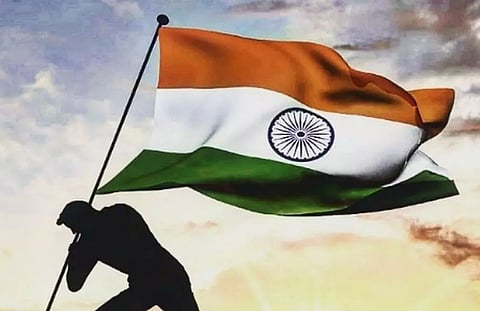
The proclamation, “When the tricolour will be hoisted in 2047, the world will witness and praise a developed India,” resonated from Prime Minister Narendra Modi’s address on India’s 77th Independence Day, as he spoke from the iconic Red Fort’s ramparts. This refrain has echoed through numerous speeches by Mr. Modi himself and his party’s spokespersons.
The critical aspect lies in how “development” is defined. While this might appear abstract, it fundamentally hinges on lived experiences—the aspects one chooses to prioritize and those that are disregarded.
The backdrop against which I am composing this column is one characterized by the ongoing havoc brought upon Himachal Pradesh and Uttarakhand, two northern Indian hill states, due to relentless rainfall, sudden floods, cloudbursts, and devastating landslides. In Himachal, the state hit hardest, the aftermath is grim—automobiles swept away, infrastructure ravaged, buildings and bridges obliterated. The economic toll has surged beyond Rs 7,020.28 crore. Regrettably, the tragic death toll stands at 60 individuals who succumbed to landslides and flash floods. Numerous individuals remain missing or injured, while the tireless endeavours of rescue and relief operations persist.
The forefront of attention is now occupied by the catastrophes that have underscored essential inquiries concerning the prevailing development paradigm adopted within the ecologically delicate and landslide-vulnerable Himalayan states, especially against the backdrop of climate change and the escalating frequency of severe weather occurrences. As numerous experts have emphasized, a particular strain of “development” inherently heralds calamity.
The inquiry into the essence of “development” extends its reach to various domains. Even as our hearts grapple with the poignant visuals emanating from Himachal and Uttarakhand, the haunting and distressing scenes from Nuh, Haryana, and Manipur remain etched in our collective consciousness. Is it plausible that a model rooted in fear can guide us towards the realization of a “developed India” that forges a global impact?
The concise response is to embrace unvarnished candour. It is imperative to discuss both India’s strengths and vulnerabilities. Without the willingness to confront our current reality with unwavering honesty, we cannot mould our forthcoming path or participate in shaping the trajectories of others. A forthright examination of our present condition must underlie any endeavours to influence our future. Amidst the lofty rhetoric that enshrouds the magnificence of India’s narrative, introspection and challenging conversations must infuse a sense of realism.
The present day witnesses India as the possessor of the world’s fifth-largest economy. A multitude of Indians experience lives akin to those in the “first world.” However, it’s essential to acknowledge that India is a nation encompassing 1.43 billion individuals, with a median age of approximately 28. While India’s economic ascension may persist, it’s the tangible experiences of the majority that will ultimately shape the essence of the “developed” label.
In April of this year, Apple’s CEO Tim Cook inaugurated the company’s inaugural retail store in Mumbai, an event that drew a crowd of over 300 individuals eager to acquire phones priced at over Rs 1 lakh. Mr. Cook expressed his belief that India possessed the capability to rank among Apple’s leading markets. For numerous observers, this occurrence marked yet another testament to India’s unflagging trajectory and its undeniable ascent on the global stage.
Amid the prevailing euphoria, a subset of commentators brought attention to an undeniable fact: India’s per capita income stands as the lowest among the 26 nations where the iPhone manufacturer maintains retail establishments. At present, India’s per capita income hovers around $2,500. Thus, when contemplating the concept of “development” within the Indian context, a crucial question emerges: “Which India?” Within the landscape exists a globalized, urbanized, interconnected India, where opportunities abound and horizons expand. This is undoubtedly a heartening narrative. However, coexistence is an alternate facet of India, inhabited by individuals who lack substantial education, skills, connections, and societal influence. These individuals make headlines only in the aftermath of calamitous events.
The situation has conceivably undergone a transformation for millions of Indians over the past few decades. The narrative of India’s triumph is no longer relegated solely to sprawling metropolises or the privileged affluent.
The discussion encompassing the gross domestic product gains added depth when considering India’s elevation above the United Kingdom, securing the position of the world’s fifth-largest economy. However, it is imperative to underline that relying solely on GDP fails to convey the complete narrative and cannot foretell the trajectory awaiting ordinary citizens in the future. A comprehensive view requires coupling GDP with per capita GDP, per capita gross national income, and human development indicators. Such amalgamation paints a more comprehensive portrait of the nation’s condition.
The World Inequality Report 2022 delineates that India persists as a nation characterized by poverty and marked inequality, housing a prosperous elite. Within this framework, the uppermost 10 percent commands a staggering 57 percent of the overall national income, whereas the share held by the bottom 50 percent stood at a mere 13 percent in 2021.
The disparity extends beyond income disparities to encompass fundamental education and skill levels. As we contemplate spearheading the burgeoning global knowledge economy, we must not disregard the disheartening reality that a considerable number of Indians continue to grapple with illiteracy. The absence of a census since 2011 has left us with a last-recorded average literacy rate of 73 percent in the country. Though subsequent official surveys suggest a modest uptick in literacy rates, they still remain below 80 percent. Moreover, among those who are literate, many do not complete their education.
The issue of India’s capacity to generate sufficient employment opportunities stands as a pivotal concern, one that is poised to maintain its relevance in the forthcoming years. Conversations surrounding India’s technological prowess often become narrowly centered around the Indian Institutes of Technology (IITs) and the Indian Institutes of Management (IIMs). While it is unsurprising that graduates from these institutions, having surmounted rigorous entrance exams, find success, how does this offer solace to the millions who are either unemployed or barely making ends meet? The disparity becomes evident when comparing the percentage of India’s youth entering IITs with those securing positions in multinational corporations, whether domestically or overseas. India grapples with fatal deficiencies—its incapacity to provide a substantial portion of the populace with a sufficiently high level of education and its remarkably low rate of female workforce participation. To assume a leadership role in the Global South, India must intensify its investments in nurturing the human capital of its most vulnerable segments.
All these factors exert an influence on the narrative of development and India’s capability to steer its course forward and assume leadership.
The distinctiveness of India lies in its possession of a 1,000-year policy framework, a singular trait not found elsewhere globally. During his Independence Day address, Prime Minister Modi underscored that choices made during Amrit Kaal (now termed Kartavya Kaal) will reverberate across the subsequent millennium. Yet, as a common Indian citizen, my primary apprehension revolves around India’s trajectory within the upcoming five to ten years. I’m deeply concerned about the durability of its physical and human resources and the cohesive fabric of its society.
The discourse we engage in, as well as the discussions we opt to omit, will ultimately shape the magnitude, or lack thereof, of the India narrative. This impact extends not only to our collective story but also to our future trajectory.
