
- Home
- Live Blog
- Breaking News
- Top Headlines
- Cities
- NE News
- Sentinel Media
- Sports
- Education
- Jobs
Mita Nath
(mitanathbora7@gmail.com)
The world today stands at a critical juncture in its fight against climate
change, adopting a transition towards cleaner energy, biofuels, particularly ethanol, that have emerged as one of the most practical and scalable solutions. Rising temperatures, frequent extreme weather events, melting glaciers and increasing air pollution has shown us frequent calamities like flash flood, erosion, landslides, wildfire and more, and have forced nations to rethink their dependence on fossil fuels. Transportation alone accounts for nearly one-fourth of global carbon dioxide emissions, making the decarbonisation of the transport sector an urgent necessity. While electric vehicles and green hydrogen represent the future of mobility, ethanol offers an immediate and affordable pathway to reduce fossil fuel consumption and lower emissions.
Recognising this opportunity, India has adopted one of the world’s most ambitious ethanol blending policy and energy initiatives undertaken by any major developing economy. By simultaneously addressing energy security, rural prosperity and decarbonization, it offers a holistic model that few countries have matched. Ethanol’s oxygen-rich composition enables cleaner combustion, reducing emissions of carbon monoxide, unburnt hydrocarbons and particulate matter, while its renewable origin helps lower life-cycle greenhouse-gas emissions when produced sustainably. India’s rapid progress in expanding ethanol production capacity, achieving nationwide E20 availability ahead of schedule, and promoting flex-fuel vehicles demonstrates how climate action can be aligned with economic development and farmer welfare. Unlike many countries that have focused solely on mandates, India is building an integrated ecosystem encompassing feedstocks, distilleries, vehicle technology and distribution infrastructure, a lesson drawn from global successes such as Brazil. In this sense, India’s approach represents one of the world’s most comprehensive and replicable models for the sustainable use of biofuels.
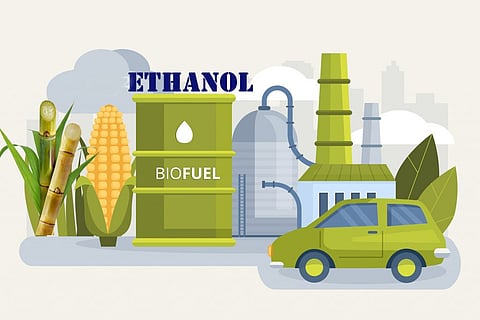
Ethanol is an alcohol produced from renewable resources such as sugarcane, molasses, maize and agricultural residues. Unlike petrol, which releases carbon that has been trapped underground for millions of years, ethanol is derived from plants that absorb carbon dioxide from the atmosphere during their growth. Consequently, when ethanol is burned, much of the carbon released is part of a short biological carbon cycle rather than introducing entirely new fossil carbon into the atmosphere. Ethanol is also known as an oxygenated fuel because it contains oxygen within its molecular structure. This oxygen enables more complete combustion in engines, resulting in lower carbon monoxide emissions, lower unburnt hydrocarbon emissions, reduced soot formation, cleaner engine operation and improved combustion efficiency.
While the overall climate benefits depend upon sustainable production methods, ethanol remains one of the most effective low-carbon fuels currently available for large-scale use in internal combustion engines.
The push towards ethanol is closely linked to global climate commitments under the United Nations Framework Convention on Climate Change. At COP27 in Egypt, countries emphasised reducing greenhouse-gas emissions from transportation through multiple pathways, including biofuels. At COP28 in Dubai, nations agreed to accelerate the transition away from fossil fuels and expand the use of low-carbon fuels, including sustainable biofuels where appropriate. This has made ethanol a key component of the global clean-energy transition.
Brazil is universally regarded as the world’s most successful ethanol story. Following the oil crisis of the 1970s, Brazil launched the Pró-Álcool Programme in 1975 to reduce dependence on imported oil and utilise its abundant sugarcane resources. Over five decades, the country built an entire ecosystem around ethanol, including flex-fuel vehicles, dedicated ethanol pumps, stable long-term policies, massive investments in sugarcane production and processing. Today, more than 80 percent of new vehicles sold in Brazil are flex-fuel vehicles capable of running on petrol or high-ethanol blends. The country dramatically reduced its oil imports and built one of the world’s most competitive biofuel industries.
The United States is today the world’s largest producer of ethanol, primarily using corn as feedstock. Nearly all gasoline sold in the country contains ethanol blends, and millions of flex-fuel vehicles use E85 fuel. The programme has strengthened rural economies and reduced gasoline consumption. Thailand has successfully introduced ethanol through gradual implementation, strong agricultural support and vehicle compatibility measures. The country now widely uses E10, E20 and E85 blends and is regarded as one of Asia’s most successful biofuel programmes. Sweden used ethanol as a transition fuel while developing its electric-vehicle ecosystem. The country demonstrated that ethanol and electric vehicles are not competitors but complementary technologies in the broader decarbonisation journey.
Against the global backdrop, India’s ethanol policy stands out as one of the most meaningful and forward-looking energy reforms of recent decades. India imports nearly 85% of its crude oil requirements. Every litre of ethanol blended into petrol means less imported crude oil, lower foreign exchange outflow, greater energy security, a larger domestic market for agricultural products. Unlike many countries that pursued ethanol solely for environmental reasons, India has designed a programme that simultaneously addresses climate action by reducing dependence on fossil fuels and lowering certain vehicle emissions, ethanol contributes to India’s broader decarbonisation goals; energy security by reducing dependence on imported oil protects the economy from global geopolitical shocks and volatile crude prices; farmer prosperity as India’s programme creates a new market for sugarcane, maize, molasses and increasingly agricultural residues, thereby diversifying farmers’ incomes and strengthening rural economies. Also, circular economy as India is increasingly moving towards second-generation ethanol produced from agricultural residues, turning farm waste into clean energy and reducing stubble burning.
India’s ethanol programme may well represent the most balanced ethanol model seen globally. Unlike Brazil, which relies overwhelmingly on sugarcane, or the United States, which primarily uses corn, India has developed a multi-feedstock strategy that includes sugarcane juice, molasses, maize, damaged food grains, agricultural residues. This diversified approach reduces risks arising from crop failures and improves long-term sustainability. Moreover, India is not treating ethanol as a standalone solution. Instead, it has adopted a multi-technology approach — electric vehicles for urban mobility, ethanol and flex-fuel vehicles for liquid-fuel transportation, compressed bio-gas for commercial applications, green hydrogen for heavy industries and long-distance transport. Few countries have attempted such an integrated strategy.
India has also expanded ethanol production capacity dramatically. Earlier, the country struggled to produce enough ethanol even for E10 blending. Today, installed capacity has increased to approximately 1,700 crore litres annually, and India has reached aggregate E20 blending ahead of its original schedule. This achievement is remarkable for a developing country of India’s size and complexity.
The developing world faces a common challenge: how to achieve economic growth while reducing carbon emissions. India’s ethanol model offers a compelling answer. It demonstrates that climate action need not come at the expense of farmers or economic development. It shows that clean energy can simultaneously reduce emissions, strengthen energy security, generate rural employment, increase farmer incomes, promote technological innovation. For countries across Asia, Africa and Latin America, India’s ethanol journey provides a practical and replicable blueprint.
The introduction of ethanol blending in India is not merely an energy policy—it is a transformational national strategy. In the coming decades, as nations seek practical solutions to save the planet while ensuring economic growth, India’s ethanol revolution may well be remembered as one of the defining examples of how a developing country led the world towards a cleaner and more sustainable future.
