
- Home
- Live Blog
- Breaking News
- Top Headlines
- Cities
- NE News
- Sentinel Media
- Sports
- Education
- Jobs
Zahid Ahmed Tapadar
(The writer can be reached at zahidtapadar@gmail.com.)
On 26 January 1950, India stepped into a new constitutional identity. Three years after independence, the country formally became a sovereign democratic republic, adopting a constitution that replaced the British Crown’s dominion with popular sovereignty. The transformation was peaceful, constitutional, and unprecedented—a colony becoming a republic while choosing to remain within the Commonwealth. Newspapers across India and the world documented this historic moment, creating a remarkable journalistic archive of how a nation proclaimed its constitutional rebirth to itself and the world.
Indian Press: Chronicling
Constitutional Birth
Indian newspapers treated the event with historic gravity, their front pages dominated by proclamations, photographs, and ceremonial descriptions.
The Indian Express carried the headline “INDIA PROCLAIMED SOVEREIGN DEMOCRATIC REPUBLIC.” Published on January 28, 1950, the paper reported: “The birth of the Indian sovereign democratic Republic was proclaimed at 10:18 this morning by the country’s last Governor-General, Mr. Chakravarti Rajagopalachari, at the Durbar Hall at Government House in the capital, and the Republic’s first President, Dr. Rajendra Prasad, took the oath of office to the boom of a salute of 31 guns at a most brilliant ceremony.”
The paper also documented Communist anti-Republic Day demonstrations, reflecting the ideological tensions of the era.
The Hindustan Times presented celebrations through photographs and descriptive reportage by a “Special Correspondent, New Delhi,” publishing multiple images of crowds, illuminated buildings, and ceremonial moments. The Times of India documented the transition through powerful photographs, including one captioned: “After proclaiming India a Republic, the retiring Governor-General, C. Rajagopalachari, invites the first elected President of the Republic, Dr. Rajendra Prasad. …”
Fauji Akhbar/Sainik Samachar, the military journal published on February 4, 1950, provided vivid details: “At the most solemn ceremony held in the brilliantly lit and high domes of Durbar Hall at Government House, India was declared a Sovereign Democratic Republic exactly at 18 minutes past 10 on the morning of Thursday, January 26, 1950.” The journal continued: “The birth of the Indian Republic and the installation of its first president were announced by a salute of 31 guns shortly after 10:30 AM.”
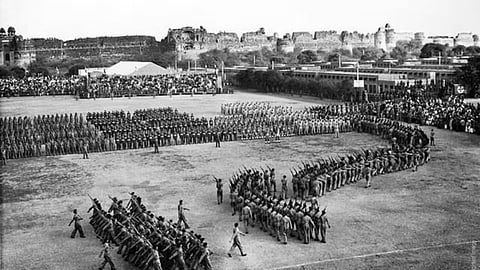
The publication captured the presidential procession’s pageantry: “The president drove out of the Government House (now Rashtrapati Bhavan) in state exactly at 2:30 PM in a 35-year-old coach especially renovated for the occasion, bearing the new emblem of Asoka’s capital and drawn by six sturdy Australian horses. “ The President’s route took him from Government House through Vijay Chowk, past Parliament House, around Connaught Place, to India Gate, and finally to Irwin Amphitheatre (now Major Dhyan Chand Stadium). An estimated 15,000 attendees gathered at the venue to witness history, while chants of “jai” echoed through streets lined with people on trees, roofs, and every vantage point.
The Statesman covered the bitterly cold day extensively. A 2017 retrospective recalled that General (later Field Marshal) Cariappa told his men, “Aaj hum bhi azad, tum bhi azad aur hamara kutta bhi azad” (Today we are free, you are free, and even our dog is free), causing merriment among assembled troops.
Presidential Words
for the Nation
President Rajendra Prasad’s statement, preserved in official records, gave the global press a moral frame: “I shall only hope that all those whose good fortune it may be to work this Constitution in the future will remember that it was a unique victory that we achieved by a unique method taught by the Father of the Nation, and it is up to us to preserve and protect the independence that we have won and to make it really bear fruit for the man in the street.”
International Coverage: India Enters World Headlines
The declaration of the Republic did not remain confined to Indian pages. International newspapers, especially in Britain, the United States, and the Commonwealth, devoted prominent space to the event, recognizing its significance in the post-war reconfiguration of global power.
The New York Times carried a dispatch titled “India a Republic, Prasad President” by Robert Trumbull, one of the few clearly identifiable journalists whose name is directly associated with first-hand international reporting on the inaugural Republic Day. Trumbull’s report outlined the constitutional transition, the oath-taking ceremony, and the declaration of a two-day national holiday, presenting the event as a milestone in Asian democracy.
The Courier-Mail, Brisbane, ran a front-page headline on January 26, 1950: “INDIA BECOMES A REPUBLIC TO-DAY—Modern miracle of a bloodless revolution.”
A Reuters dispatch, reprinted in multiple Commonwealth papers, described the celebrations: “Thousands of Indians poured from the hills and from farm lands into the cities last night to celebrate the birth of the independent Indian Republic… Hotels are packed with visitors, and buildings are strung with hundreds of thousands of colored lights as ancient India prepared to become the world’s youngest republic.”
The Manchester Guardian (later The Guardian) situated India’s transformation within the post-war reshaping of former empires. The Indian Daily Mail reported that “Many British newspapers yesterday prominently reported the election of 66-year-old Dr. Rajendra Prasad as the first President of the Republic of India.”
President Sukarno of Indonesia was the chief guest at India’s first Republic Day, symbolizing solidarity between newly independent Asian nations emerging from colonial rule.
Visual Documentation
Photographs shaped international understanding of the event. Images from official government photographers, coordinated through the Press Information Bureau, showed the president taking the salute, ceremonial parades, and illuminated landmarks. These photographs were reused by newspapers and magazines abroad.
British Pathé newsreel footage recorded early Republic Day scenes for cinema audiences in Europe. Decades later, commercial archives such as Getty Images would catalogue still photographs from the day.
Journalism of an Era
A striking feature of the 1950 coverage is the relative absence of named reporters in Indian newspapers. Major dailies relied on institutional bylines—”Staff Reporter” or “Special Correspondent”—and official photographs. In contrast, international newspapers, particularly in the United States, were more likely to attach individual correspondent names to their reports.
Framing a Moment
Indian newspapers framed the day as the fulfillment of a long constitutional struggle, emphasizing sovereignty, democratic values, and a peaceful transition from Dominion status to Republic transformation through constitutional means rather than revolution. The emphasis on Gandhi’s methods and constitutional legitimacy distinguished India’s path from other post-colonial transitions.
International newspapers interpreted the event as the emergence of “the world’s youngest republic,” signaling a shift in global political geography. For Commonwealth nations, it marked India’s continued membership in a transforming association—a novel arrangement where a republic acknowledged the British monarch as the symbolic head of the Commonwealth. For the United States and other powers, it represented democracy’s consolidation in a strategically significant Asian nation during the early Cold War, when the continent’s political future remained uncertain. The coverage also revealed tensions: while most papers celebrated the constitutional achievement, reports of Communist demonstrations reminded readers that India’s democratic experiment faced domestic challenges.
A Living Archive
What survives today in headlines, captions, wire reports, and photographs is a documentary archive of how India announced itself to its people and the world on 26 January 1950. The press coverage shaped collective memory of this constitutional milestone, captured through official proclamations, correspondent reports, wire service dispatches, and photographs that traveled from New Delhi across the globe.
The journalistic record of that January morning demonstrates how media shape national memory and international understanding. Through the words, images, and editorial choices of 1950, we can still witness the moment when India, as President Prasad declared, committed itself to making independence “really bear fruit for the man in the street.”
