
- Home
- Live Blog
- Breaking News
- Top Headlines
- Cities
- NE News
- Sentinel Media
- Sports
- Education
- Jobs
Chandan Kumar Nath
(chandankumarnath7236@gmail.com)
The twenty-sixth summit of the Shanghai Cooperation Organisation, held in the Kyrgyz capital of Bishkek from August thirty-first to September first, 2026, marks a pivotal juncture in the geopolitical evolution of the Eurasian landmass. Celebrating the twenty-fifth anniversary of the bloc, the summit convened under the banner of Together Towards Sustainable Peace, Development and Prosperity. As global power dynamics undergo profound transformations, this gathering reinforced the organization as a formidable institutional mechanism. For India, navigating the complex crosscurrents of contemporary global political diplomacy, the Shanghai Cooperation Organisation represents a truly indispensable platform for deep Eurasian regional engagement.
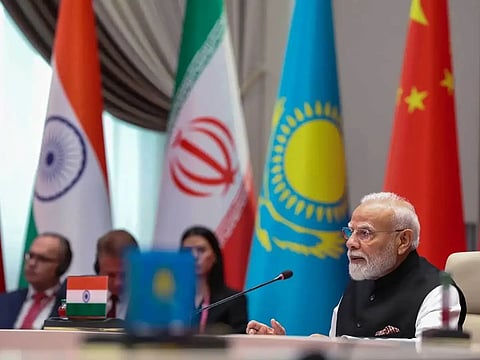
By dispatching Prime Minister Narendra Modi to this diplomatic theatre, New Delhi unequivocally signaled its enduring commitment to the region while simultaneously delineating firm boundaries regarding sovereignty, cross-border terrorism, and the dangers of unilateral expansionist agendas. Observers often point out the inherent paradox of India’s active participation in this grouping, which is heavily influenced by Beijing and Moscow, even as it deepens its strategic partnership with Western nations. Yet, from the vantage point of Indian diplomatic strategy, there is absolutely no contradiction. New Delhi views its global engagements through a geographical matrix rather than a zero-sum ideological structural lens. The Bishkek summit provided a crucial arena for India to assert its strategic autonomy, championing a multipolar world order while refusing to let the consortium devolve into a singular vehicle for anti-Western posturing or authoritarian hegemony. By remaining actively engaged at the high table, India ensures that the organization operates as an inclusive cooperative framework. At the heart of India’s agenda within the organization lies a steadfast framework emphasizing security, economic cooperation, connectivity, unity, respect for territorial sovereignty, and environmental protection. Among these foundational pillars, the issues of connectivity and border integrity have emerged as primary battlegrounds for Indian diplomacy. As Eurasian integration accelerates, competing visions of regional infrastructure have clashed repeatedly. India has consistently and uniquely stood as the sole member state to refuse endorsement of China’s Belt and Road Initiative. New Delhi’s opposition is fundamentally rooted in the fact that opaque infrastructure projects frequently violate sovereign borders, leading to severe debt entrapment for vulnerable nations. At the recent summit in Kyrgyzstan, Indian representatives were unequivocal in asserting that regional cooperation must be built on genuine partnerships and mutual respect, rather than unilateral agendas that deliberately cherry-pick global practices of trade and transit to suit their strategic geopolitical motives. Instead of endorsing debt-inducing mega-projects, India champions transparent and sustainable connectivity alternatives. While the China-Kyrgyzstan-Uzbekistan railway project dominated bilateral discussions at the summit, India reaffirmed its commitment to forging viable trade routes that respect the sovereignty of all participating nations. Such endeavours unlock the economic potential of landlocked Central Asian republics without entrapping them in strategic vulnerability. Beyond economics and infrastructure, security remains a foundational pillar of the organization, originally conceived to combat the three evils of terrorism, separatism, and extremism. For India, this mandate is not a mere rhetorical flourish but an absolute, undeniable existential imperative political reality. India utilized the summit platform to strongly condemn double standards in combating global terrorism, ensuring the Bishkek Declaration explicitly called on the international community to counter cross-border terrorist movements. Indian diplomats continuously highlighted the hypocrisy of member states that provide state sponsorship to terrorist networks while simultaneously preaching regional stability. Prime Minister Modi stressed the vital need to move away from prolonged armed conflicts toward peaceful resolutions, invoking the timeless messages shared by the historic traditions associated with Gandhi and Buddha. He clearly articulated that meaningful development and lasting economic growth inherently require an absolute environment of peace. Trade, energy flows, and people-to-people exchanges simply cannot flourish in parallel with cross-border extremism. By directly addressing the trust deficit fueled by regional terror infrastructure and unilateral border transgressions, India effectively challenged the grouping to look inward. The underlying message was undeniable: multilateral mechanisms cannot succeed if fundamental principles of good neighborliness are blatantly disregarded. India resolutely refuses to normalize terrorism as a legitimate tool of statecraft, maintaining that any genuine Eurasian integration must be prefaced by an uncompromising and universal crackdown on militant sanctuaries. Furthermore, India has leveraged its unique position to represent the broader Global South interests perfectly.
Bridging the gap between developing nations and the shifting Eurasian power structures remains a core objective. India consistently argues that global institutions remain anachronistic and fail to reflect the geopolitical realities of the twenty-first century. Within this framework, India pushes for reformed multilateralism, urging member states to collectively demand a more equitable international order. The ongoing conflicts in West Asia and Ukraine featured prominently in the Bishkek discussions, with member states expressing deep concern over military strikes and civilian casualties. India broadened the scope beyond hard security, emphasizing climate action, digital public infrastructure, and comprehensive global food economic security. Recognizing that the developing world has borne the disproportionate brunt of recent global crises, India positioned itself as a constructive developmental partner. This deeply resonates with the Central Asian republics, projecting India not merely as a regional counterbalance, but as a reliable entity capable of delivering tangible solutions to shared transnational challenges. The summit also underscored cultural and civilizational connectivity. Leaders actively welcomed the holding of the upcoming Civilization Dialogue Forum, which is scheduled to take place in India during the autumn of twenty twenty-six, thereby fostering greater scientific and innovative cooperation among the vibrant youth populations across Eurasia. Looking ahead, the geopolitical landscape presents profound new challenges as the organization’s presidency officially transitions to the Islamic Republic of Pakistan for the twenty twenty-seven cycle. This transition will inevitably place India’s diplomatic agility under intense international scrutiny, as New Delhi must navigate meetings hosted by a neighbour it consistently accuses of harboring terrorists. However, India’s active and sustained engagement with the group remains a strong testament to its deeply pragmatic, interest-driven statecraft. New Delhi operates within this complex framework not to appease geopolitical rivals, but to fiercely protect its vital continental interests and secure resource access without compromise.
India acts as an indispensable democratic counterweight in a predominantly authoritarian theater, consistently ensuring that connectivity initiatives respect sovereign boundaries rather than serving imperial designs. By steadfastly advocating for an international system anchored in international law, absolute transparency, and mutual respect, New Delhi continues to prioritize dialogue over division and consensus over coercion. As the world transitions through a period of profound turbulence, marked by economic uncertainties and geopolitical realignments, India’s firm, unyielding, yet deeply engaged posture at the Shanghai Cooperation Organisation will remain a definitive cornerstone of its overarching strategy to shape a balanced, multipolar Asian institutional strategic architecture.
