
- Home
- Live Blog
- Breaking News
- Top Headlines
- Cities
- NE News
- Sentinel Media
- Sports
- Education
- Jobs
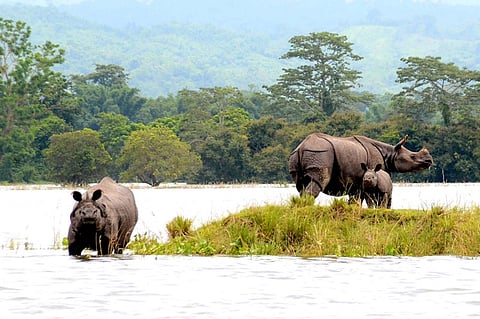
There is bad news from Kaziranga. The mighty Brahmaputra, which passes through the World Heritage Site, has been causing major bank erosion, leading to rapid shrinking of the total area of the animal habitat. Studies have shown that Kaziranga has lost over 150 sq km of area between 1915 and 2008. Taking into consideration that silt deposit by the Brahmaputra has led to overall accretion of about 61 sq km in the same period, Kaziranga has still lost over 88 sq km of valuable land. Scientists have attributed the main cause of erosion of the Brahmaputra to the loose non-cohesive sediments of the bank throughout the National Park. Scholars studying different aspects of Kaziranga have also pointed out that the braided channel of the Brahmaputra strikes the river bank along the north land boundary of the southern part of Kaziranga directly, thus undermining the silty bank and causing overhanging blocks to be easily carried away by the swift undercurrent that the mighty river is known for. Erosion caused by the Brahmaputra is said to have caused particular threat to the Agaratoli Range which is the easternmost portion of the rhino sanctuary. An estimated 35 sq km of land of Kaziranga has been lost in the Agaratoli Range alone, which is not at all an encouraging sign. It has also triggered off increased incidence of rhinos straying out in search of food and space, which in turn have made them more vulnerable to poaching. According to reports, there has been a gradual decrease of rhino population in the Agaratoli Range over the past few years. This, in turn, must be causing the rhino density in the remaining parts of Kaziranga to increase, which means less space and less fodder for the animal. Though the area of Kaziranga National Park has substantially increased and nearly doubled to 860 sq km after the additions on the north bank of the Brahmaputra, yet the National Park is facing severe space constraints. The historic Arimora Forest Inspection Bungalow, which was once the pride of Kaziranga, has been already taken away by the Brahmaputra a few years ago, with conservationists and forest officials ascertaining that the river had come in by about three kms in that portion. Though the Asian Development Bank had in 2018 approved the Kaziranga sub-project dyke with a 82.34 million US dollar funding, it has hardly made any difference to the National Park because the project has not yet taken off. According to the ADB website, the Kaziranga dyke sub-project will have two components – (i) a 20 km riverbank protection works with innovative cost-effective technologies combined with 5 km of pro-siltation measures; and (ii) upgrading 13 km flood embankments, including emergency earthworks at erosion hotspots after the 2017 flood season in Kaziranga sub-project. With a section of people trying to resist removal of the National Highway through the National Park and with a section of unscrupulous traders setting up restaurants, lodges and resorts all along the southern boundary – some up to the fence – of the Park, rhinos, tigers and all other inmates of the world’s most amazing wildlife habitat is really under increasing threat. People in Assam, including the government, often fail to remember that Kaziranga does not belong to Assam or India alone; it is a heritage property of the human race as a whole.