
- Home
- Live Blog
- Breaking News
- Top Headlines
- Cities
- NE News
- Sentinel Media
- Sports
- Education
- Jobs
Siddharth Roy
(siddharth001.roy@gmail.com)
Assam is known across the world for its rich forests, its wildlife, and its deep connection with nature. Elephants, in particular, have always held a special place in the cultural and ecological fabric of the state. They are symbols of wisdom, strength, and harmony. Yet, in recent years, this relationship has come under serious strain. The rise in human–elephant conflict has become one of the most worrying environmental challenges for Assam, affecting both people and the gentle giants who roam its forests.
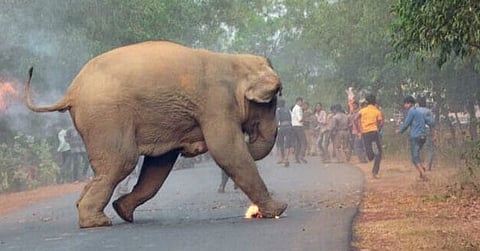
Till 2025, the state recorded around 71 human deaths and 41 elephant deaths, a grim reminder that both sides are losing in this escalating struggle. Many of these incidents take place in areas where villages and farmlands lie close to elephant corridors or habitats that have shrunk over time. The growing tension has put enormous pressure on communities who already live with limited resources, and it has pushed elephant herds into situations where they are forced to compete for space, food, and survival.
The key question today is: How did we reach this stage, and what can be done to restore the delicate balance between humans and elephants?
The roots of this conflict go deep. Assam’s elephant population has remained relatively stable, but the land available to them has not. Rapid urbanisation and expansion of farms, tea gardens, roads, railways, and other development projects have cut through traditional elephant corridors. What once were continuous stretches of forest have turned into fragmented patches, forcing elephants to wander into human settlements in search of food and safe passage. In many places, paddy fields and crop plantations have become unintended feeding grounds, bringing elephants dangerously close to people.
Climate change has added another layer of difficulty. Changing rainfall patterns and the loss of forest cover have affected food availability in the wild. As a result, elephants are now more likely to move out of forests during certain seasons. For villagers, particularly those dependent on agriculture, this means living in constant fear of nighttime raids, damaged crops, and sudden encounters. For elephants, it means navigating a maze of human habitations, electric lines, and roads that threaten their lives every single day.
But the rising conflict is not just about shrinking spaces; it is also about shrinking understanding. Traditionally, the people of Assam have shown great respect for elephants and have coexisted with them for generations. Festivals, folklore, and local customs reflect this bond. However, the increasing frequency of deadly encounters has strained this emotional connection. Villagers who lose their crops, homes, or family members often feel helpless and angry. At the same time, elephants face hostility and sometimes retaliation, even though they are simply following ancient migration routes that existed long before human settlements expanded.
The Assam government recently issued a fresh framework aimed at promoting long-term human–elephant coexistence, marking a crucial step in addressing this complex challenge. The framework focuses on preventive steps, scientific planning, and community participation. It recognises that coexistence cannot be achieved through force or firefighting measures alone; it requires thoughtful, long-term action.
One of the key components of the new framework is the creation and protection of elephant corridors. These are natural routes that elephants use to move between forest patches. Securing these corridors by preventing construction and ensuring safe passage can significantly reduce accidental encounters. Assam has already identified many such corridors, and the new plan emphasises restoring degraded areas and reconnecting fragmented forests.
Another major step involves improving early warning systems. Many parts of Assam have already introduced alert mechanisms using mobile networks, drones, and watchtowers to inform villagers when herds are nearby. Strengthening these systems can help people prepare in advance, avoid conflict, and protect their crops. Fencing sensitive areas with solar-powered or biofences, such as thorny plants or chilli-based barriers, has also shown promising results in some communities.
The government’s framework also highlights the need for better compensation mechanisms. For many families, the loss of crops or livestock can destroy their livelihood. Quick and fair compensation can reduce resentment and encourage villagers to cooperate with conservation efforts. Alongside this, involving communities in conservation through jobs like forest guards, community watchers, and eco-tourism guides can create a sense of shared responsibility and economic benefit.
However, government action alone is not enough. Civil society, NGOs, research institutions, and local communities must all work together. Many grassroots groups in Assam are already doing valuable work by educating villagers about safe practices, building night shelters for farmers, and using innovative methods to gently guide elephant herds away from populated areas. Their efforts show that coexistence is possible when communities feel empowered rather than abandoned.
At the national level too, policies need to recognize that human–elephant conflict is not a problem of a single state but a wider ecological issue across India. Elephants migrate across large landscapes, and protecting their habitat requires regional coordination. The central government can support Assam through funding, technical expertise, and stricter monitoring of development activities in sensitive zones.
Ultimately, what Assam needs is a balanced approach, one that respects the needs of its people while protecting the majestic elephants that define its natural heritage. Coexistence is not just an environmental necessity; it is a moral responsibility. Elephants are a part of India’s identity, culture, and biodiversity. Losing them or allowing unchecked conflict would be a loss for the entire nation.
The rising conflict is a warning that the old balance between humans and nature has been disturbed. But it is also an opportunity. By embracing scientific solutions, empowering communities, and reviving traditional wisdom, Assam can show the world how coexistence can be rebuilt, even in difficult times.
The path ahead is challenging, but not impossible. If the state acts with compassion, firmness, and vision, the forests of Assam may once again echo with the peaceful footsteps of elephants moving freely through the land, just as they have for centuries.
