
- Home
- Live Blog
- Breaking News
- Top Headlines
- Cities
- NE News
- Sentinel Media
- Sports
- Education
- Jobs
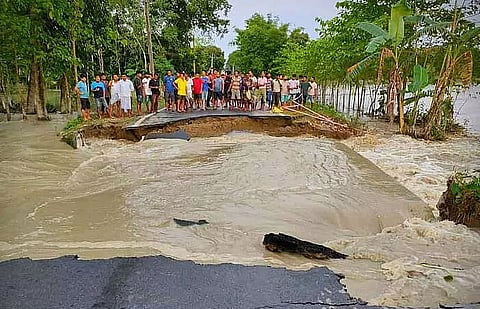
The devastation, relief, and rehabilitation on account of flood and erosion in Assam dominate the public and policy discourses but not the long-term solutions to these problems. Miseries of flood-hit people have become a never-ending story told by one generation after another, as long-term solution of creating reservoirs in upper reaches of the River Brahmaputra and Barak and their tributaries continue to be missing from disaster management. Ironically, this long-term solution was conceived in 1954 but flood management is still focused on temporary response of raising and strengthening as well as plugging breaches in embankments, most of which have outlived their spans. Besides, the existing embankments provide protection to about 52% of total flood-prone areas of the state, provided they are all in good shape to withstand pressure of surging flood waters. In 2013, the Ministry of Jalshakti, then known as the Ministry of Water Resources, constituted a committee comprising representatives of the Central Water Commission, Central Electricity Authority, National Hydroelectric Power Corporation Limited, National Water Development Agency, Brahmaputra Board and Arunachal Pradesh to address the issue of flood storage needs in the Brahmaputra basin. In its report, the committee concluded that the flood or high discharge in the Brahmaputra basin is basically due to very high rainfall in the Indian catchment of the basin and suggested that in order to mitigate the flood peaks in Brahmaputra, flood storages are required in the basin, states a report of the Parliamentary Standing Committee on Water Resources. The committee further states that due to natural topography of the basin, these flood storages can be provided in Siang, Subansiri, Lohit and Dibang sub basins only. Based on its study, the Committee estimated that a flood storage of about 9.2 Billion Cubic Meters (BCM) in Siang, 1.91BCM in Subansiri, 1.61 BCM in Lohit and 0.56 BCM in Dibang sub basin will be required, which may reduce the water level in the Brahmaputra at Guwahati during floods by 1.2m to 1.5 m, depending upon the rainfall condition in intermediate catchment, states the panel's report. It was not the first time the reservoirs or flood storages as long-term solution to Assam's recurring flood problem came up in policy suggestions. The first National Flood Policy adopted in 1954 also envisaged construction of storage reservoirs as long-term measure. In 1980, however, the Rashtriya Barh Ayog (RBA) (National Commission on Flood) in its report highlighted benefits as well as limitations of reservoirs in flood mitigation. Reservoirs can, as a general rule, control the rate and timing of the flood that may be let out. Their efficiency can be increased considerably with a reliable forecast of the inflow, the report states. It points out that reservoirs occupy a substantial area and modify stream behaviour and habitat in both beneficial and adverse ways. The effect of flood moderation through reservoir storage does not usually travel far downstream of the structure. There is also the problem of a false sense of security which leads to encroachments upon and deterioration of the river channel downstream. This can lead to serious damages when a large flood has to be let down from the reservoir. The RBA also cautioned that the effectiveness of flood moderation through storage reservoirs reduces considerably, if there is a large free catchment, downstream of the dam, up to the flood-affected zone, for, the contribution from the uncontrolled catchment can be significant and flood moderation effect of the reservoirs in the upper basin is greatly reduced at the lower part of the basin. In such cases, the moderation provided by reservoirs needs to be supplemented by embankments to contain the residual floods. Another challenge in creation of storage reservoir flagged in the report is that burden of sacrificing land for reservoir fall on the community which has no tangible flood problem, and this leads to opposition to reservoir projects. Priority of the central government to generate electricity from the Brahmaputra and its tributaries led to replacement of multipurpose hydel projects with flood cushion included in the Master Plan prepared by the Brahmaputra Board with run-of-the river hydroelectric projects in Arunachal Pradesh such as 2000-megawatt Lower Subonsiri hydroelectric projects of NHPC. The "Report of the Committee Constituted for Formulation of Strategy for Flood Management Works in Entire Country and River Management Activities and Works Related to Border Areas (2021– 26)" published by the NITI Ayog in January 2021 states that flood storage is essential in Subansiri, Siang, Dibang and Lohit sub basins for mitigating floods in the Brahmaputra and flood storage is also essential for mitigating floods in the Barak basin. It also says that there is an urgent need to expedite implementation of the identified projects. Ending inconsistencies in approaches towards utilization of water resources vis-à-vis management of ravaging annual floods in Assam is critical to finding a long-term solution to the recurring problem.