
- Home
- Live Blog
- Breaking News
- Top Headlines
- Cities
- NE News
- Sentinel Media
- Sports
- Education
- Jobs
Lalit Nath
(lalitnath784@gmail.com)
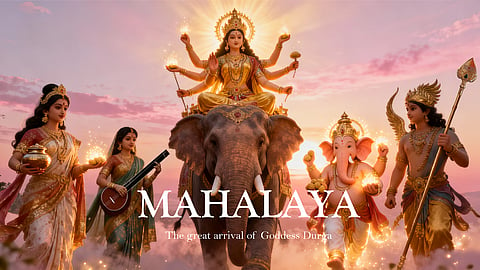
Mahalaya is a deeply sacred, solemn, and spiritually enriched tradition for the followers of Sanatana Dharma. It marks the auspicious and formal beginning of the autumnal Durga Puja festival. The final day of the Krishna Paksha in the month of Ashin-the Amavasya-is known as 'Mahalaya.' The conclusion of this sacred Mahalaya Amavasya marks the end of the 15-day period of Pitru Paksha and heralds the auspicious start of Devi Paksha. It carries the message of Goddess Durga's arrival on Earth and opens the main gateway to the sacred autumn festival.
The word Mahalaya holds deep spiritual and grammatical significance. It is formed by combining two Sanskrit words: Maha and Alaya. The word Maha means great, supreme, or vast, and Alaya means shelter, abode, or foundation. Etymologically, Mahalaya signifies the "Great Abode." As the Mother of the Universe, Goddess Durga is the ultimate foundation of the creation, preservation, and dissolution of the cosmos; thus, She is the supreme shelter (Mahalaya) for all humanity and creation. Furthermore, according to Hindu philosophy and timekeeping, this day is called Mahalaya because it marks the new moon transition, during which the darkness of Krishna Paksha dissolves into the light of the sacred Devi Paksha. It represents a grand transition from darkness to light and from tamasic qualities to sattvic virtues.
According to mythological lore, the day of Mahalaya is deeply tied to the incarnation of Goddess Durga as Mahishasuramardini and Her journey to slay the demon. When the arrogance and atrocities of the demon king Mahishasura reached their peak in the three worlds, the celestial gods found themselves distressed and helpless. Empowered by the boon of Lord Brahma, Mahishasura defeated Indra, conquered the heavens, and banished the gods. Seeking deliverance from this severe crisis, Brahma, Vishnu, Shiva, and all the deities gathered in deep deliberation. From their collective anger, radiance, and divine energy emerged a supreme, luminous female power-Goddess Durga. Homage is paid to this auspicious, all-powerful form of the Divine Mother in the Shri Shri Chandi: "Sarva-mangala-mangalye Shive Sarvaartha-saadhike | Sharanye Tryambake Gauri Narayani Namo'stute||"
This mantra establishes the Goddess as a compassionate saviour, bringing peace and blessings to human society.
The gods adorned Goddess Durga with their finest weapons and ornaments. Lord Shiva granted Her the trident (Trishula), Lord Vishnu gave Her the discus (Chakra), Varuna offered the conch (Shankha), Agni gave Her the fire weapon (Shakti), and the Himalayas presented Her with the lion as Her mount, shaping Her into the embodiment of supreme power. It is believed that on the day of Mahalaya, the Goddess received these divine weapons and assumed Her formidable form to prepare for war against Mahishasura. Eventually, on the Dashami of the Shukla Paksha in the month of Ashin, Goddess Durga slew Mahishasura, restoring righteousness and peace across the earth and heavens.
From a religious perspective, Mahalaya holds two major dimensions: the beginning of Devi Paksha and the conclusion of Pitru Paksha. The 15-day period from the full moon of Bhadra to the new moon of Ashin is known as Pitru Paksha. According to Hindu scriptures and beliefs, the spirits of departed ancestors descend to the earthly realm during these 15 days. On Mahalaya, this period comes to an end. On this sacred day, devotees offer water and sesame seeds with deep reverence to seek peace and salvation for the souls of their departed parents and ancestors. This ritual is known as Pitru Tarpana or Mahalaya Shraddha. Performing Tarpana at riverbanks, holy water bodies, temples, or sanctified spaces at home after a morning bath is widely believed to satisfy ancestors and bring their blessings upon future generations. It is not merely a religious ritual but also a unique cultural tradition of expressing respect and gratitude towards one's roots, ancestors, and history.
According to religious belief, on this special Amavasya tithi, Goddess Durga is invoked onto Earth through the recitation of Chandi Path to save the universe from Mahishasura's tyranny and welcome Her arrival. The chants of Chandi Path and the sound of conch shells drifting through the dawn air mark the footsteps of the Goddess, filling human hearts with immense joy. In today's digital age, people tune in to these devotional morning chants via radio, mobile devices, and television. The famous verse from Shri Shri Chandi reads:
"Yaa Devi Sarva-Bhuteshu Buddhi-Rupena Samsthita | Namastasyai Namastasyai Namastasyai Namo Namah||"
Through this mantra, the Goddess is acknowledged not only as a symbol of external power but also as the source of human intellect, conscience, and wisdom. Thus, Durga Puja is not just a festival of religious rituals; it is a spiritual awakening of humanity's inner righteousness.
The arrival of Mahalaya is intimately linked with the beauty of nature during autumn. Around this time, the summer heat subsides, giving way to a gentle, cool breeze at night. White clouds drift across clear blue skies, and lush green paddy fields dance in the wind. The most enchanting sights are the fragrant Shiuli blooms at doorsteps and the swaying Kash grass along riverbanks. These natural transformations serve as a gentle reminder that Mother Durga's arrival is at hand, bringing a positive, sacred, and joyful atmosphere to the earth.
Beyond its religious customs, Mahalaya carries immense social significance. From this day onward, preparations for Durga Puja gather momentum. Festival shopping, house cleaning, and the construction of puja pandals become livelier. It is also an extraordinarily important day for idol artisans, as tradition dictates that the eyes of the Goddess's idols are painted on the sacred day of Mahalaya-a ritual known as Chakshudan.
Mahalaya is a festival of light, hope, and spiritual awakening. It serves as a reminder that eradicating injustice, unrighteousness, and evil forces from society to establish truth and righteousness is the ultimate goal of human life. Transcending boundaries of wealth, caste, and creed, it binds everyone in a thread of joy and unity. It purges superstition, anger, hatred, and ego from our minds, awakening feelings of love and compassion. On this sacred occasion of Mahalaya, let us all pray that, through Goddess Durga's divine blessings, all darkness and evil forces are banished from the world, bringing eternal peace, prosperity, and well-being to all humankind. Bowing at the feet of Mother Durga, we extend our wishes for peace and goodwill to everyone on this auspicious day.
