
- Home
- Live Blog
- Breaking News
- Top Headlines
- Cities
- NE News
- Sentinel Media
- Sports
- Education
- Jobs
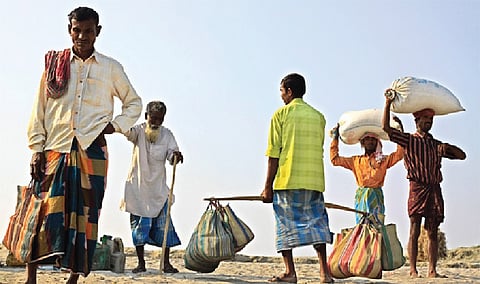
The tragic death of four youths from Assam working in a private company in Bengaluru last week has once again brought to the fore the plight of thousands of young people from the region working and living under alleged unsafe conditions in other states. There was a time when unemployed young people of Assam were shy to go out and work in other parts of the country. But, with drastic improvement of railway connectivity and mobile internet connectivity, large numbers of young people from the region have gone out to work in various kinds of private companies. A 2011 report had estimated that 5.7 lakh young people from Assam were working outside, particularly in Kerala, Karnataka, Tamil Nadu and Delhi. This figure must have definitely increased manifold in the past 15 years. Unfortunately, the overwhelming majority of these people work in private companies and enterprises where service conditions are not satisfactory. Absence of enough employment and livelihood opportunities in the region is one reason behind this massive out-migration. Inter-state migrant workers in India, estimated to number between 60 million and 140 million, are a vital, yet largely “invisible” part of the economy, and they are generally engaged in and contribute significantly to sectors like construction, manufacturing, and services. Extreme precariousness characterises their plight, with many living and working in substandard conditions without the benefit of social security. That the migrant workers from Assam are largely insecure had first come to light when an SMS message containing threats issued by a pro-Bangladeshi group caused large-scale panic in August 2012. Since then, the Government of Assam has made several announcements for formulating a concrete policy to regulate out-migrating workers from the state. But this has unfortunately not turned into reality. A few weeks ago the state government announced it will launch a dedicated portal to register migrant workers from the state employed outside. In the absence of official, accurate, and up-to-date data, thousands of such persons have remained deprived of essential state-provided social protection programmes like food security, healthcare and insurance. Since most of them work in the informal sector, they are often exposed to hazardous environments with low wages, long hours, and no employment contracts. They often reside in overcrowded slums or temporary, on-site shelters, lacking basic amenities. What is required is a national database as well as a state database, alongside effective legal provisions to ensure that all benefits are portable across states. It is also time to conduct an audit of both direct and indirect employment—permanent and contractual—created within the state by various companies that have established factories, in order to determine the percentage of workers who are from within the state compared to those from outside. Moreover, self-employment and livelihood schemes introduced by the state government should also undergo a thorough audit to find out how such schemes have been able to arrest the outflow of young people.
