
- Home
- Live Blog
- Breaking News
- Top Headlines
- Cities
- NE News
- Sentinel Media
- Sports
- Education
- Jobs
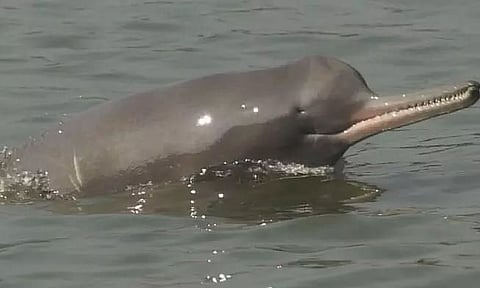
The Ganges River dolphins are a key indicator of the health of the ecosystem of a river that sustains the endangered species, as they play the role akin to the tiger in the forest as the top predator for maintaining the balance of the food chain. Conservation of the endangered species is critical not just to protect the livelihoods of fishing communities and fish traders but also for the conservation of indigenous fish species and other biodiversity of these rivers. The first-ever national estimation of Ganges River dolphins, known as Xihu in Assam, estimated the total population of the species in Assam to be 635, i.e., about 10% of the total population of the species (6324) found in India. Of these, 584 Xihu were found in the Brahmaputra River, and the remaining 51 were found in its four tributaries (Subansiri (22), Kulsi (20), Kopili (5), and Beki (4)). The report of Project Dolphin, which was launched in 2020, puts the estimation of the Xihu population in Assam at 987, and clearly, the current population reflected in the national count shows a sharp decline, which is a cause for grave concern. A previous count carried out in the Kulsi River estimated a residential population of 25 in 2021, which indicates a decline in its population in the tributary of the Brahmaputra. Indiscriminate, illegal mechanised sand mining in the river, destroying the river ecology and affecting the water flow regime, has posed an extinction threat to the mammals. Besides, the construction of bridge pillars on the river has also created an acoustic barrier for the species, which has no eyesight and uses echolocation for navigation and hunting fish and other aquatic prey species. The hard realities of the declining population of Xihu in the Kulsi River are a grim reminder of prioritising conservation efforts along the Brahmaputra River and its tributaries while undertaking infrastructure projects like bridges, hydropower dams, jetties, etc. The decline in the estimated population of the Subansiri River from 29 in 2010 to 22 after the construction of the 2000-MW Lower Subansiri Hydroelectric project, resulting in a drastic change in sedimentation and flow regime in the river, has sounded the alarm bell on the gradual extinction of Xihu without a comprehensive conservation plan to reverse the process. Even though Xihu was declared to be India’s national aquatic animal, a year after Assam declared it to be a state aquatic animal, increasing conservation threats to the endangered species speak volumes about the growing disconnect between such a declaration and ground realities in the state. Ironically, the Ministry of Environment, Forest and Climate Change included Xihu as one of the 22 species for taking up the recovery programme under the Centrally Sponsored Scheme ‘Development of Wildlife Habitats.’. The Project Dolphin outlined two major goals: securing the dolphin populations in their range and controlling factors for dolphin mortality. The objectives of the project included minimising the alteration of the river ecosystem and reducing pollution levels in rivers. A key action plan suggested in the guiding framework of Ganges River dolphin conservation is a joint protection mechanism of the fishery and forest department for reducing the mortality of Xihu from entanglement in fishing nets. It envisages promoting eco-friendly fishing gear to reduce accidental entanglement in fishing nets. The action plan suggested in the project also underscores the need for continual evaluation of the effectiveness of the policies and incorporation of adaptive measures, riverscape scale, and ecosystem-based approaches while developing policies and eco-safety guidelines for all river development projects. As several river development projects in the Brahmaputra have been initiated to increase passenger and goods movement along the national waterway, building awareness among the project developers on the eco-safety guidelines to protect Xihu is critical to translating this action plan into result-orientated intervention and ensuring that these do not remain on paper. Management plans for stretches used by Xihu must be meticulous and vetted by river dolphin experts; it is essential to ensure sustainable use of the river for balancing development priorities with conservation goals. The discharge of untreated industrial effluents directly into rivers is another major threat to river dolphin conservation, and if left unaddressed, it can severely degrade the river ecosystem, making it unsuitable for the species and its prey base in the long run. Sadly, effluent treatment plants continue to be the least priority even when pollution levels in several rivers, including stretches of the Brahmaputra, are at alarming levels. Building awareness among the riverine communities on the conservation of Xihu alone is not going to help achieve the goals, as they cannot exercise direct influence on river development projects or prevent illegal mechanised sand mining, which are among the key factors posing conservation threats to the species. A coordinated approach by the central and state governments is an urgent need of the hour. A multisectoral approach is needed to prevent further decline in the Xihu population in the Brahmaputra and its tributaries and conserve the endangered species.
