
- Home
- Live Blog
- Breaking News
- Top Headlines
- Cities
- NE News
- Sentinel Media
- Sports
- Education
- Jobs
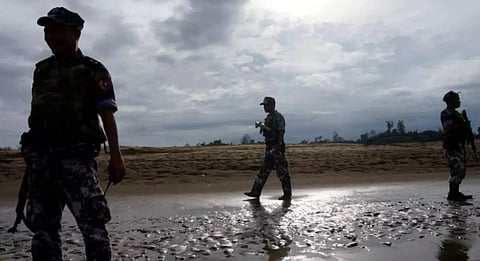
Air strikes by the Myanmar Army on ethnic rebels and fierce fighting close to the India-Myanmar border have led to a fresh influx of Chin refugees from the neighbouring country into Mizoram. The fresh outbreak of clashes close to the Mizoram-Myanmar border has enveloped India’s Kaladan Multimodal Transit Transport project using Sittwe port in Myanmar with a cloud of uncertainty. Restoration of peace in Myanmar is critical to prevent more influxes of refugees into Mizoram and facilitate the early return of about 35,000 Myanmar refugees who have been sheltered in the state since 2020. These refugees fled their country following fierce fighting that ensued between the Myanmar Army and supporters of pro-democracy after the military coup. Relative peace in the intermittent period allowed resumption of construction work on the road component of the Kaladan project from Paletwa in Myanmar to Zorinpui in Mizoram, but fresh turmoil has stoked apprehension of missing new target dates for commissioning. The project is aimed at India, using the Sittwe port in Myanmar to connect northeastern states with the rest of India through an alternative route. This route is in addition to India using Chittagong port in Bangladesh to connect the region through Tripura and using the inland waterways of Bangladesh via the Indo-Bangladesh Protocol route and the Brahmaputra train line connecting Kolkata-Dhaka-Agartala through Akhaura to connect the region with the rest of India through Assam. Apart from significantly reducing travel time and distance between the northeastern region and the rest of India, the alternative routes through Bangladesh and Myanmar are strategically much more important to reduce dependence on the narrow Chicken Neck Corridor for surface connectivity between the northeastern region and the rest of India. Political unrest in Bangladesh ahead of general elections in the neighbouring country has worried traders, investors, and stakeholders in the tourism industry exploring new trade and commerce opportunities using sea ports in Bangladesh, besides inland water and road and railway connectivity using the northeast region as a hub of south and southeast Asia. India remaining vigilant against anti-Indian forces seeking to destabilise peace in the sub-region is crucial to prevent such forces from pouring cold water into its plans to deepen bilateral and multilateral engagements under the Act East Policy and Neighbourhood First policy and make the northeast region the gateway to the sub-region. Reports of Arakan Army columns moving into Chin State of Myanmar into several towns, including Paletwa, have also triggered concern for peace in the areas in Rakhine State and Chin State concerning the Kaladan project remaining fragile for a longer period. Further delay in the Kaladan project will lead to further time and cost escalation. The estimated cost of the project has already escalated from Rs 530 crore in 2010 to Rs 3200 crore in 2022. The project component includes the development of Sittwe port and inland waterways along the River Kaladan (158 km) from Sittwe to Paletwa, which have already been completed. The progress of the road component of the multimodal project from Paletwa to Zorinpui (110 km) has been slow and delayed by internal disturbances in Myanmar, due to which the project is yet to be commissioned, even though Sittwe Port was inaugurated in May. The Union Minister for Ports, Shipping, and Waterways, AYUSH Sarbananda Sonowal, and Deputy Prime Minister and Union Minister for Transport and Communications, Admiral Tin Aung San of Myanmar, jointly inaugurated the port and received the first Indian cargo ship that was flagged off from Kolkata port and traversed the 539 km sea route between Kolkata and Sittwe. India walks a tightrope as far as the internal situation in Myanmar. It is aware of the complexities that any move to budge under international pressure to cede relations with the military regime, even while firmly reiterating its position for the restoration of democracy, would only encourage anti-Indian forces to use it as a springboard to destabilise peace in north-eastern states. Such forces inimical to India’s interests will back rebel groups in the northeast and push drug lords to flood the region with illicit drugs. The swelling of the number of Myanmar refugees taking shelter in Mizoram, therefore, has pressed the alarm bell. The influx of refugees in Mizoram and Manipur, giving rise to a serious internal security threat in the long run, cannot be overlooked and must not be viewed only from the humanitarian perspective of providing food and shelter to refugees. Mizoram shares a 510-km unfenced border with Myanmar, which makes it difficult for Indian security forces to check the influx of Myanmar nationals. External Affairs is solely the domain of the central government, which takes into consideration geopolitics in the neighbourhood and the ramifications of bilateral engagement and disengagement. A new government to be elected in Mizoram acting as per the advice of the central government on issues related to Myanmar refugees will be crucial to preventing any adverse fallout. Restoration of peace and democracy in Myanmar remains critical for the sustainability of India’s cross-border connectivity, which hopes to accelerate development in the northeastern region.