
- Home
- Live Blog
- Breaking News
- Top Headlines
- Cities
- NE News
- Sentinel Media
- Sports
- Education
- Jobs
Mondeep Das
(mondeepmica@gmail.com)
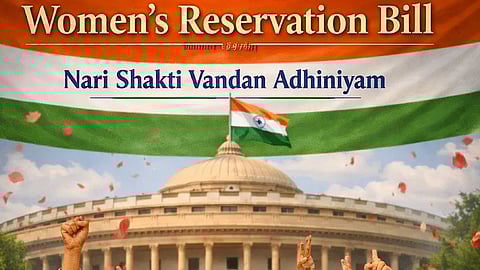
The passage of the Constitution (One Hundred and Sixth Amendment) Act, 2023, popularly known as the Nari Shakti Vandan Adhiniyam, stands as a watershed moment in the history of Indian democracy. By mandating a 33% reservation for women in the Lok Sabha and State Legislative Assemblies, the legislation seeks to correct a historical gender imbalance that has persisted for over seven decades. While the Act has been celebrated as a milestone, it is essential to understand why such a mandate was required, the mechanics of its future implementation, and its non-negotiable role in achieving the vision of Vikshit Bharat.
The Imperative for Reservation: Why now?
For nearly thirty years, the Women’s Reservation Bill remained one of the most debated yet elusive pieces of legislation in Indian parliamentary history. Since its first introduction in 1996, successive governments struggled to find the political consensus required to turn the bill into law. During this long interval, the representation of women in India’s highest law-making bodies remained stagnantly low.
Even in the current 17th Lok Sabha, women constitute only about 15% of the total membership. This figure is significantly lower than the global average and pales in comparison to countries like Rwanda or several Nordic nations where women comprise nearly half of the legislature. The persistent lack of “political will” and “consensus” meant that without a legal mandate, the natural progression of women into leadership roles was being hindered by deep-seated patriarchal structures and entry barriers.
The road to implementation:
The delimitation link
One of the most frequently discussed aspects of the 2023 Act is its implementation timeline. Unlike ordinary laws that take effect immediately, the Nari Shakti Vandan Adhiniyam is tied to two critical constitutional processes: the census and delimitation.
The Act specifies that the reservation will come into effect after a new census is published following the bill’s enactment. Based on these census figures, a delimitation exercise—the process of redrawing the boundaries of parliamentary and assembly constituencies—will be undertaken to identify which specific seats will be reserved for women. This linkage ensures that the reservation is based on the most current demographic data, providing a fair and transparent method for seat allocation. While this process means the 33% quota may only be fully realised by the 2029 general elections, the legal foundation is now permanent and irreversible, providing a clear roadmap for the decade to come.
Women in Administration: A Pillar for Vikshit Bharat
The government’s vision of Vikshit Bharat @2047 (Developed India by 2047) is built on four pillars: the youth, the poor, the farmers, and women (Mahila). A nation can’t be “developed” if half its population is under-represented in decision-making. Women in political administration do not just represent a demographic; they bring a unique, empathetic, and ground-level perspective to governance.
1. Advancing Maternity and Healthcare
Studies have consistently shown that when women hold political power, there is a marked increase in the priority placed on maternal and child health. Female legislators are more likely to advocate for the following:
n Maternity Benefits: Expanding paid leave and nutritional support for expectant mothers.
n Healthcare Infrastructure: Investing in Primary Health Centres (PHCs) and ensuring the availability of skilled birth attendants.
n Sanitation: Prioritizing clean water and hygiene, which directly impacts maternal mortality rates.
Reducing the maternal mortality ratio (MMR) and improving the nutritional index are as vital as increasing the GDP on the journey toward a developed nation. Women leaders are uniquely positioned to turn these social indicators into political priorities.
2. Strengthening Women’s Safety and Security
Safety is a prerequisite for economic participation. A “Vikshit Bharat” requires women to feel secure in public spaces, workplaces, and homes. Political empowerment allows women to influence the legal and judicial framework surrounding gender-based violence.
n Police reforms: Pushing for more women in the police force and the establishment of “all-women police stations.”
n Urban Planning: Designing “Safe Cities” with better lighting, surveillance, and public transport tailored to the needs of female commuters.
n Stricter Enforcement: Ensuring that laws regarding women’s safety are not just on paper but are enforced with sensitivity and speed.
3. Economic Contribution and Inclusive Growth
The “feminisation” of politics often leads to the “feminisation” of the economy. Women leaders tend to focus on skill development for girls, supporting self-help groups (SHGs), and ensuring equal pay. By removing the barriers to women’s entry into the workforce, female administrators directly accelerate India’s transition into a $30-trillion economy.
Navigating the Political Landscape
The passage of Nari Shakti Vandan Adhiniyam was a rare moment of near unanimity in the Indian Parliament, signalling a shift in the national consciousness. However, the path was not entirely without friction; for instance, the Opposition INDI Alliance did not vote for the bill, raising concerns regarding the immediate implementation and the inclusion of specific sub-quotas.
Despite these differences, the enactment of the law signifies that the “tokenism” of the past is being replaced by “systemic empowerment”. The reservation is not a gift or a charity; it is a recognition of the agency of Indian women.
Conclusion: From Representation to Leadership
The Nari Shakti Vandan Adhiniyam is more than a seat-sharing arrangement; it is an invitation for women to become the architects of modern India. By ensuring that one-third of the Parliament will soon consist of women, India is ensuring that its laws will be more inclusive, its safety protocols more robust, and its social welfare schemes more empathetic.
As we move toward 2047, the presence of women in the highest offices of political administration will ensure that the growth of the nation is not just fast but also fair. The “Vandana” (salutation) to Nari Shakti is, in reality, a commitment to a stronger, safer, and more prosperous India for all.
"When women prosper, the world prospers. Their economic empowerment fuels growth, and their political participation ensures stability.”
