
- Home
- Live Blog
- Breaking News
- Top Headlines
- Cities
- NE News
- Sentinel Media
- Sports
- Education
- Jobs
Lalit Garg
(The writer can be reached at lalitgarg11@gmail.com)
Policy-making, national security, and parliamentary discourse are the backbone of any democracy. Parliament is not merely an arena for confrontation between the ruling party and the opposition; it is the highest forum for national unity, collective wisdom, and responsible expression. Therefore, when discussions are underway on a constitutional and dignified occasion such as the President’s Address, it is only natural to expect every leader to exercise extra caution with words, references, and timing.
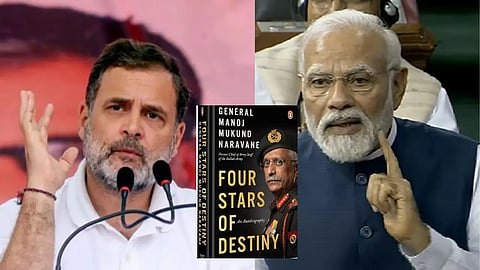
In the recent episode, the statement made in the Lok Sabha by the Leader of the Opposition, Rahul Gandhi—citing certain excerpts from the unpublished book of former Army Chief General M. M. Naravane to allege Chinese incursions—raised serious questions about this expectation. The government alleged that the statement attempted to mislead the House, while the opposition countered by accusing the government of suppressing the truth. The outcome was predictable: parliamentary proceedings were disrupted, sharp exchanges led to the adjournment of the entire day’s session, and the focus of national discourse shifted from substantive issues to mutual accusations and counter-accusations.
This is not merely about a single statement; it is about political maturity, responsibility, and an understanding of national interest. Matters related to national security demand exceptional sensitivity in public statements. Border-related facts, military deployments, and strategic assessments are areas where partial contexts or selective quotations can create unnecessary confusion. This is precisely why Defence Minister Rajnath Singh and Home Minister Amit Shah described the episode as a violation of parliamentary norms and a reckless gamble with national security. When a leader continues to stand by a statement, even after the Speaker’s ruling, it prompts a fundamental question: was the intention to uncover the truth or to gain political advantage?
Holding the government accountable is the opposition’s duty—it is the lifeblood of democracy. Yet the language of questioning, the forum, and the timing are all bound by democratic propriety. The discussion on the President’s Address is meant for a comprehensive debate on the government’s policies, achievements, and future direction. Turning selective excerpts from military memoirs into political weapons during such a discussion, without due context or institutional process, is bound to generate controversy. The opposition’s claim that the government seeks to suppress uncomfortable questions is a familiar and often hollow political refrain; equally weighty is the government’s argument that politicising national security is inappropriate. Balance between the two is possible only where facts, procedure, and timing are respected.
Controversy over referencing an unpublished “memoir” within Parliament is hardly surprising. Parliamentary traditions and established rules do not permit members to cite material from any published or unpublished book, article, or journal as evidence unless it has been formally laid on the Table of the House. Especially in the case of excerpts from books or articles that have neither undergone parliamentary verification nor been officially recorded with the House’s consent, treating them as factual proof violates parliamentary decorum. From this perspective, Rahul Gandhi’s direct citation of excerpts from an unpublished book and presentation of them as definitive truths on matters of policy and national importance amounts not only to a breach of parliamentary rules but also undermines the dignity and credibility of the House.
Rahul Gandhi is not merely a Congress leader; he is the Leader of the Opposition in the Lok Sabha. At the very least, on matters of national security, he is expected to stand with the narrative of India’s armed forces. Unfortunately, he often does not. He seeks to corner the Modi government on China and Pakistan, yet overlooks the fact that incursions into Indian territory by these two countries occurred when the Congress was in power. In the case of the bloody clash with the Chinese army in Galwan, it was inevitable that his reference to alleged excerpts from the then Army Chief’s unpublished book would provoke an uproar. After all, how can one cite a book that has not even been published? Rahul Gandhi’s charge that the Modi government failed to show resolve in the face of Chinese aggression is baseless and misleading. This is not the first time he has attempted to portray Prime Minister Modi as hesitant to confront China. To project the government as weak, he has repeatedly claimed that China has occupied Indian territory. He has even gone so far as to say that Chinese soldiers beat Indian troops—remarks for which he was reprimanded by the Supreme Court. Yet he seems to believe that national security should be politicised on the basis of superficial allegations. The truth, widely acknowledged, is that in Galwan the Chinese army received a strong response, which compelled it to come to the negotiating table and helped restore the status quo in several areas of Ladakh.
The Congress party, too, must engage in serious introspection. Once a party that provided leadership to the nation, it now appears repeatedly entangled in controversies where rhetoric overshadows substance. Rahul Gandhi is an effective speaker, capable of touching public sentiment and engaging with the youth. Precisely for this reason, greater responsibility is expected of him. Persistently raising issues that the ruling party portrays as harmful to national unity only reinforces the image of the Congress as an irresponsible opposition. Whether this perception is entirely fair or not, in politics, opinion can be as powerful as fact.
A comparative look at mature democracies shows that debates on national security are often conducted through specialised parliamentary committees, closed-door sessions, and institutional processes. Public statements by leaders are usually confined to broad signals and policy questions, avoiding detailed military disclosures. India, too, must cultivate such a tradition—one where the opposition demands accountability from the government without turning the credibility of the armed forces and security institutions into an arena for political combat. This balance is what strengthens democracy. Yet Rahul Gandhi has, on previous occasions as well, not only endangered security through his military-related statements but also hurt the morale of our soldiers.
At the same time, it is equally true that the government should not fear transparency. If the opposition cites a book, report, or statement, it deserves an institutional and fact-based response. Ending debate merely by invoking rule violations is not a healthy democratic practice. Complete silence in the name of national security is also contrary to democratic accountability. Both sides must recognize their respective limits. Ultimately, the question is also one of Rahul Gandhi’s maturity. Maturity does not mean silence; it means understanding which question should be raised, when, where, and how. A national leader is expected to act with strategic wisdom rather than emotional impulse. Similarly, it is the collective responsibility of the opposition to make Parliament a forum for effective debate rather than repeated disruptions. The adjournment of Parliament is no one’s victory; it is a defeat for democracy.
This entire episode once again underscores how powerful words are in a diverse and sensitive democracy like India. National unity is safeguarded not only by protecting borders but also by practising responsible politics. The Congress must reflect on whether short-term political gains are more important than long-term credibility. Rahul Gandhi must introspect whether leadership is built merely by raising questions or also by exercising restraint and timely judgement. And the government must remember that a strong nation is strengthened not by avoiding questions, but by answering them. Only if this balance is achieved will every session of Parliament truly serve the national interest.
