
- Home
- Live Blog
- Breaking News
- Top Headlines
- Cities
- NE News
- Sentinel Media
- Sports
- Education
- Jobs
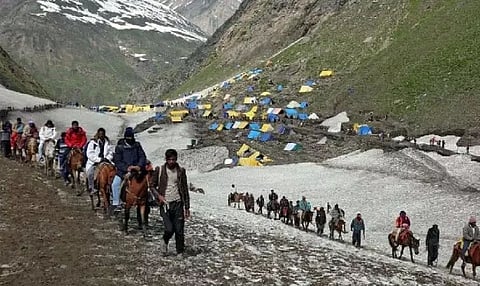
Friday's cloudburst which left 15 to 18 persons dead near the Amarnath shrine in Kashmir is yet another example of increasing fury of nature. Thanks to indiscriminate destruction of nature – forests in particular – the number of such calamities is on the increase. The Amarnath cloudburst, which occurred in broad daylight, was followed by heavy rain, prompting thick streams of sludge to roll down the mountain slopes, bringing down the pilgrimage tracks as well as camp sites. The North-eastern region too has been experiencing some of the worst natural calamities in the past few weeks. While the Dima Hasao hill district is yet to recover from the trail of destruction caused by heavy rains which lasted for about 14 hours non-stop, the landslide tragedy at Tupul in Manipur has left close to 50 dead and missing. There have been similar incidents of landslides caused by heavy rains in Arunachal Pradesh and Meghalaya too in the past couple of weeks. In the Assam plains – be it the Brahmaputra Valley or the Barak Valley – thousands of people have lost their homes to floods in the past few weeks. Even as the governments are groping in the dark to identify the causes of these incidents of natural calamity, any lay person with minimum common sense will say that indiscriminate destruction of hills and forests has been the primary reason behind the recent incidents of floods and landslides. Official reports claim that there has been a marginal increase in the country's total forest and tree cover in the past decade or so. But then, it is also a fact that the North-eastern region has lost 79 per cent of its tree cover in 2020, recording the biggest dip in the entire country. According to data released by University of Maryland, over 1,10,000 hectares of tree cover had vanished from the North-eastern region during 2020. The report has also said that the seven sister states of Assam, Arunachal Pradesh, Tripura, Meghalaya, Manipur, Mizoram and Nagaland individually were responsible for 5 to 14 percent of the country's loss in forest area between 2001 and 2020. Assam alone contributed the most (14.1 percent) to the national tree cover loss during the period. During 2021, forest cover in the North-eastern region had reduced by 1,020 sq km in comparison to the previous year. Arunachal Pradesh lost 257 sq km of forest cover in 2021, with the impact falling not only on the mountain state, but also on Assam, especially because most of Assam's rivers, including the Brahmaputra, flow down from there. According to government estimates placed in the Rajya Sabha, Arunachal Pradesh is followed by Manipur which lost 249 sq km of forest area and Nagaland which lost 235 sq km forest cover during 2021. There is thus no doubt that it is such massive forest cover loss which is responsible for nature's fury in the region.