
- Home
- Live Blog
- Breaking News
- Top Headlines
- Cities
- NE News
- Sentinel Media
- Sports
- Education
- Jobs
Pallab Bhattacharyya
(pallab1959@hotmail.com)
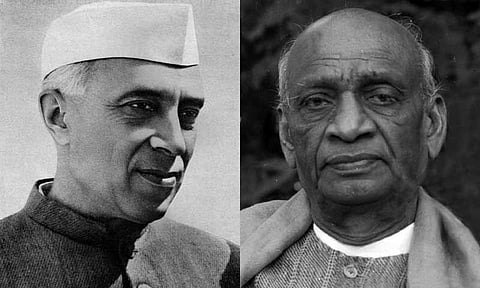
When Jawaharlal Nehru passed away on 27 May 1964, India lost not merely its first prime minister but also the principal architect of its early political imagination. More than six decades later, the debate around his legacy has intensified rather than diminished. In contemporary India, especially under the present political dispensation, Nehru is often criticised for what are described as strategic blunders, excessive idealism, economic over-centralisation and misplaced faith in international diplomacy. Simultaneously, Sardar Vallabhbhai Patel has been elevated as the embodiment of realism, nationalism and administrative firmness. Statues, speeches and political narratives increasingly portray Patel as the leader India "should have chosen" after independence. Yet history is rarely so simple. Nations are not built by single personalities alone, and modern India emerged through the combined strengths, contradictions and compromises of both men.
To examine Nehru and Patel honestly is to understand that they were neither saints nor villains. They were products of their age, shaped by colonialism, Partition, communal violence, global ideological conflicts and the urgent challenge of nation-building after 1947. Their differences were real, often sharp, but their partnership was equally indispensable. If Nehru imagined India's future, Patel ensured India survived long enough to reach it.
The contrast between the two leaders began with their backgrounds and temperaments. Nehru, educated at the University of Cambridge and influenced by Fabian socialism and Enlightenment liberalism, saw India as a civilisation that had to modernise rapidly through science, industry and secular democracy. He believed poverty, superstition and social inequality could only be overcome through a strong developmental state. Patel, in contrast, emerged from the practical realities of rural Gujarat. Though equally trained in law in England, his politics was grounded less in intellectual theory and more in administrative realism. He trusted discipline, order and gradual transformation. Where Nehru spoke the language of dreams and ideals, Patel spoke the language of execution and authority.
These differences were visible even before independence. As chairman of the Allahabad Municipality, Nehru often appeared impatient with routine governance, preferring larger ideological battles. Patel's tenure in Ahmedabad Municipal Council, however, demonstrated meticulous attention to civic administration, sanitation and infrastructure. These early experiences foreshadowed their later roles in independent India. Nehru became the visionary who sought emotional and ideological integration of the country, while Patel became the organiser who ensured territorial and administrative integration.
Patel's greatest contribution undoubtedly lay in the integration of more than 560 princely states into the Indian Union. At independence, India faced the terrifying possibility of fragmentation. Many princely rulers wished to remain independent, while some considered joining Pakistan. Patel, assisted by V. P. Menon, used persuasion, negotiation and occasionally force to unify the country. Junagadh, Hyderabad and Kashmir became defining tests of his resolve. In Hyderabad, Patel authorised military action through Operation Polo when negotiations with the Nizam failed. In Junagadh, he responded firmly against accession to Pakistan despite a Hindu-majority population. His methods were unsentimental but effective. Without Patel's determination, India may well have resembled a fractured subcontinent vulnerable to endless internal conflicts.
Yet the tendency to contrast Patel's realism with Nehru's idealism often ignores the reality that both leaders frequently worked in tandem. Even in Kashmir, now endlessly cited as Nehru's greatest failure, the decisions were collective rather than individual. Nehru's emotional connection to Kashmir certainly influenced policy, and his decision to approach the United Nations remains controversial. Critics argue that the Indian Army should have been allowed to recover the entire territory before a ceasefire. However, the decision emerged from fears of wider war, communal instability and international pressure during an extremely fragile period. Patel himself had initially prioritised Hyderabad over Kashmir, considering the former more essential for India's internal cohesion. Historical reality therefore resists simplistic claims that one leader alone was responsible for success or failure.
If Patel consolidated India territorially, Nehru attempted to shape its intellectual and institutional foundations. He established institutions that continue to define modern India: the Indian Institutes of Technology, All India Institute of Medical Sciences, scientific laboratories, atomic energy programmes and the Planning Commission. He regarded dams, factories and research institutions as the "temples of modern India". His commitment to parliamentary democracy was equally remarkable. At a time when many postcolonial nations descended into dictatorship, military coups or one-party rule, India under Nehru retained elections, judicial independence and a free press.
This achievement is often underestimated because democracy today appears natural in India. In 1947, however, few international observers believed a poor, deeply divided and largely illiterate country could sustain democratic governance. Nehru insisted not merely on elections but on constitutional morality and secular citizenship. His vision of India rejected the idea that religion should determine nationhood. After the trauma of Partition, this was not a minor philosophical choice but a foundational civilizational commitment.
At the same time, Nehru's weaknesses were substantial and cannot be ignored. His faith in China and the "Hindi-Chini Bhai-Bhai" sentiment contributed to India's humiliation in the Sino-Indian War. Warnings from Patel and others regarding Chinese intentions after Tibet's annexation were not adequately heeded. The defeat of 1962 shattered India's confidence and deeply damaged Nehru's prestige. Similarly, his economic policies created a heavily centralised state apparatus that later evolved into the notorious Licence Raj. While his socialist model sought equitable development, excessive bureaucracy and state control stifled entrepreneurship and slowed economic growth for decades.
Patel too had limitations. His critics viewed him as overly conservative and insufficiently sensitive toward minority anxieties during Partition. Leaders like Maulana Abul Kalam Azad sometimes feared that Patel's realism bordered on communal majoritarianism, though there is little evidence that Patel himself embraced sectarian politics. He was also less interested in international diplomacy and broader ideological questions. His instinctive preference for order occasionally made him suspicious of mass mobilisation and radical social reform.
The debate over the two leaders has acquired renewed intensity in recent years because historical memory itself has become politically contested. The rise of the Bharatiya Janata Party has encouraged a reinterpretation of Indian history in which Patel symbolises muscular nationalism while Nehru represents weak secularism and elite detachment. The construction of the Statue of Unity has become both a tribute to Patel and a political statement about alternative visions of India. Conversely, many defenders of Nehru argue that contemporary criticism ignores the impossible circumstances he inherited: Partition, refugee crises, food shortages, communal riots and the pressures of the Cold War.
Much of today's polarisation also stems from frustration with the long dominance of the Nehru-Gandhi family within the Indian National Congress. Over time, criticism of dynastic politics gradually merged with criticism of Nehru himself. In reaction, Patel emerged as a counter-symbol. Yet reducing Patel into merely an anti-Nehru figure distorts history. Patel remained loyal to the Congress and respected Nehru's leadership despite disagreements. After Mahatma Gandhi was assassinated in 1948, both leaders consciously subordinated personal tensions to national stability. Patel even banned the Rashtriya Swayamsevak Sangh after Gandhi's assassination, demonstrating that his nationalism differed significantly from later ideological appropriations.
The truth is that India required both temperaments. Nehru alone may have produced a visionary but unstable republic lacking administrative cohesion. Patel alone may have produced a disciplined state without the expansive democratic imagination that allowed India's diversity to survive. Their relationship functioned as a balance between aspiration and restraint, between future-orientated transformation and immediate survival.
Historical judgements must therefore account for context rather than contemporary political convenience. Leaders are shaped by the crises they confront, and neither Nehru nor Patel governed under conditions of peace or certainty. The generation that inherited independence was burdened with responsibilities unprecedented in modern history: integrating territories, rehabilitating millions displaced by Partition, drafting a Constitution, building institutions, preventing famine and defining India's global identity amid Cold War rivalries.
Nehru's idealism often appears naïve today because later decades revealed the limitations of his assumptions. Yet idealism also gave India democratic legitimacy, scientific ambition and moral standing in the postcolonial world. Patel's realism appears attractive because he understood power, security and statecraft with remarkable clarity. Yet realism without broader social imagination can harden into mere authority. India survived because both tendencies coexisted.
The current tendency to glorify one while condemning the other ultimately impoverishes public understanding. Nations are rarely built by perfect individuals. They are built by flawed human beings responding imperfectly to extraordinary challenges. Nehru and Patel were not adversaries struggling for ownership of India; they were collaborators who carried different parts of the same burden. One built the framework of the Indian mind; the other secured the framework of the Indian state.
Remembering Nehru today should therefore not mean denying his mistakes, just as honouring Patel should not require diminishing Nehru. Mature democracies do not fear complexity in their founding figures. They recognise that history is strengthened, not weakened, by nuance. India's survival as a democratic and united republic owes as much to Nehru's imagination as to Patel's iron resolve. To separate them entirely is to misunderstand both men and the difficult birth of the nation they helped create.
