
- Home
- Live Blog
- Breaking News
- Top Headlines
- Cities
- NE News
- Sentinel Media
- Sports
- Education
- Jobs
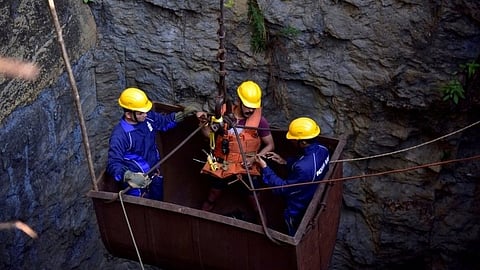
The coal mine explosion in the East Jaintia Hills district in Meghalaya, leaving 25 miners dead, laid bare the grim reality-illegal and hazardous rat-hole mining continuing unchecked. The police and administration looking the other way, allowing the coal mafias to run their writ with impunity even after judicial intervention, is deeply worrying. The arrest of two mine owners follows a directive issued by the High Court of Meghalaya to the Deputy Commissioner, Superintendent of Police, East Jaintia Hills, to take immediate action to identify and arrest the mine owners and operators and to seize all incriminating materials. The Division Bench of the High Court of Justice H. S. Thangkhiew and Justice W. Diengdoh voiced concern as to how illegal coal mining is continuing in this area in spite of the reported loss of life of one person in an incident that occurred on January 14, which also spoke volumes about the persistent violation of the ban imposed by the National Green Tribunal on illegal coal mining. The Meghalaya government has ordered a comprehensive inquiry into the incident. Chief Minister Conrad Sangma's announcement that accountability will be fixed, those responsible will face strict legal action, and there will be no compromise when it comes to the safety of lives will require strengthening of surveillance and enforcement against illegal mining. Ironically, there are standing orders for the deputation of executive magistrates police station-wise, who are to coordinate with respective officers-in-charge and officials of the mining department to conduct surprise checks/inspections on vulnerable pockets to detect any instance of illegal mining activity. The state government is also learnt to have issued directions for the submission of monthly reports to undertake Drone-based monitoring in hard and inaccessible areas and holding monthly review meetings with all the officials concerned for gathering actionable inputs from the ground and coordinating with local headmen for the detection of illegal mining. Recurrence of coal mine tragedy and illegal mining continuing unchecked in the state demands that the government put in place a strong oversight mechanism for ensuring compliance with the directions and taking prompt and strict action whenever any instance of non-compliance is detected. The Division Bench of the High Court observed, in its order passed on Thursday, that the Thirty-Fifth Interim Report filed by the Justice B.P. Katakey Committee on January 17 flagged the issue that East Jaintia Hills is the most affected district in the State of Meghalaya in terms of coal mining activities, which have been held to be illegal by the National Green Tribunal (NGT) and by the Supreme Court, as well as the large-scale continuance of illegal mining activities, which has been reported from time to time in the district. The findings of the Katakey Committee are reflective of administrative laxity in the district, which needs to be addressed urgently to prevent further loss of lives. Chief Minister Sangma inaugurated the state's first scientific mining in East Jaintia Hills on March 17 last year, and the government hoped that many more mine owners would come forward to apply and adopt scientific mining to replace the hazardous rat-hole mining. After more than 11 years of a ban on coal mining imposed by the NGT in 2014 due to an environmental disaster caused by indiscriminate rat-hole mining, so far four licenses for scientific coal mining have been issued in the state, and about 15/16 applications are reportedly pending with the central government for approval. More mine owners coming forward for scientific mining is a positive development, but there is little room for complacency with coal mine tragedy recurring in rat-hole mines being operated illegally. This calls for building awareness among traditional small-scale private mine owners on the importance of transitioning to scientific coal mining in the state for sustainable mining operations to make it less hazardous. Persistence of hazardous coal mining in defiance of the blanket ban on rat-hole mining has also fueled a cheap labor market, where workers have neither safety over their lives nor any form of economic security due to the illegal status of mining activities. While coal mining has economic importance, Meghalaya cannot overlook the adverse impact of indiscriminate mining on its fragile environment and rich biodiversity. Scientific mining can ensure that the mining plan is subjected to environmental protection and safety norms that illegal mines bypass. Mine closure is another crucial aspect of scientific coal mining, and "Guidelines for Preparation of Mining Plan and Mine Closure Plan for Coal and Lignite Mines, 2025," issued by the Coal Ministry, seek to ensure scientific mine closure and rehabilitation of mining sites, minimizing environmental degradation, safeguarding public health, and promoting sustainable development by restoring the land to a condition suitable for future use of land or returning it to a near-natural state. Meghalaya prioritizing scientific coal mining is not just about curbing rat-hole mining; it is also crucial for generating revenue through sustainable and legally compliant mining.
