
- Home
- Live Blog
- Breaking News
- Top Headlines
- Cities
- NE News
- Sentinel Media
- Sports
- Education
- Jobs
Himangshu Ranjan Bhuyan
(himangshur1989@gmail.com)
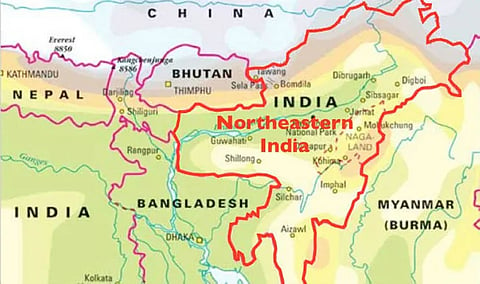
Northeast India occupies a singular place in the Indian Union. It is a region of extraordinary ethnic diversity, linguistic richness, ecological abundance, and cultural resilience, yet it continues to exist on the margins of the country's collective imagination. This paradox has persisted despite decades of political integration and constitutional equality. The challenge confronting the Northeast today is not simply one of geography or infrastructure; it is fundamentally a question of emotional belonging. Far too many people from the region continue to encounter situations that make them feel like outsiders within their nation. Such experiences expose an uncomfortable reality: legal integration does not automatically produce emotional integration. National unity cannot be sustained merely through maps, institutions, or political rhetoric. It must be reinforced through mutual respect, historical recognition, and social acceptance. Unfortunately, these foundations remain uneven. School curricula continue to devote disproportionate attention to certain chapters of Indian history while overlooking the remarkable contributions of Northeast India. The achievements of the Ahom Kingdom, the sacrifices of indigenous communities, and the region's role in shaping India's civilizational diversity receive comparatively limited attention. This educational imbalance has lasting consequences. Generations grow up without understanding the region beyond superficial stereotypes, creating an intellectual vacuum that encourages ignorance rather than curiosity. The result is a national consciousness in which the Northeast often appears distant despite being an inseparable part of the Republic. This disconnect is reinforced by limited interaction between communities and by persistent misconceptions that portray the region either as a remote tourist destination or as a landscape defined primarily by conflict. Such narratives diminish the complexity of a society that has long contributed to India's democratic, cultural, and strategic strength. Unless India begins to acknowledge Northeast India not as a peripheral frontier but as an equal partner in the national story, the promise of genuine unity will remain incomplete.
The consequences of this disconnect become increasingly visible in politics, public discourse, and everyday social life. Although India's democracy guarantees equal citizenship, political influence frequently follows demographic weight. The relatively smaller populations of the northeastern states inevitably limit their influence in national decision-making, leaving many regional concerns overshadowed by the priorities of larger states. Too often, issues affecting the Northeast receive national attention only during elections, security crises, or natural disasters. Equally troubling is the manner in which national media frequently frames the region. News coverage overwhelmingly emphasizes insurgency, border tensions, ethnic violence, or floods, while achievements in education, literature, entrepreneurship, sports, science, and the arts rarely command similar visibility. Such selective representation shapes public perception, encouraging millions of Indians to associate the Northeast primarily with instability rather than innovation. This distorted understanding often translates into discrimination experienced by students and professionals who migrate to metropolitan cities for education and employment. Many, many people face racial slurs, insensitive remarks, and repeated questions about their Indian identity. Many people face racial slurs, insensitive remarks, and repeated questions about whether they are "really Indian". Their appearance, language, and food habits become grounds for exclusion despite the constitutional guarantee of equality. These experiences are not isolated incidents; they reflect deeper structural prejudices born of unfamiliarity. Economic challenges further compound this sense of alienation. Despite possessing abundant natural resources, immense biodiversity, and enormous tourism potential, the region continues to struggle with inadequate infrastructure, limited industrial investment, and insufficient connectivity. Talented young people frequently leave their home states in search of better opportunities, only to encounter prejudice elsewhere. Such circumstances inevitably weaken emotional attachment to institutions that appear indifferent to their aspirations. National integration cannot flourish when opportunity remains uneven and dignity uncertain.
Yet the future need not be defined by alienation. Northeast India should never be viewed merely through the narrow lenses of security, electoral arithmetic, or developmental imbalance. It represents one of India's greatest reservoirs of cultural diversity, ecological wealth, and democratic resilience. The responsibility for closing the emotional distance separating the region from the national mainstream belongs not only to governments but also to educational institutions, media organizations, civil society, and ordinary citizens. School curricula must present a fuller account of Indian history that genuinely reflects the contributions of the Northeast. National media must move beyond episodic crisis reporting and consistently highlight stories of innovation, creativity, and achievement emerging from the region. Cultural exchanges, academic partnerships, tourism, and sustained people-to-people interaction can gradually dismantle stereotypes that have survived for generations. Equally important is the need to reject every form of racial discrimination and regional prejudice wherever it appears. Every Indian, irrespective of appearance, language, ethnicity, or place of birth, deserves equal dignity and unquestioned belonging. India's constitutional vision is not fulfilled simply by preserving territorial integrity; it is realised when every citizen feels equally respected in every corner of the nation. Northeast India does not seek sympathy, exceptional treatment, or symbolic recognition. It seeks what every citizen deserves-respect, representation, opportunity, and acceptance. The measure of India's democratic maturity will ultimately depend on whether these aspirations are met. Ultimately, the fulfilment of these aspirations will determine the measure of India's democratic maturity. A truly united India will emerge not when the Northeast is merely included on the political map, but when it occupies its rightful place in the minds and hearts of every Indian, transforming national unity from an ideal into a lived reality.
