
- Home
- Live Blog
- Breaking News
- Top Headlines
- Cities
- NE News
- Sentinel Media
- Sports
- Education
- Jobs
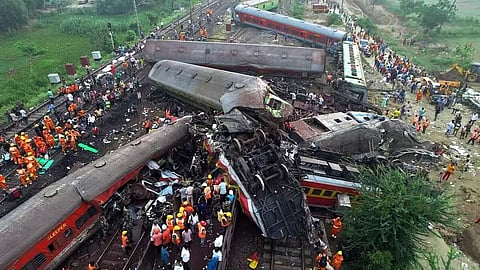
No words are adequate to express the horror of the Balasore train disaster, which claimed the lives of nearly 300 people and leaving many more injured. Many families have been orphaned, and it will take years for the survivors to come out of their trauma. Most victims are migrant workers, making it tough to identify them.
“Rail passenger safety” is in force, yet again. Although trains have resumed on the track, sadly many derailed families are not completely on track.
Questions galore
Trains more or less crash the same way they did 100 years ago – albeit less often. Trains still derail, usually because of equipment failure, and trains still collide, often due to human error. It puzzles that an indifferent signal maintainer, or for that matter ‘a criminal’ can tamper with the system and cause a wreck of this magnitude.
The tragedy has not just shocked the whole nation, but has thrown many posers about “safety”. The multi-train collision is a grisly reminder that the passenger safety is primary when it comes to infrastructure modernization.
Was it a mess-up on the electronic signalling and not a human error? If it was a technological glitch, electronic engineering experts need to pitch in. How would you penalise faceless technology? Can machines do no wrong? How would you have emergency plans in place?
Has the implementation of contemporary signalling and train anti-collision systems kept pace with the expansion of railway traffic? Is the Railway Minister burdened with multiple portfolios?
Don’t be complacent.
Passengers on the early railways took their lives in their hands every time they got on board a train. It was so dangerous that they could buy an insurance policy with their ticket.
Though the number of derailments and serious train accidents has dropped in recent decades, is spending falling for safety measures, including for older trains and track maintenance? An earlier white paper by the Ministry of Railways reportedly says that 4,500 km of track should be renewed annually. Can the officials confirm the compliance status? When the Prime Minister said that those found guilty would not be spared, did he hint at sabotage?
Though TV channels widely debated, not many panellists explained how the railways can work to ensure that such tragedies will not recur.
As per the National Crime Records Bureau, an average of 23,000 people died every year between 2010 and 2021 in railway accidents. It may appear consoling when likened to road mishaps. A Ministry of Road Transport and Highways report in 2021 put the number of road accidents that year at 412,342, claiming about 154,000 lives while causing injuries to more than double that number.
Caution ignored?
An accident of this nature had been forewarned in February this year when a collision was fortuitously averted in the Mysore division. Did the authorities address the flaw? Has the railway bureaucracy possibly ignored the recommendations of earlier committees that were set up to look into the issue of safety?
Collisions are usually caused by human operations missing a signal to stop. Hardly 5 percent of all accidents are collisions, but they account for 80 percent of fatalities.
Beyond the digital infrastructure, you need to provide the emergency teams that will deal with the glitches. An exhaustive probe should unravel how the lapse escaped both human and electronic detection.
Indian Railways should consult Japan, which has been operating bullet trains without any major accidents. Trains in many western countries are equipped with advanced signalling systems that automatically apply brakes to prevent possible collisions. While skilling the personnel, also include those working on a contractual basis.
Safety over showpiece
The drive to modernise as a sign of development needs to be tempered with caution. A reality check is due. A passenger survey would showcase that people want train travel to be safe, comfortable, and punctual, rather than railway stations having the look of airport lounges. Insist on accountability at all levels.
Former Prime Minister Lal Bahadur Sastri’s resignation as Railway Minister in 1956 after assuming moral ownership over the rail accident in Ariyalaurin, Tamil Nadu, is public knowledge. Well, the past is history, and the present is politics.
The tragedy of our country is our weak memories. For instance, the disaster knocked off the news related to the sexual harassment of women wrestlers. Alas, the lapses are forgotten till the next mishap, thanks to the TRP-oriented stories.
An old saying goes, “If safety is expensive, try having an accident” Rail safety is paramount in a country where about 1.3 million people travel daily on about 20,000 trains. The fourth-largest railway network, which covers a stupefying 65,000 km and carries over 1400 metric tonnes of freight annually, expressly warrants a fundamental bottom-up upgrade. No second opinion is required.
Good samaritan
Soon as the news flashed, the locals in and around Balasore instantly reached out to the victims, and many volunteered to donate blood to save lives. The selfless acts of humanitarianism are truly inspiring. They’re the real heroes, not the ones seen on silver screens. The Odisha government’s manner of handling the rescue and relief work was commendable. It was also the right decision to preserve the unclaimed bodies.
Interestingly, in 1865, in one carriage of a train that crashed at Staplehurst (England), was a very famous passenger, Charles Dickens, who, ignoring his own safety, went to the aid of several severely injured and dying passengers. Not many people realise how close the country came to losing one of its most famous authors and never knowing the works he penned after the crash. Lastly, the casual attitude cannot be condoned in this era. Devise a safer system without awaiting any inquiry reports. Speed and sophistication should supplement, not supplant, safety.