
- Home
- Live Blog
- Breaking News
- Top Headlines
- Cities
- NE News
- Sentinel Media
- Sports
- Education
- Jobs
ANCESTOR WORSHIP
Dr. B. K. Gohain
(The writer can be reached at dr.gohain@gmail.com)
PART-I
The concept of ancestors’ worship is very vibrant amongst the Tai Ahoms. The ancestor worship in the household of an Ahom family, which practices the traditional Ahom religion, is called dam-puja (dam-phi or ancient worship) of the household. It is observed that the ritual of Dam Phi (ancestor-worship) in the household has a connection with the wet-paddy cultivation as the Tais are rice-eaters and they choose their habitat in places where rice grows. Rice being the staple food is important in life; so is the worship of their ancestors as they have the firm belief that their ancestors protect them in every walk of life.
The kitchen which is located in the main room of the principal house of the Ahoms which is usually situated in the north is the place where the Ahom family practising the traditional religion sets up the post for the worship of the Dam (spirits of the ancestors). This post is called Dam - Khuta (the post for spirits of the ancestors) or Pho’ kam post. It is fixed up in the west by the Mohans while the Deodhai - Bailung set it up in the east. It is said that since one of Mohans’ ancestors was a descendant of Moon God (Khun Tun) and one of the Deodhai’s ancestors was a descendant of the Sun God (Khun Ban) the Dam post is located facing the east and the west respectively. The Mohan clan sleeps in the bed with head towards the west and the Deodhai clan sleeps with head towards the east to avoid pointing their legs towards the dam - posts. The household Dam Phi ritual is observed in the household of a priestly family on the following occasions:
Except on the various stages of wet rice cultivation like sowing of the seeds, transplanting the seedlings etc. there is no Dam Phi ritual observed on the Kati Bihu.
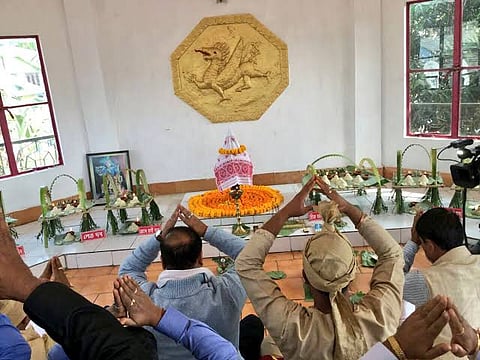
The raised bamboo platforms for the forefathers worshipped in front of the post of spirits (dam post) in the kitchen are arranged in the following order one after the other:
From left to the right while facing the dam post:
1) The principal spirits (ghai dam in Assamese/ Chao Tung Dam in Tai)),
2) the collective spirits (jakorua dam in Assamese/ Dam Likha Likhi in Tai)),
3) the ancient spirits (Chi ren dam in Tai)
4) the new spirit (na dam in Assamese/ On mou dam in Tai) of father of the head of the family and
5) the new spirit (na dam) of mother of the head of the family. If one parent is dead, one bamboo platform is arranged. In case the household does not have any death of children, unmarried persons, issueless parents, the raised platform for the collective spirits (jakorua dam in Assamese/ Dam likha likhi in Tai) is not required.
Three raised platforms (mehenga or pang) are constructed with bamboo for the principal spirits (ghai dam), ancient (chiren) dam and the new (Na) dam. One old red chicken placed near each platform is beaten to death with a small branch of a guava tree and cooked. The meat is placed on the banana leaves spread over the platforms (pang). Some families also have a separate platform for the collective spirits ((jakorua dam). The offerings for the principal spirits (ghai dam) are two pieces of betel nut wrapped up with the petals of holy blakchengpha flower overwrapped with cut pieces of betel leaf. The other food items are one cooked chicken, two portions of cooked vegetables, two containers made of the sheaths of the plantain tree of homemade liquor and one portion is meant for its assistant Teolung which is placed on plantain leaves spread over the ground below the bamboo platform for the principal spirits (Ghai dam). If there is jakorua dam in the family, three pieces of betel nuts wrapped up with blakchenga flower and overwrapped with cut pieces of betel leaf, three portions of cooked vegetables and a container of homemade liquor are offered. For more ancient spirit (Chi ren) dam, the offerings are two pieces of betel nuts wrapped up with blakchenga flower over wrapped with pieces of betel leaf, two portions of cooked vegetables and two containers of homemade liquor, one cooked chicken. For the new dam (spirit of the dead father), the offerings are one piece of betel nuts wrapped up with blakchenga flower over wrapped with pieces of betel leaf, one portion of cooked vegetables and one container of homemade liquor, one cooked chicken. Similarly for the new spirit (na dam of mother), same offerings as given for the new male spirit are offered. Thus two raised platforms (pang) are made for the new spirits. One stick of guava tree each for the platforms is kept for beating the chicken to death. The incantations are sung, meaning of which is already given above.
The offering for the principal dam (Ghai-Dam or Chao Tung Dam) are given in two parts with two pieces of betel-nut wrapped with Chinkara flower overwrapped with pieces of betel leaf, two small banana sheath containers of home-made rice liquor, vegetables (of jute seedling or lai, a leafy vegetable). Similarly, the offering for Chi ren dam is given in two parts with each of the aforesaid articles. For Jakorua (collective) dam (Dam likha likhi in Tai), the offerings are two small containers of banana sheath with a small groove in which is filled up with small quantity of home-made rice spirit, betel nut pieces and three parts of vegetables. For the Na-dam, one offering with each of the aforesaid articles for each Dam is to be given. In Mohung family, the Ghai-dam is seated on the right side of the post and for Deodhai and Bailung, on the left side. The priest arranges the banana leaves, banana stem containers, and raised platforms and purifies these articles by sprinkling water mixed with Chinkara flower. Then in the raised platforms for the Ghai-Dam (Principal Dam), Na-Dam (new spirit/spirits), Chirin Dam (more ancient spirits) etc. the articles for offerings are placed. The priest asks the members of the family to salute the three generations of immediate ancestors i.e the principal spirits, the ancient spirits and the new spirits as well as the collective spirits if any, (that is, the Ghai-Dam, Na-dam, Chiren-Dam, Dam-Khao, Dam-bao, Dam Likhai Phusai) with raised folded hands (above the head) and requests the spirits (Dam) to accept the offerings. This is called “Aao-Tang”. Before each raised platform, one old chicken will be offered by placing it on a banana leaf (Cheopat Kentong). For beating the hen to death one small branch of a guava tree or of Dighlati (Litsoka saicifolia) plant is used. The priest will chant the “Kintang” mantra and beats the chickens to death with the said stick. The chickens are then boiled in water and the feathers are burnt in the hearth. Then the chickens are slit open and except the heart, other things are taken out and cleansed and mixed with mustard oil, ginger, salt and heated in fire. Then each chicken is stuffed with bora rice (sticky rice) or rice and chosen vegetables. Vegetables are put through the beaks of the chickens. The priest will then place rice liquor for the Dams and then chant the Kintang (eating ceremony) mantras. Each of the offerings will be named in Tai Ahom and given to the spirits. The Ghai-Dam (principal dam) will be offered prayer by chanting “Chao Nuru Chao Kao Oi” three times and “Nuk tu-dam Tiren Dam Dam Nak Cha Khok pin Dam” etc. Thus chanting such mantras offerings will be made and offering rice liquor will complete the ceremony. Then the priest will bless the family members (Jonming). Then the priest will take the choicest pieces of cooked meat. After that, the priest will chant the Boi-tang (farewell) mantra. Then sprinkling water mixed with Chinkara flower with the flower three times, the priest will push ahead the Mehenga (bamboo platforms) and end the Dam-Puia. Similarly, some families celebrate the “Na Khowa” (new rice eating) festival by observing only “Khen-Khao” ritual. Some families observe “Na-Khowa” (new rice eating) festival for the Sali paddy (winter paddy) in the month of Aghon (Dinching). Similarly, Na-Khowa festival for Ahu paddy is celebrated in the month of Ahar or Saaon.
Two pieces of betel nut and betel leaf covered with the petals of holy chinkara flower overwrapped with pieces of the plantain leaf for the principal spirits, two portions of cooked vegetable, two containers of rice liquor, one chicken are given for the principal spirits. One piece of betel nut, one portion of cooked vegetables, one container of rice liquor are for the Teolung, the attendant of the principal spirits.
Three pieces of betel nut, three portions of cooked vegetable, three containers of rice liquor are offered to the collective spirits. Two pieces of betel nut, two portions of cooked vegetable, two containers of rice liquor and one chicken are offered to the ancient spirits. One piece of betel nut, one portion of cooked vegetable, one container of rice liquor and chicken for the spirit of the dead father and of the equal quantities of each article for the spirit of the dead mother are offered on the plantain leaves spread over the raised bamboo platforms. In each of the platforms, one portion of cooked new rice, one portion of fish cooked with sour vegetable like Khoricha tenga ou tenga or in place of fish, one portion of steamed sticky rice, one portion of cooked black gram are offered. The rice liquor is prepared for the new rice. The chickens killed by beating on the head with a stick of guava tree are cooked.
The offerings are:
(To be continued)
