
- Home
- Live Blog
- Breaking News
- Top Headlines
- Cities
- NE News
- Sentinel Media
- Sports
- Education
- Jobs
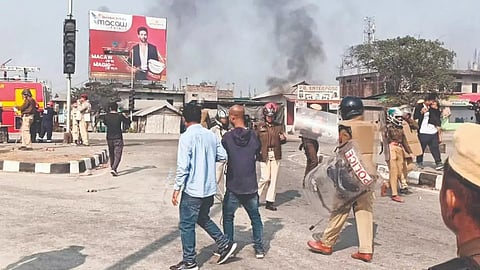
Isolated pockets of Kokrajhar and Chirang districts witnessing ethnic clashes over an incident of mob- lynching following a road accident have pressed the alarm bell on disruptive elements seeking to turn hard-earned peace in the Bodoland Territorial Region (BTR) fragile again. BTR has left behind a violent past of ethnic conflicts and insurgency to move ahead along a trajectory of peace and progress. Fresh ethnic clashes which claimed two lives saw incidents of arson and attack which led to about 1,200 displaced people belonging to Bodo and Adivasi communities taking shelter in makeshift relief camps. Swift and decisive action by Assam Police with the help of the army and central paramilitary forces, as ordered by Chief Minister Himanta Biswa Sarma, who is closely monitoring the situation from Davos in Switzerland, where he is attending the World Economic Forum 2026, prevented escalation. As simmering tension continues to grip the affected areas, the guards must not be lowered. A flag march by the army and the deployment of the Rapid Action Force helped Assam Police contain the situation. Convening of a peace meeting is a laudable initiative to restore confidence among displaced people to return to their villages at the earliest. Communities isolating the disruptive elements is crucial to ensure faster restoration of normalcy. Even though preventing escalation and the return of displaced people to their homes remain the top priority, a thorough investigation into the incident that triggered the clash is essential to get to the bottom. Bodoland Territorial Council Chief Hagrama Mahiliary, hinting at the involvement of a “third force” behind the outbreak of violence, which he claimed had occurred due to “misunderstanding”, called for an investigation of the “conspiracy angle” and identification of the conspirators. Demographic and ethnic faultlines in BTR have been mended by the central government through the signing of the peace accords, which was possible through years of dialogue and articulation of solutions for conflict resolutions. Any fresh clash runs the risk of opening the deep wounds of past conflicts, and, therefore, leaders and organisations of different communities shouldering the responsibility to prevent escalation in the situation is critical for sustainable peace in BTR. Increasing community economic interdependence through trade, commerce and regular cultural exchange can strengthen the bond and harmony. The Bodoland Territorial Council can play the crucial role in strengthening such a bond by ensuring that the development process is inclusive and that there is an equitable distribution of resources. BTC authorities need to build awareness among the communities that BTR is on the cusp of unprecedented development, with the central and state governments initiating a host of infrastructure development projects, and all the communities stand to gain from these projects. Notable among these is the rail link between Kokrajhar and Gelephu in Bhutan. With Bhutan fast-tracking the development of the Gelephu Mindfulness City as a sustainable and technologically advanced city, the strategic rail link has the potential to transform the entire BTR into a global hub of economic activities. The Ministry of Railways already notified this cross-border rail link as a Special Railway Project, which is reflective of the strategic importance of the BTR region for the entire country. When India and Bhutan expedite the strategic projects along the India-Bhutan borders to deepen bilateral relations between the two neighbouring countries, an outbreak of violence in BTR will only send negative signals to potential investors. People in BTR are realising that maintenance of peace and harmony is vital to creating the conducive situation and building of the required ecosystem to attract domestic and global big-ticket investors to leverage the cross-border strategic infrastructure projects pushed by India in BTR. It is unfortunate that when people in BTR need to focus on increasing agricultural production, skill building of youth, and improving health and education to derive optimal economic benefits from multisectoral development initiatives by the central government, state government and BTC authorities, disruptive elements are desperate to create trouble and revive the bitter memories of the past to divide the people on ethnic lines. Organisations of different communities in BTR playing an active role to dissuade people from abusing the social media networks for spreading hate messages against members of other communities can be more effective than suspension of internet services to prevent escalation in the situation. The organisations and BTC authorities spreading information about economic opportunities from various development projects and cross-border connectivity projects and bilateral trade and commerce between India and Bhutan can help bring development in BTR to the centre stage of social media discourse and counter hate campaigns. With assembly elections around the corner, the administration will be under pressure to maintain law and order as forces inimical to the country try to disrupt peace and harmony to prevent the smooth conduct of the election process. BTR risks missing the bus of faster progress if communities fail to see through the vested interests which are determined to sabotage peace.
