
- Home
- Live Blog
- Breaking News
- Top Headlines
- Cities
- NE News
- Sentinel Media
- Sports
- Education
- Jobs
Himangshu Ranjan Bhuyan
(hrbhuyancolumnist@gmail.com)
Assam’s vast geographical expanse and its immense potential in natural resources have historically accorded this land a special significance. Yet, in reality, a prolonged disparity has been evident in the proper utilization of these resources and in the equitable distribution of the benefits derived from them. For the comprehensive development of any nation or state, the mineral resources beneath the land and the forest resources upon it are considered the most powerful elements. In the case of Assam, despite the abundant presence of valuable resources such as mineral oil, coal, natural gas, and the tea industry, the standard of living of the state’s general population has not improved in the manner one would expect from such wealth. The primary reason for this lies in the systematically orchestrated method of resource extraction and the consequent outflow of generated wealth.
This history of continuous plunder of resources is not merely a tale of economic exploitation; it is a methodical process that has systematically undermined the economic and social rights of a vast population. While other developed regions of the world have ascended to peaks of prosperity through the proper utilization of their resources, in Assam the very same resources have created wealth solely for external powers, leaving behind for the local people only pollution and poverty. This situation is not an accidental misfortune but the outcome of a deep-seated economic inequality that began during British colonial rule and has undergone no substantial change even in independent India.
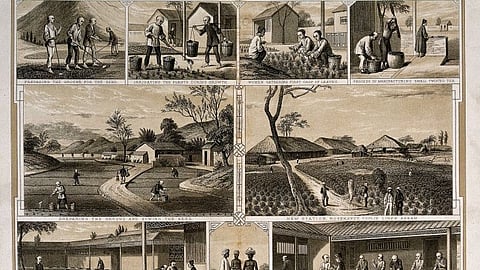
In the early nineteenth century, when the British East India Company entered the political landscape of Assam, their primary objective was to exploit the region’s storehouse of raw materials for their commercial interests. Following the Yandabo Treaty, the British swiftly conducted surveys of Assam’s forests and lands to assess the commercial value of the hidden resources. The discovery of the tea plant and the subsequent potential of mineral oil encouraged them to establish even stricter control over this territory. The British rulers did not regard Assam merely as an agricultural land but treated it purely as a mine from which as much wealth as possible could be extracted to enrich the markets of London. Every law and administrative regulation they framed served only as a means to legitimize this plunder of resources.
In the allocation of land for tea gardens, the rights of indigenous people were completely disregarded, and vast tracts were handed over to British companies either at very low prices or free of cost. This action destroyed the self-sufficient economy that had existed among the native population of Assam. The enormous wealth generated through the tea industry was not utilized for the development of Assam in any measure. Instead, capital flowed abroad, and Assam remained merely a supplier of raw materials and a center of labour.
The same exploitative and one-sided policy prevailed in the case of mineral oil and coal. Following the discovery of oil in Digboi, foreign institutions such as the Assam Railways and Trading Company established a monopoly over this crucial resource. Since the technology and capital required for oil extraction were in British hands, they took full advantage of this to transform Assam’s soil into nothing more than a mining field. The royalty or dividends paid to the local administration during that period were nominal, making any developmental work impossible. A similar picture emerged in coal mining, where forests were destroyed and coal was extracted from the heart of hills without any concern for the resulting environmental damage. The railways and waterways constructed by the British in Assam were designed solely to transport resources rapidly to central markets or ports. No infrastructure was built for the convenience of the general population or for the promotion of local trade.
This colonial economic character kept Assam in a uniquely backward condition compared to other parts of India, where, despite possessing abundant resources, people’s lives remained a constant struggle against extreme poverty. This centralized plunder of resources completely stripped Assam of its economic autonomy.
After India gained independence, the people of Assam hoped that indigenous rights over the land’s resources would finally be established and that the benefits would be equitably shared with the general population. However, in practice, it became evident that the policies of the central government were, to a large extent, built upon the very same resource-extraction model of the British. Through various provisions of the Constitution, the rights of the state over mineral resources were limited, while the authority of the central government was strengthened. The determination of royalties on oil and gas extracted from Assam remained solely in the hands of the centre. Consequently, Assam’s interests have consistently gone unnoticed, forcing the state to settle for a meagre revenue share.
Central government-owned oil companies extract thousands of crores of rupees in profits from Assam every year, yet only a minuscule portion of that profit is spent on education, health, or agriculture in the state. The oil extracted from Assam’s soil fuels the entire country’s economy, yet the prices of diesel and petrol in Assam show no significant reduction compared to many other parts of the country. This economic disparity continues as an ongoing process even within independent India’s parliamentary democracy. This centralized system of resource management has reduced a resource-rich state like Assam to a puppet in the hands of the centre, with the state’s financial dependence increasing day by day.
The most significant problem in the utilization of Assam’s resources is the absence of value addition or industrialization. Raw materials such as crude oil, coal, or tea leaves are exported from the state in their primary form. Consequently, the profits and employment opportunities that should have been created remain established outside Assam. For instance, had final products been manufactured within the state using these resources, thousands of local youths would have found employment, and the state government would have received substantial revenue through sales tax. However, the policy of the central government and large capitalists has always been to use Assam merely as a “supply center.”
The movements in Assam regarding oil refineries arose precisely against this injustice. It would have been logical for the state producing the oil to refine it locally and develop ancillary industries based on by-products. Yet policymakers have consistently preferred that Assam’s resources be transported to other more developed states to keep their industries operational. As a result, Assam’s industrial map has remained consistently dim, and local talent as well as the labour force have been wasted. This form of economic deprivation has kept Assam confined in a colonial condition, where, despite being the owner of resources, the people remain entirely dependent on others.
In the present era, under the name of a free market economy and globalization, large corporate groups have begun a direct assault on Assam’s resources. Sectors previously under government control, which at least had some social responsibility, are now gradually being handed over to the private sector. Through open auctions of oil fields and changes in ownership of tea gardens, the influence of local people over Assam’s land has been rendered virtually nonexistent. For these large companies, Assam is merely a site for profit extraction, with no connection whatsoever to the social or cultural life of the region. They employ the most modern machinery for resource extraction but show no interest in providing employment to local people.
Moreover, unscientific mining of forest and water resources, along with dam construction, has caused severe damage to Assam’s environment, yet these companies face no accountability. In the name of resource extraction, hills are being cut down, forests cleared for railway lines or industrial corridors, and wildlife habitats destroyed. The entire process benefits only economic powers located outside the state. What the people of Assam receive is only natural disasters and a devastated life. This new economic arrangement has legally extinguished the historical rights of local society over Assam’s resources.
Another terrifying aspect of this vast picture of resource plunder is the extreme degradation of the environment. Any uncontrolled extraction inevitably disrupts the natural balance, given the close interconnection between Assam’s resources and nature. Pollution of soil and water resulting from open-pit coal mining and oil production has made agricultural activities increasingly difficult. Changing river courses and siltation caused by sand extraction have intensified the menace of floods every year. When a company extracts resources and departs, it assumes no responsibility for environmental restoration of the site. Local residents suffer as a result, not just financially but also physically and medically.
Had the revenue from these resources reached the state, modern measures could perhaps have been adopted to address these environmental problems. But since the lion’s share of profits flows outward, Assam lacks sufficient funds even to clean up the waste generated from its own resources. This situation is the cruellest consequence of resource plunder: the gold of one’s own land is carried away to others, while the indigenous people are left only with the silence of a graveyard. The moral duty to leave behind a secure world for future generations has been completely sacrificed in this race for extraction.
The weak control of the state government over Assam’s resources has always forced it to kneel before the center. Promises of resource rights and development are made during every election, yet no strong laws or policies are enacted to halt this plunder. For any major central project, Assam’s land is easily acquired, but securing the state’s rightful share from such projects requires years of struggle. The state’s financial condition has been kept so weak that even minor funds require central approval. This environment has created deep feelings of alienation and resentment among the Assamese people. When people see trucks carrying resources away from their doorstep while their villages lack a suitable hospital or school, it is natural for trust in the system to erode.
Time and again, mass movements have arisen against this discriminatory policy regarding resources, but they are almost always suppressed through repressive measures or false promises. The root of the problem truly lies in the centralization of decision-making power over the economy. Until the final authority over Assam’s resources comes into the hands of its people, there will be no change in this history of plunder.
The tea industry of Assam remains one of the largest examples of resource plunder even today. Thousands of labourers spend their lives in this industry, yet their economic condition remains deplorable. The headquarters of the large companies owning the gardens are located outside Assam. As a result, a large portion of the profits from tea sales flows out of the state. Although Assam produces some of the finest tea in the world, the state has no strong market or control to determine its rightful price. Even the auction centres are dominated by external traders. The issue of wages for tea workers remains a major problem, proving that this vast industry has enriched only the owners while bringing no improvement to the lives of those whose labour creates the resource.
The land on which these vast tea gardens stand also carries no rights for local people. Had this enormous land been used for other productive purposes, the picture of Assam’s agricultural economy might have been different. Instead, the tea industry is presented as an emotional prize, constantly attempting to conceal the economic exploitation hidden within it. Rather than serving Assam’s economy to the extent it should have, this industry has been used more as a tool to ensure the outward flow of resources.
In conclusion, to change this long history of plunder of Assam’s resources, a new economic vision is required. Mere political slogans cannot solve this problem. What is needed is a strong legal framework that establishes the state’s ownership over natural resources and ensures a definite share of royalties. Alongside this, emphasis must be placed on halting the export of raw materials and promoting processing and value addition within the state itself. Through the development of local skills, a capable society must be built that can utilize its own resources independently. The education system must also be designed so that the younger generation understands the commercial and technical aspects of resources and can build its own economy without dependence on external forces.
Preventing the plunder of resources is not merely an economic struggle for one state; it is a crucial fight for the survival of the Assamese nation. If we remain unconscious, one day this prosperous land may turn into a barren desert where neither nature nor the means of human survival will remain. It is the duty of every conscious citizen to form a strong and reasoned public opinion against this exploitative policy while time still permits. Establishing rights over resources is our birthright, and there is no alternative to a united and well-considered struggle to achieve it.
