
- Home
- Live Blog
- Breaking News
- Top Headlines
- Cities
- NE News
- Sentinel Media
- Sports
- Education
- Jobs
Vijay Garg
(The writer can be reached at vkmalout@gmail.com)
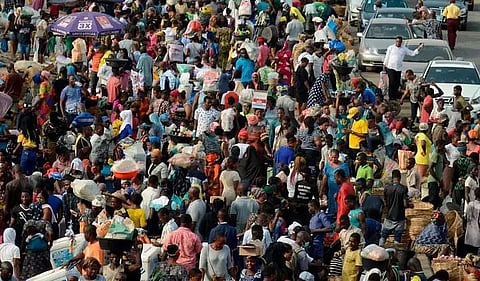
The world's population has crossed the eight billion mark. According to the United Nations, India will become the most populous country in the world by surpassing China next year. After this, the population of India will continue to increase till 2064. It took 12 years for the world's population to reach seven to eight billion and India contributed the most. Population growth in low-income and lower-middle-income countries has been observed. This trend will continue in the next few decades. This will have profound implications for India not only because more people will have to be provided with food and water, but it will also have social and political consequences because the growth in the population of different religious communities is uneven and irrational. Weeks before the UN announcement, Rashtriya Swayamsevak Sangh leader Dattatreya Hosbale, who has been a long-time advocate for Hindus, had also raised his voice on the issue. This issue has been at the forefront of India's changing religious demographics for decades. It is associated with decline in Hindu population. Hosbale said that the population trend is also changing due to cross-border infiltration and religious conversion.
In such a situation, the policy of 'population control' has become extremely necessary. According to him, the government should make such a consensus population policy that is applicable to all religious communities and geographical areas. He also mentioned the need for a strict law against religious conversion. If we scrutinize the census data in the last 50 years, it is clear how the changing demographics have affected the Hindus. In the census of 1961, the total share of Hindus was 83.40 per cent, which decreased to 79.80 per cent in 2011 and when the data of 2021 is unavailable, it will definitely see a further decline. On the other hand, in 1961, Muslims were 10.70 per cent which became 14.20 per cent in 2011. The change in the number of these communities came about because of the huge difference in their decadal growth rate. If we look at the previous census, then the national average of the decennial population growth rate was 17.70 per cent. While the respective growth rate of Jains remained significantly below the national average, there was a decadal growth of 24.60 per cent in the Muslim population. This fact is also significant that during 2001-11 there was an increase in the Muslim population in 27 states of the country.
In Assam it increased from 30.90 per cent to 34.20 per cent, in Kerala from 24.20 per cent to 26.60 per cent, in Uttarakhand from 11.90 per cent to 13.90 per cent and in Bengal from 25.20 to 27.90 per cent. According to Hosbala, apart from religious conversion, human trafficking also occurs in north Bihar in addition to other states. The demographic pattern of many districts is changing. He reminded that the examples of the past show that the population imbalance has a serious impact on the geographical and demographic situation of the country. Their reference to conversion is clearly seen in North-East India. A dramatic increase in the Christian population in Arunachal Pradesh, Manipur and Meghalaya confirms this. Religious conversion is responsible for the unexpected change in the population of many states. As of 1951, the number of Christians in the population of Nagaland was 52.98 per cent which has increased to more than 90 per cent in 60 years. There, till 1981, the population of Hindus in the state used to be 14.36 per cent, which decreased to 7.70 per cent in 2001. This concern of Sangh's leaders is not unfounded. AP Joshi, MD Srinivas and JK Bajaj have done a research titled 'Religious Population in India'.
In this, after analyzing the data of 2002, they have presented a big scary picture. It has expressed apprehension that followers of Indian religions may belong to minority communities. This study is a wake-up call for Hindu groups to press for a population policy to ensure uniform decadal population growth of all religious groups in the country and prevent a steady decline in the Hindu population. Needless to say, drastic changes in demographics have profound political, geographical and social consequences. One cannot even forget how much violence and bloodshed took place in the partition of the country on religious grounds in 1947. It is said that the memory of the people is fleeting but memories of the Partition of the country are still fresh in the minds of Indians. Mizoram, Nagaland, Meghalaya, Arunachal Pradesh, Manipur, Punjab, Jammu and Kashmir and Lakshadweep have become Hindu minority states. In other words, Hindus are among the minority communities in almost one-fourth of the states of the country. What are its political and social consequences and how will it affect national security, space security and social cohesion? There is a need for introspection and discussion on these questions.
These questions are also at the root of the concern of the Sangh's leadership. Now it is the government's turn to take notice of this issue and take necessary policy initiatives. Although there are some visible political risks, the Congress's aggressive campaign to control population during 1975-77 was so unpopular that future governments avoided it. The fear of losing in the elections was eating away at them. The result of this was that they sat idly by on this issue and the population of the country continued to grow exponentially. The Modi government should now move forward with a population policy that motivates people through understanding and not a policy that is in any way equipped with authoritarian behaviour that reduces population. Also, the government will have to ensure that this policy will be applied equally to all religious groups. Now it has to be seen how the government will react. Will the Modi government accept this challenge?