
- Home
- Live Blog
- Breaking News
- Top Headlines
- Cities
- NE News
- Sentinel Media
- Sports
- Education
- Jobs
Dr Jintu Sarma
(Asstt. Professor at Guwahati College, drjintusarma@gmail.com)
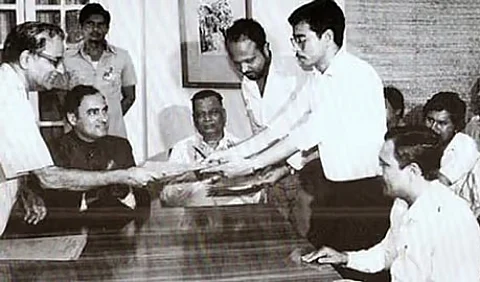
The signing of the Assam Accord on August 15, 1985, was a watershed moment that rec-alibrated the state’s political trajectory. It was intended to end a six-year-long anti-foreigner agitation (1979–1985) led by the All Assam Students’ Union (AASU). The Assam Accord is a Memorandum of Settlement (MoS) signed on August 15, 1985, between the Government of India and the leaders of the Assam Movement. It marked the culmination of a six-year-long mass agitation (1979–1985) spearheaded by the All Assam Students’ Union (AASU) and the All Assam Gana Sangram Parishad (AAGSP) against illegal migration. Following the 1971 Bangladesh Liberation War, Assam saw a significant influx of immigrants. Concerns grew among the indigenous population that these demographic shifts would threaten their political rights, culture, and land ownership. The discovery of a massive spike in the 1979 electoral rolls in Mangaldoi served as the immediate catalyst for the movement, demanding the “detection, deletion, and deportation” of foreigners. However, the decades following the Accord have been defined not by simple resolution, but by a complex interplay of regionalism, ethnic fragmentation, the rise of Hindu nationalism, and a persistent struggle over the definition of citizenship.
The Accord’s most immediate political effect was the creation of the Asom Gana Parishad (AGP). Formed in Golaghat in October 1985 by student leaders of the movement, the AGP symbolized the triumph of regional identity over the national hegemony of the Indian National Congress. In the 1985 Assembly elections, the AGP swept to power under the leadership of Prafulla Kumar Mahanta, who became the youngest Chief Minister in India. This victory represented a historic shift, as the Assamese electorate chose a party born from the streets to protect their cultural and linguistic rights. However, the AGP’s tenure was marred by administrative inexperience and internal friction. Its failure to implement the core promises of the Accord—specifically the detection and deportation of illegal immigrants—led to a rapid erosion of its support base.
While the Assam Accord spoke of Assamese people, it inadvertently triggered a crisis of definition. Various ethnic groups, such as the Bodos, Karbis, and Dimasas, felt that the accord focused primarily on the interests of the Assamese-speaking majority of the Brahmaputra Valley, neglecting the aspirations of the state’s diverse tribal populations.
This led to a surge in sub-regionalism and ignited many other regional political issues and raised a number of movements. Led by the All Bodo Students’ Union (ABSU), the Bodo movement demanded a separate state (Bodoland), arguing that Bodos needed their own political space to survive. This resulted in multiple “Bodo Accords” (1993, 2003, and 2020) and the creation of the Bodoland Territorial Region (BTR). Similar demands for autonomy arose among the Karbis and Dimasas, leading to the formation of autonomous councils. The political landscape shifted from binary (Assamese vs. foreigner) to a multi-polar “ethnic minefield.” The post-Accord period was also defined by the shadow of the United Liberation Front of Asom (ULFA). Formed in 1979 but gaining massive traction in the late 1980s, the ULFA rejected the accord, viewing it as a compromise within the framework of the colonial Indian state.
By 1990, the law-and-order situation had deteriorated so significantly that the central government imposed President’s Rule and launched Operation Bajrang. For nearly two decades, the political discourse in Assam was dominated by the conflict between the state and insurgent groups, leading to a climate of violence, secret killings, and the normalization of the Armed Forces Special Powers Act (AFSPA). After the 90s massive crisis in law and order, Tarun Gogoi assumed office as the 13th Chief Minister of Assam, holding office for three consecutive terms from 2001 to 2016. His 15-year tenure is often characterized as a period of transition, during which he moved the state from a “morass of insurgency” and financial bankruptcy toward a path of relative peace and economic growth. As the longest-serving Chief Minister of Assam, Gogoi’s legacy is defined by his “peace through development” philosophy and his ability to navigate the complex ethnic and political landscape of the Northeast. When Tarun Gogoi assumed office in May 2001, he inherited a state in deep crisis. The previous administration had left the treasury empty, with a budget deficit of approximately Rs 7.8 billion. The situation was so dire that the state could not pay salaries to government employees or pensions to retirees.
The early 2010s saw a shift in political power away from the AGP. The regional party’s inability to solve the foreigner issue created a vacuum that the Bharatiya Janata Party (BJP) skilfully filled. The BJP redefined the “insider-outsider” narrative from a linguistic one (Assamese vs. Bengali) to a religious one (Hindu vs. Muslim). By framing the issue as protecting “Indigenous Hindus” from “illegal infiltrators”, the BJP managed to consolidate a large section of the indigenous vote. Their victory in 2016, led by Sarbananda Sonowal (a former AASU president), marked the end of Congress dominance and the weakening of pure regionalism.
In the last decade, two major legislative and administrative exercises have brought the Assam Accord back to the centre of national debate: the NRC & CAA. Under Supreme Court supervision, the National Register of Citizens (NRC) was updated with the Accord’s cutoff date of March 24, 1971. However, the final list, which excluded 1.9 million people, dissatisfied many. Many indigenous groups felt the number was too low, while others were concerned about the humanitarian cost. The CAA allows non-Muslim immigrants from neighbouring countries to fast-track their citizenship. In Assam, this was met with fierce protests because it effectively violates the 1971 cutoff date agreed upon in the Assam Accord.
The political scenario of Assam after the 1985 Accord has been a journey from the euphoric rise of regionalism to a complex, fragmented reality. While the Accord succeeded in providing a legal framework for citizenship, its implementation remained a “bureaucratic tangle”. Currently, the state finds itself at a pivotal point. The implementation of Clause 6 (promising safeguards for Assamese identity) remains the great promise of the Accord yet to be fully realized. As Assam navigates the tensions between the secular regionalism of the 1980s and the religious nationalism of the 2020s, the “foreigner issue” continues to be the primary engine of its political heart.
