
- Home
- Live Blog
- Breaking News
- Top Headlines
- Cities
- NE News
- Sentinel Media
- Sports
- Education
- Jobs
Siddharth Roy
(siddharth001.roy@gmail.com)
In an age of rapid globalisation, where cultural identities are often diluted under the weight of homogenisation, the journey of Assam’s traditional masks from Majuli to international platforms offers a powerful counternarrative. The recent global recognition of masks crafted at the historic Samaguri Satra is not merely a story of artistic export; it is a testament to the resilience of a centuries-old cultural tradition that continues to adapt, survive and inspire.
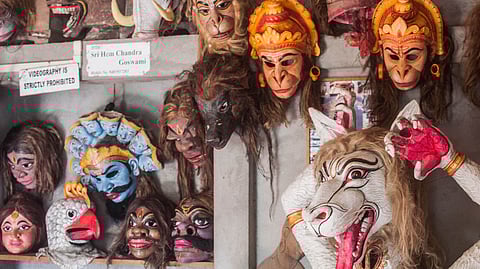
Situated in Majuli, the world’s largest river island, Samaguri Satra stands as a unique cultural institution within Assam’s Neo-Vaishnavite heritage. Established as part of the Vaishnavite movement propagated by Srimanta Sankardeva in the 15th-16th centuries, the satras have long functioned as centres of spiritual, artistic and social life. Among them, Samaguri Satra carved out a distinctive identity through its unparalleled tradition of mask-making, a craft that blends devotion, theatre and craftsmanship into a single expressive form.
The masks, locally known as mukha, are not mere decorative artefacts. They are integral to Bhaona, the traditional theatrical performances depicting episodes from epics like the Ramayana and the Mahabharata. Crafted painstakingly from bamboo, clay, cloth and natural fibres, these masks bring mythological characters to life, transforming performance into a deeply immersive spiritual experience. Over centuries, this art has evolved in technique and form, yet it has retained its core philosophical essence, communicating moral and spiritual ideas through visual storytelling.
What makes the recent international exposure of Samaguri masks particularly significant is the validation it offers to a fragile yet vibrant tradition. According to reports, these masks have found their way to global audiences, including prestigious institutions such as museums abroad, signalling a growing appreciation of Assam’s intangible cultural heritage. This global journey is not just symbolic; it represents an opportunity for cultural diplomacy, where art becomes a bridge between Assam and the world.
However, this recognition also raises important questions about sustainability and preservation. Traditional art forms like mask-making have historically depended on institutional patronage within the xatra system and local community participation. Today, they face challenges ranging from declining interest among younger generations to the pressures of commercialisation. While tourism and international demand have opened new avenues, they have also introduced market-driven changes that risk diluting the ritualistic and cultural significance of the craft.
Encouragingly, innovation within tradition has played a crucial role in keeping the art relevant. Modern adaptations such as lighter masks with movable parts have enhanced theatrical expression and expanded the scope of performance. Artisans have also diversified their creations, producing smaller masks for decorative and commercial purposes, thereby generating livelihoods and attracting global buyers. Yet, the essence of the craft continues to be rooted in the xatra’s spiritual ethos, ensuring that innovation does not come at the cost of authenticity.
The broader context of Majuli further underscores the urgency of preservation. As a river island constantly threatened by erosion and environmental changes, Majuli itself is a fragile cultural landscape. The xatras, including Samaguri, are not just religious institutions but custodians of Assam’s collective memory. The survival of their artistic traditions is inseparable from the survival of the island itself.
In this regard, policy interventions become crucial. The recent Geographical Indication (GI) tag granted to Majuli’s mask-making tradition is a step in the right direction, offering legal protection and enhancing market value. However, more comprehensive measures are needed, ranging from financial support and skill development initiatives to the integration of such art forms into educational curricula. Documentation, digital archiving and global collaborations can further strengthen the ecosystem around this heritage.
Equally important is the role of the community. The continuity of the Samaguri tradition has been ensured by generations of artisans who have preserved and transmitted their knowledge with remarkable dedication. Their work is not just a profession but a form of devotion. Recognising and empowering these artisans is essential to sustaining the tradition in the long run.
The story of Samaguri Satra masks, therefore, is not just about art; it is about identity, resilience and the dynamic interplay between tradition and modernity. As these masks travel from the quiet environs of Majuli to international galleries, they carry with them the spirit of Assam’s cultural heritage. They remind us that even in a rapidly changing world, rooted traditions can find new relevance without losing their essence.
Ultimately, the challenge lies in ensuring that global recognition translates into local revitalisation. The masks of Samaguri Satra have already captured the imagination of the world; the task now is to ensure that they continue to thrive in their homeland as living symbols of Assam’s rich and enduring cultural legacy.
