
- Home
- Live Blog
- Breaking News
- Top Headlines
- Cities
- NE News
- Sentinel Media
- Sports
- Education
- Jobs
Prof. (Dr.) Jayadeba Sahoo
(Faculty, Brahma Kumaris & Dean, Faculty of Education,
Rajiv Gandhi (Central) University, Itanagar. He can be reached
at jayadeba.sahoo@rgu.ac.in or drjayadeb12@gmail.com.)
(I am neither virtues, nor sin, nor happiness nor sorrow, nor Mantra, nor pilgrimage, nor Veda nor Yagya. I am neither food nor do I eat nor am I to eat; I am a conscious form; I am bliss; I am Shiva.)
India is a spiritually oriented country; the number of festivals celebrated here is hardly comparable to festivals celebrated in other countries. Twelve months in a year filled with more than thirteen big festivals, Maha Shivratri has a special importance amongst them. Shivaratri is one of the most important festivals in the world, celebrating the time when God, the incorporeal Shiva, incarnated to establish heaven on earth. The festival of Mahashivaratri, which is celebrated with great reverence and devotion all over India on Falgun Krishna Paksha Chaturdashi Tithi, has been mentioned in various Puranas, such as Skanda Puran, Linga Puran, and Padma Puran. There are several legends, traditions, beliefs, and customs that make this occasion special among the festivals celebrated around the world.
On this day, devotees visit Shiva temples to offer leaves of Bel upon the Shiva Linga, observe fast, and are awake all night as a mark of devotion to God Shiva. In order to celebrate this festival in its true spirit, it is essential to know who is God Shiva and why Shiva ratri [Shiva’s night] is commemorated by the devotees.
God Shiva and Shiva-Ratri have always fascinated historians, researchers, and intellectuals in India and abroad, as the very name, form, and symbol of God Shiva bear a unique similarity abroad in the ancient relics, reliefs, and writings of early religions and civilizations. Out of His thousand attributive names, ‘SHIVA’ stands out as the most inspiring for its phonetic resemblance with the ancient names of God in different cultures and messages about His consummating cosmic character.
Shiva: The Universal Name
of God Incorporeal
The ancient names of God, such as ‘SHIUN’ in Babylon, ‘Seva’ or ‘Sevajya’ in Syria, in Egypt and Fiji; ’Sibru’ in the land occupied by the progeny of Abraham; and ‘Jehova’ to Moses and his followers, seem very similar to the Sanskrit word ‘Shiva’ derived from two phonetic parts, ‘Shi’ and ‘Va’ meaning ‘Redeemer’ and ‘Liberator’ of sins, which indicate Almighty alone. Literally, “Shiva” also means the ‘Benevolent’ or ‘Benefactor’ or the benign or a divine dot, i.e., who is beneficial to all, and ‘Linga’ means’symbol’. The characteristics that “Shiva” conveys clearly correspond to His form, attributes, and actions as the subtlest seed of creation, sustenance, succour, and as the Universal Benefactor.
Similarly, the Sanskrit suffix (to shiva) in ShivaLinga (m), i.e., ‘Linga’ or ‘Lingam’, means sign or symbol when subdivined into two phonetic constituents, i.e., ‘Li’, ‘Lin’, or ‘Laya’, and ‘ga’, ‘gam’, or ‘agaman’, respectively, refer to the processes of destruction and recreation. Thus, the etymological composition and connotation of the triple-lettered term ‘G O D’ meant His divine triple actions, i.e., G-Generator, O-Operator, and D-Destruction, which perfectly coincide with that of ‘Shiva Linga’ or ‘Shiva’.
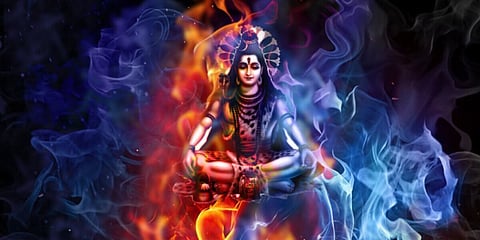
Shiva is also called “Trimurti’’ and “Trinath’’—’The’Lord of Tri Dev (Three Deights),’ i.e., Brahma, Vishnu, and Shankar, whom He creates and performs His divine triple actions of generation (creation), operation (sustenance), and destruction by them. This is vindicated in the Epic Shiv Puran when it reads “Brahma, Vishnu, Maheswar, Rudrama Srijayam.” That means Brahma, Vishnu, and Maheswar (Shankar) were created by Rudra (Shiva). That is why it is called “Rudra Yajna,” not “Shankar Yajna”; “Rudra Avisheka, not “Shankar” Abhishek.” Moreover, Shankar is depicted having human form and meditative posture before Shiva Linga, the oval shape of flame or light, which clearly indicates the difference between Shiva and Shankar and Shiva as Supreme Light—the Supreme Soul.
Again, the Sanskrit verse reads, “Brahma Devatay Namah, Vishnu Devataya Namah, Shankar Devatay Namah, Shiva Paramatmaya Namah.” This indicates that when Brahma, Vishnu, and Shankar are revered as Devatas (Deities), Shiva is revered as Param Atma (Supreme Soul).
SHIVALINGA: The Symbolic Form of Universal God
Moreover, ‘Shiva Linga’ was a symbol of worship common to almost all religions in the world. For example, the Jews used to worship ‘Bailfago’ in the form of ‘ShivaLinga’ called ‘Baleswara’ in India. Abraham, whom Jews, Christians, and Mohammedans regard as God’s messenger, built Kaba in Mecca, where he installed an oval-shaped black stone (similar to Shiva Linga) called Sang-e-Ahswad (Liberator), as Shiva is known as Mukteswar (Liberator).
Sir Willam Jones depicts that absolute God or Supreme Soul is venerated in Egypt in the names ‘Osiris’ and ‘Ishis’, a modified form of God’s name in Sanskrit, ‘Ishwara’ and ‘Ish’. A stone bull is also kept before Linga, ‘Osiris’, as ‘Nandi’ before Shivalinga. The celebrated Vatican Museum in Rome has a cute ‘Shivalinga’ claimed by Vatican authority to be of Italian origin and part of Etruscan’s heritage. Images of Shivalinga are also kept in churches in Italy.
‘God’ is the incorporeal point
of eternal light
Description of Shivalinga as ‘Jyotirlingam’ (Jyoti & Lingam ), the divine vision of flame like of God to Moses, whom Jews, Christians and Mohammedans respect as messenger of God; Jesus Christ’s reference to God as Light and the Christians’ practice of burning the ‘Sanctuary Lamp’ – the ‘Eternal Light’ representing the living God; the holy flame ‘Ner Tamid’; ‘Eternal Light’ raised above the ‘Ark of Law’ in the Jewish Synagogue; the image of God as a point of light radiating His illumination symbolized by Egyptian Pyramid; the worship of fire God advocated by Zoroastrians (parsees); a small oval-shaped red stone called ‘Chin-kon-Seki’ (Peace giver) meditated upon by Buddhists in Japan; the light symbols associated with Egyptian, Babylonian, Druid, Norse & Donyi-Polo Faith (of Arunachal Pradesh) Supreme God lend enough credence to the identity of ‘God’ as an Incorporeal Point of Eternal Light.
Shivalinga and the Shivalinga-like solid objects mentioned above, including Bailfago in Israel, “Sang-e-Aswad” in Mecca, “Phallos” in Greece, ‘Periapus in Italy, Fassinum in France, Ekonis/Estergeries in Siam (Thailand), etc., are the symbolic prototypes of the Supreme Being—a conscient point of light radiating an oval auro just as the candlelight emerges from a point source and takes an oval form, wherefore Shivalinga is known as ‘Jyotirlingam’ (symbol of light), i.e. of the form of neither a male nor a female, but of light only.
SHIVA-RATRI: Its Real
Significance
So, Shiva-Ratri reminds mankind that He is not omnipresent but manifests Himself and descends on to this world drama stage from His Supreme Abode (Param Dham/Seventh or Highest Heaven) to awaken mankind from the graveyard (death or slumber of ignorance) at a time when there is RATRI—the night or utter darkness of ignorance or complete irreligiousness (Gita,Ch-4/Verse-9), otherwise known as ‘Kayamat Ka Samay’—a p period of destruction/end of time ycle. God Shiva comes to this world at the end of the cycle of world history, according to the Rig Veda (1-161-14).
Unlike human beings taking birth from mothers’ wombs, He is immune to and above birth and death. He is called Ajanma and Ajonijanma, but as He manifests or depicts Himself, He is called Swayambhu, Shambhu, or Khuda (Khud+a). Literally, “Khud” means the ‘one self, and ‘a’ means ‘to come’. Thus, Khuda means one who comes himself. Jesus also says, “But I tell you the truth: it is better for you that I go away because if I do not go away, the helper will not come to you. And when He comes, He will prove to the people of the world that they are wrong about what is right and about God’s judgement. I have much more to tell you, but now it would be too much for you to bear. But when the Sprit of Truth comes, He will lead you into all truth.”
The ordinary human person on whom Incorporeal God Shiva descends incognito as per his promise in (Gita, Ch. 4/Verse 8–9) and through whose mouth He reveals the spiritual truth about Himself, the whole creation, and the process of communion with Him (Yoga) comes to be known as Brahma, Adi Dev, Adam, or Abu Tani—the First Man. After descending into this world, God imparts divine knowledge to humans through the mouth of Brahma, whose body he enters (Samveda 559). This incarnation of God happens after humans call out to Him to come and incarnate in the body of Brahma.
The Samveda (459) describes this prayer: O, Almighty God! Come to us from your faraway abode of Brahman, which, according to the Bhagawat Gita (8–2), is the highest of all abodes, the place of salvation, where the souls go after death.
Athervaveda (7:41–1) tells us that God Shiva comes to this world after crossing the whole universe for the sake of His beloved Brahma. The Samveda (1276) further tells us that God Shiva comes flying fast like a falcon. After entering the body of Brahma, God Shiva sits in the seat of the soul, between the eyebrows (Samveda 739). Another hymn in the Samveda (1209) refers to the seat of the soul, saying, “Please enter the interior of the forehead of Brahma.” By means of this spiritual wisdom, He establishes a new socio-political and socio-spiritual order called the Golden Age, or Satya Yuga—the Age of Truth, Enlightenment, and Perfection. This period when the Iron Age, or Kaliyuga (Dark Age), is coming to an end and the Golden Age, or Satya Yuga, is about to commence is called the Confluence Age, or Sangamyuga (Transition Period). Jesus says, “When you see a cloud coming up in the west, at once you say, ‘It is going to rain,’ and it does. And when you feel the south wind blowing, you say, ‘It is going to get hot,’ and it does. Hypocrites! You can look at the earth and sky and tell what it means; why, then, don’t you know the meaning of this present time?”
Shiva Jayanti is the remembrance day of the extraordinary birth of Incorporeal God, Shiva. When we celebrate the birth centenary of any person, we call it a birthday, but the question arises: why is Shiva’s birth called Shivaratri? Actually, ‘Ratri’ or night symbolises the utter darkness of ignorance shrouding and clouding the intellectual horizons of mankind. The event of Shiva’s divine birth is celebrated on the day before the darkest night of Phalgun, which is the last month of the Indian calendar and ignorance at the end of one world cycle. At such a time, superstition, blind faith, religious persecution of one sect by another, lawlessness, corruption, and amorality are rampant in society. At such juncture of ‘Dharma Glani’ i.e., moral, religious, and spiritual downfall, God Shiva, the Incorporeal Supreme Soul, stops the vicious trends and creates a world of high ideals and morals and noble acts called heaven, or paradise.
God Shiva reveals very deep knowledge about the creator and creation. He reminds us that we are all sparkling sentient points of light—souls, different from the body. He explains that God is not omnipresent, which is the general misconception, and that he has an abode called ‘Paramdham’ or the ‘Seventh Sky’ that is beyond this physical world of the sun, moon, stars, galaxies, etc. He teaches the long-lost art of yoga called Raj-Yoga, which purifies the mind, intellect, and habits of the soul. He gives the charges of transformation of the world in the hands of women, who were neglected and downplayed in society. He asks all human beings to be morally and spiritually elevated. He discloses that time is cyclic in nature and that this world is a drama that repeats every 5,000 years (Kalpa). In fact, the greatest magic of God is that he transforms this old world into a new one, called Paradise, by the power of Raja-yoga (supreme communion) and divine wisdom.
At this fag end of RATRI—the Dark Age/Kaliyuga—this act of the same Supreme Soul has been going on since 1936–37, when Dada Lekhraj Kripalini, a Sindhi jeweller in Karachi, baptised him as Prajapita Brahma and imparted that spiritual wisdom to establish that Age of Perfection after the mass annihilation of this present degraded society of the Dark Age. The true way of celebrating Shivaratri would be to realise the significance of the present auspicious time (Sangam Yuga, which is the end of Kaliyuga, the Iron Age, and the beginning of Satyuga, the Golden Age), by pledging to discard all negative traits such as anger, greed, ego, and lust, and by leading a life filled with love, compassion, respect, humility, cooperation, responsibility, and divinity.
So, let us all, irrespective of different religious faiths, celebrate this ‘SHIVA-RATRI’ as the 88th anniversary of His birth extraordinary of our Supreme Father-Mother and empower ourselves through the process of Supreme Communion (Raja Yoga) with Him to inculcate His Supreme Commands of Universal Values to establish a “value-based happy society of a culture of peace and non-violence”—our m most cherished desire. The understanding of this eternal truth will usher in religious harmony and world peace. Brahma Kumaris World Spiritual University has been engaged in this task for the last 82 years since its inception in 1936–37. Let us all make use of their services for personal and universal transformation, become partners in God’s enterprise, and thus ensure our presence in the forthcoming new world of spiritual and human values.
“Happy greetings on the Divine Birthnight of God Shiva.”
(On the occasion of the 88th “Trimurti Shiva Jayanti”—Anniversary of God’s Advent (birth extraordinary) on to the corporeal medium of Prajapita Brahma).
