
- Home
- Live Blog
- Breaking News
- Top Headlines
- Cities
- NE News
- Sentinel Media
- Sports
- Education
- Jobs
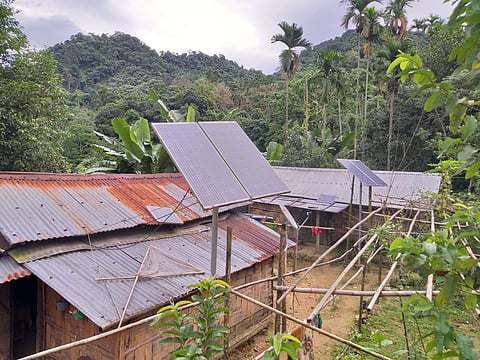
Model Solar Village (MSV) is an innovative concept of promoting solar use in rural India to demonstrate the economic and logistical benefits of the availability of uninterrupted electricity supply in the chosen village. The pace of establishing MSV is not picking up momentum in Assam. Despite the fact that special category states, such as those in the Northeast, have an advantage over other states regarding the population criteria set for the scheme, the slow progress is baffling. The central sector scheme envisages establishing one MSV in each district of the country to promote adoption of solar energy and empower village communities to achieve energy self-sufficiency. Each selected MSV is provided financial assistance of Rs 1 crore, for which the central government has earmarked an allocation of Rs 800 crore for the entire country. Even though Assam has completed the constitution of the District Level Committee (DLC) for overall monitoring and implementation of the scheme at the district level in all 35 districts of the state, MSVs have been selected in five districts, and Detailed Project Reports have been prepared for only two MSVs, which reflect the slow pace of progress. In comparison, Manipur has declared 12, Mizoram -11, and Nagaland has declared 9 MSVs. Ironically, more than two years have already elapsed since the Guidelines for MSVs under the PM Surya Ghar: Muft Bijli Yojana were issued by the Ministry of New and Renewable Energy (MNRE). One of the key objectives of the scheme is to promote technologies like solar-based home lighting systems in all households, solar-based water systems in the village, solar pumps for agricultural purposes and the installation of solar streetlights covering village roads and common village infrastructure. The competitive process through which MSVs are selected encourages villages to maximise solar adoption, especially under PM Surya Ghar: Muft Bijli Yojana and other solar use schemes such as PM-KUSUM. The Guidelines state that after the challenge period is over, the villages will be assessed on the total distributed Renewable Energy (RE) capacity installed within the revenue border of the village, and the village with the highest capacity (cumulative) is chosen as the MSV. Building awareness on this criterion can ensure healthy competition among the villages on solar adoption, and even though one village is chosen for the central assistance, several villages in the district can achieve significant progress in RE adoption. In order to streamline the competition, the guidelines allow DLC to opt for identifying potential candidate villages from among the eligible villages on the basis of feasibility of implementation of rooftop solar, community mobilisation and interest, applications by interested Panchayats, etc., and then announce the start of the competition period among these potential candidate villages for selection as the MSV of the District. After the competition period starts, an extensive mobilisation exercise is to be carried out in these villages under the leadership of the respective Panchayats, which includes reaching out door to door to prospective beneficiaries of the solar adoption schemes, planning solar installations through the convergence of other government schemes and raising awareness among the people of the Panchayat. During the mobilization exercise, the respective Panchayats/Cooperatives/SHG groups and other collectives can participate in mobilization activities and attempt to maximize the deployment of RE in the village by promotion of adoption of solar energy. This provision can play a crucial role in maximising solar energy adoption in many villages across the panchayats within a district. The DLCs are allowed to converge funds from other sources, such as corporate social responsibility, departmental funds, district-level funds, etc., to maximise RE deployment in these villages, which implies that there is no dearth of funds to promote solar adoption, provided the DLCs play an active role to translate the intent of the scheme into actual implementation on the ground. Once the MSV is selected, the State Renewable Energy Development Agency shall act as the Model Solar Village Implementing Agency and develop a detailed project report for transitioning the village to a solar-powered village by utilising the central financial assistance of Rs 1 crore provided under the scheme. The scheme's provisions highlight that the panchayats can leverage the competition under the MSV scheme to maximise solar power and other RE adoption in villages under their respective jurisdictions. The slow pace of the MSV scheme also reflects poor awareness among elected panchayat representatives about the importance of solar adoption for energy self-sufficiency and availability of cheaper electricity and the clean power bringing double the advantage of climate resilience of the villages. The demand for expeditious implementation of the scheme and fast tracking of MSV selection in all the districts will be created only when awareness is built among residents of each village for solar power adoption in every household and for irrigating their farm lands. MSVs have the potential to transform villages from passive beneficiaries into active participants in last-lime RE delivery provided their role is viewed beyond the routine government scheme-bound approach.
