
- Home
- Live Blog
- Breaking News
- Top Headlines
- Cities
- NE News
- Sentinel Media
- Sports
- Education
- Jobs
Himangshu Ranjan Bhuyan
(himangshur1989@gmail.com)
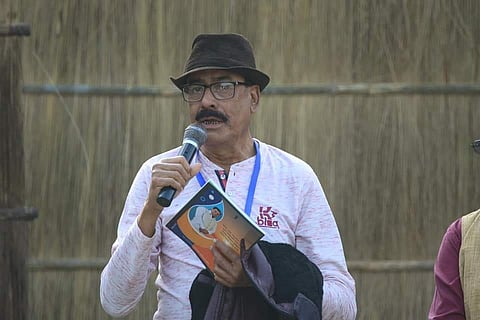
The silent departure of Rafiqul Hussain—one of the great practitioners of Assamese literature and culture, and a brilliant star in the world of Assamese drama and poetry—has today plunged the realm of Assamese poetry and theatre into a profound void. From the 1980s until the moment of his death, he travelled tirelessly from one end of Assam to the other, spreading only the fragrance of poetry and drama. In a word, Rafiqul Hussain was a rare and astonishing genius of Assamese literature and theatre. He was simultaneously a sensitive poet, a powerful playwright, a highly skilled director, and, above all, a man of immense heart enriched with humane values. His philosophy of life was to merge with the people of the soil and pursue art in that oneness.
The most captivating aspect of Rafiqul Hussain’s artistic personality was his multifaceted talent. To describe him merely as a poet or merely as a playwright would be an injustice to his genius. In the 1980s, when a new wave was sweeping through Assamese poetry, it was through his poetry collection “Sharabiddho Akash” (Arrow-Pierced Sky) that Rafiqul Hussain created something of a sensation. Published in 1984, this volume gave him a distinct identity as a poet. But what is surprising is that even after creating such a stir in the world of poetry, an intense attraction towards the art of theatre kept pulling him repeatedly towards the stage from some corner of his heart. Just as his poetry was a mirror of life’s subtle feelings, his dramatic works were living documents reflecting the real picture of society. In both poetry and drama, he displayed equal mastery. A wonderful fusion of dramatic quality in his poetry and poetic grace in his plays sets his creative body of work apart from others.
Rafiqul Hussain was truly a wandering artist. He had no fixed address; the whole of Assam was his home. His creations were not born in air-conditioned rooms. Rather, the ink of his pen flowed beneath the shade of boats tied at riverbanks, sometimes on the heated sandbanks of the Brahmaputra amid grazing cattle, and at other times in the quiet surroundings of tribal stilt houses. The earthy fragrance found in his poetry and plays comes precisely from the fact that he was never detached from the soil. He needed no luxury; an ordinary hotel room or the bed in a circuit house was sufficient as his creative space. This nomadic life of experience gave his literature a rare depth. From “Sharabiddho Akash” to “Bishad Basanta” (2009), “Chakiro Changghar” (2018), and his very recent “Goponor Antesthapur” (2022), the imprint of this wandering life is clearly visible throughout his poetic journey. He believed that poetry is the subtlest expression of life, and such expression is possible only by touching life closely—not merely through imagination.
As a playwright, Rafiqul Hussain’s contribution will remain written in golden letters in the history of Assamese dramatic literature. From his entry into the theatre world in 1981–82 through the play “Ajanma”, he never paused. The range of his dramatic oeuvre is vast and remarkably diverse. Full-length plays such as “Ujaan” (1985), “Jalashoy” (1986), “Daivaki” (1987), “Dhoowa” (1992), “Jalprapat” (2000), “Shoponor Brindaban” (2002), “Aranyat Urmila” (2004), and “Ratir Akash” (2007) offered Assamese audiences a fresh taste. His dialogues carried intense emotion and social awareness. The 1995 collection of three plays titled “Dhoowa–Daivaki–Jalashoy” remains a significant work in Assamese dramatic literature. Beyond full-length plays, he wrote eight one-act plays and gave momentum to the one-act drama movement. His plays portrayed with great finesse the stories of oppressed classes, the psychological conflicts of human beings, and the crises of contemporary times. He never considered drama merely as dialogue written for the stage; he believed drama was a powerful instrument for social change.
Parallel to playwriting, Rafiqul Hussain was an exceptional name in the field of direction as well. Under the guidance of the renowned late playwright Dharmeswar Thakur and actor Hariprasad Barthakur of Bokakhat, he received his initial lessons in direction. Yet in later years he succeeded in developing his own distinctive directorial style. There was a kind of magic in his direction that could create an enchanting atmosphere on stage. For more than three decades he travelled across Assam—from Sadiya to Dhubri—directing plays at the invitation of over a hundred theatre groups. He did not stop at merely staging a play; his main objective was to build a new generation of artists through theatre workshops. Going from village to village, he trained young boys and girls, awakening their latent talent. Many raw talents shaped by his touch later established themselves in Assam’s theatre world. He believed that if drama is to be kept alive, it must be developed as people’s art or “gananatya” (people’s theatre). That is why he moved beyond air-conditioned urban auditoriums to perform on open-air stages beneath the sky.
Rafiqul Hussain’s role in conferring a distinct dignity upon professional mobile theatre in Assam is immeasurable. At a time when professional amateur theatre practice was gradually becoming stagnant amid the dominance of commercial mobile theatre, Rafiqul Hussain fought tirelessly like an untiring soldier to keep this stream alive. Through constant experimentation he brought professional amateur drama closer to audiences. The stage design, lighting, and background music in the plays he directed were of a very high standard. Through drama he not only entertained audiences but also compelled them to think. Thanks to his efforts, many new theatre groups were born in the interior regions of Assam. His work proved that with determination, world-class theatre can be created even with limited resources. In one interview, speaking about the contemporary journey of Assamese theatre, he himself said, “What we are creating is merely a translation of the multi-layered reality of the world we inhabit. And when that translation is crafted with deep subtlety and refinement, it becomes art. In the field of drama too, I recognize only two kinds of plays—good plays and bad plays. It appears that in the current theatre scene of Assam, there are far more bad plays or plays with shallow content than good ones.”
Rafiqul Hussain was extremely simple and unassuming. He maintained an easy relationship with people of all ages. To elders he was an object of respect; to younger people he was the affectionate “Rafiq Da”. The very address “Rafiq Da” contained the vastness of his personality. Whoever met him once became his own. Amid rehearsals or casual gatherings, the things he spoke were each a philosophy of life. He could read people. He could easily discover what talent lay hidden in whom. He placed many young boys and girls on stage and drew extraordinary performances from them. Every theatre worker who came into his company acknowledges that the time spent with Rafiq Da was the best education of their life. His discipline and punctuality during direction were exemplary. He was strict, but behind that strictness lay a fatherly affection. He was the source of inspiration for thousands of young theatre practitioners.
Another noteworthy aspect of Rafiqul Hussain’s literary practice was his “Theatrical Stories”. It is rare to find stories written about the backstage life of theatre or experiences of theatrical journeys. Yet Rafiqul Hussain created a new stream in this field as well. In popular newspapers and magazines such as “Sadin” and “Satsori”, he wrote serial accounts of his wandering life experiences. The 2015 short-story collection “Eta Petticoat-or Kahini Aru Anyanya” (The Story of a Petticoat and Others) is a product of that effort. These stories were not mere fiction; they were unadulterated real pictures from his life. The strange characters he encountered while doing theatre, moments spent in unknown places in the darkness of night, and the struggles of impoverished artists—all came alive in his stories. His language and narrative style were so captivating that readers waited eagerly from one issue to the next. These stories should not be called mere literature; they were social documents of contemporary Assamese society and life. Though he never worked in expectation of awards, various organizations honored him from time to time in recognition of his work. In 1996 he received the “Kavya Hridoy Award” from “Call of the Brahmaputra” for his first poetry collection and the Assam Sahitya Sabha’s “Tilok Chandra Sharma Memorial Drama Award” for his plays. Later he was conferred the “Shailadhar Rajkhowa Award” (2018), “Krantikal Sahitya Samman” (2017), Assam Natya Sanmilan’s “Sainik-Shilpi Brajanath Sharma Award” (2017), and Sadou Guwahati Chatra Santha’s “Amulya Kakati Memorial Award” (2009), among others. More recently, in 2020, he received the “Pathar Pradipta Award” from Duliajan’s Pathar Natya Gosthi, the Assam Natya Parishad’s “Ali Haider Natyakar Award”, and just before his death, the “Lalilang Award” from Marigaon’s Lalilang The Theatre Rhythm. These awards were society’s recognition of his lifelong dedication.
The death of an artist like Rafiqul Hussain, who was devoted to art from birth, can be called the end of a consciousness. The man who found happiness, richness, and intoxication throughout his life in drama and poetry leaves today’s Assamese theatre world grief-stricken. He will live forever through his creative works. The thousands of theatre workers he shaped will carry forward his vision. Rafiqul Hussain was truly a being dedicated to poetry and drama. This dedicated life of his will remain a source of inspiration for future generations. Today he is no longer among us, but his work, his ideals, and the memory of his affection will remain eternally alive in our hearts. To this great artist we offer our respectful obeisance. Farewell, Rafiq Da; wherever you may be, may you rest in peace. Your absence is irreplaceable, but your creation is imperishable.
(The author is the recipient of the ‘Yuba Lekhak Sanman - 2025’ from the Government of Assam.)
