
- Home
- Live Blog
- Breaking News
- Top Headlines
- Cities
- NE News
- Sentinel Media
- Sports
- Education
- Jobs
Siddharth Roy
(siddharth001.roy@gmail.com)
In Assam’s dynamic landscape, where rivers snake across fertile plains and forests teem with rare biodiversity, the region faces a growing dilemma: how to balance infrastructure development with ecological protection. A pressing and timely example of this tension has emerged from the forests around Hoollongapar Gibbon Sanctuary, where conservationists, local communities and environmentalists are urging authorities to relocate a 165-kilometre rail stretch to protect one of the world’s most endangered primates: the Hoolock gibbon.
The plea to shift the rail line is not a minor conservation request, as it runs through a crucial wildlife corridor connecting Hoollongapar to other forested areas. This issue fundamentally challenges India’s approach to development in ecologically sensitive zones and our appreciation of our natural heritage amidst escalating infrastructure demands.
Hoollongapar is unique not just for Assam but for all of India. This forest is home to the eastern hoolock gibbon, a primate classified as endangered by the International Union for Conservation of Nature (IUCN). These gibbons rely on tall trees and uninterrupted canopy cover to move, feed, mate and raise their young. The forest’s connectivity, undisturbed stretches linking one grove to another, is essential for their survival. When this connectivity is compromised, isolated groups are cut off, reducing genetic diversity and increasing risks of disease, inbreeding and eventual decline.
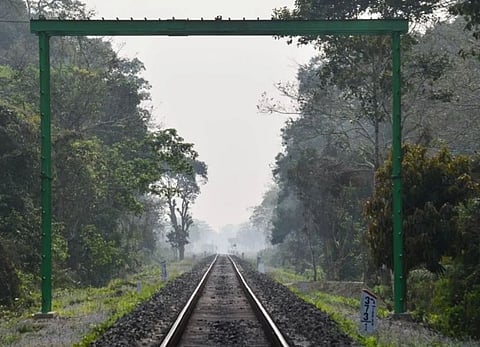
The existing rail track disrupts this connectivity. Every passing train, and there are dozens each day, means noise, vibration and human presence intruding into the gibbons’ world. Tracks fragment habitat and force animals to cross dangerous spaces. Documented sightings show gibbons withdrawing deeper into the forest or avoiding areas near the line during train movement. For a species already on the brink, such an event is not a minor stress; it is a genuine threat to population stability.
Environmentalists argue that shifting the rail line a reasonable distance—even a few kilometres—could restore the sanctuary’s core connectivity without significantly hampering transportation needs. Local demands reflect a clear understanding of landscape ecology: rails and roads should not bisect wildlife habitats where fragile species reside. Their call is not anti-development but pro-sustainable development.
Critics might counter that relocation is expensive and time-consuming and that rail lines are vital for passenger travel and freight movement across the region. These points are valid. Assam’s connectivity crunch—between urban centers, rural towns, and neighbouring states— depends on a reliable rail network. But the core question remains: should development be pursued at the cost of irreversible ecological damage? If the answer is no, then simply weighing costs in monetary terms becomes inadequate. We need to account for ecological value, cultural identity and long-term sustainability, factors that cannot be measured merely in rupees and paisa.
The Hoollongapar issue is a microcosm of a larger national challenge. India’s infrastructure ambitions are rightly bold. Bridges, highways, ports, and railways have catalysed economic activity, employment, and social integration. But in landscape depressions like Hoollongapar, where biodiversity value is exceptionally high, a different lens is required. The mantra of “development for all” must not become “development at the cost of all”.
Supporting the relocation proposal are voices from local communities and experts alike. Their argument reflects a nuanced understanding that human well-being and ecological health are intertwined. Healthy forests support pollinators, regulate water cycles and provide ecosystem services that benefit farmers, fishermen, and rural households. Herbivores and birds attract ecotourism that can generate sustainable income streams for nearby villages. Protecting a flagship species like the hoolock gibbon can thus yield broad social dividends.
This debate also underscores the need for multidisciplinary decision-making. Infrastructure planning should incorporate the insights of ecologists, economists, sociologists, and local stakeholders. Too often, projects are designed in silos, with engineering at the forefront and environmental concerns treated as an afterthought. A shift in planning culture, incorporating ecological sensitivity assessments early in the process, could help prevent such conflicts before they arise.
Moreover, the legal and policy framework in India already offers tools for such balance. The Wildlife Protection Act, Forest Conservation Act and environmental impact assessment (EIA) processes exist precisely to ensure that development does not trample biodiversity. What is needed now is a stronger will to implement recommendations from these processes and, where necessary, to act on precautionary principles rather than reactive ones.
Assam’s leadership, both in the state and at the Centre, can play a catalytic role here. Assam has previously shown that it can be a national leader in environmental governance, from flood management reforms to community-based conservation measures. Relocating the rail stretch would demonstrate a forward-looking approach to infrastructure planning, one that respects both modern needs and ecological imperatives.
We must also learn from global examples. Countries with advanced rail and highway systems in forested regions routinely adopt wildlife overpasses, underpasses and alternative alignments. These investments may cost more upfront, but they prove invaluable over time in preserving species, reducing animal–human conflict and even preventing costly delays due to environmental litigation. India is ready for similar innovations that marry engineering excellence with ecological wisdom.
At the end of the day, the choice before us is about values as much as it is about logistics. Do we choose a short-term convenience that endangers an entire species? Or do we choose a future where humans and wildlife can coexist sustainably on the same land? Moving the rail line near Hoollongapar may not solve every environmental challenge in India, but it would send a strong message: that we do not see nature merely as an obstacle to progress but as an essential partner in the story of our development.
Assam’s demand to shift the rail stretch is not a “luxury environmentalist ask”. It is a deeply rational plea rooted in science, empathy and long-term thinking. If India truly desires to be a global champion of sustainable growth, now is the time to act, with foresight, courage and respect for the voiceless inhabitants of its forests.
