
- Home
- Live Blog
- Breaking News
- Top Headlines
- Cities
- NE News
- Sentinel Media
- Sports
- Education
- Jobs
Heramba Nath
(herambanath2222@gmail.com)
India, a land steeped in ancient traditions, rituals, and spiritual philosophies, has long held festivals as vital expressions of its rich civilisational heritage. Among the countless religious celebrations that weave together the nation’s diverse cultural fabric, the Rath Jatra occupies a distinctive, sacred, and emotionally charged space in the hearts of millions. Particularly associated with the holy town of Puri in Odisha, this grand chariot procession is far more than a religious event — it is a moving emblem of communal harmony, devotion, and the living continuity of an ancient civilization.
The term ‘Rath Jatra’ literally translates to ‘Chariot Journey’ and symbolises the annual ceremonial procession of Lord Jagannath, accompanied by his siblings — Lord Balabhadra and Devi Subhadra — from the sanctum of the famed Jagannath Temple to the Gundicha Temple, where they stay for a period before returning. The event, celebrated on the second day of the Shukla Paksha in the month of Ashadha (June-July), draws not only pilgrims from India but also thousands of international visitors who come to witness and participate in this moving testament of collective faith.
What makes the Rath Jatra unique is the breaking of certain ritualistic conventions. On this day, the Lord, who is usually worshipped within the confines of the temple by select priests, ventures out amidst the public, granting ‘darshan’ to all without discrimination of caste, creed, or status. It is this openness, inclusivity, and the rare, physical closeness to the divine that infuses the festival with extraordinary emotional and spiritual energy.
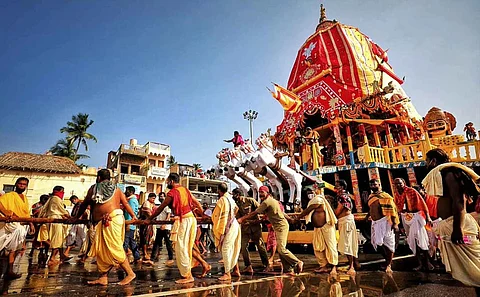
Three massive, elaborately crafted wooden chariots — Nandighosa for Lord Jagannath, Taladhwaja for Lord Balabhadra, and Darpadalana for Devi Subhadra — are constructed anew every year by dedicated artisans using sacred wood. The entire process, steeped in age-old tradition, begins months in advance and is considered a sacred duty rather than a mere occupational task. The chariots, adorned with bright canopies and intricate motifs, stand as magnificent metaphors of India’s living artistic and architectural traditions. The making of these chariots is itself a ritual, involving generations of hereditary carpenters and craftsmen. The wood used is carefully chosen from specific forests, and the cutting is performed with religious rites, highlighting the delicate balance ancient societies maintained between nature and devotion.
One of the most moving moments of the Rath Jatra is the ‘Chhera Pahanra’ ritual, where the Gajapati King of Puri, considered the foremost servitor of Lord Jagannath, personally sweeps the chariot platforms with a golden broom and sprinkles sandalwood water. This gesture underscores a profound philosophical truth enshrined in Indian thought — that before the divine, all worldly distinctions dissolve. The ritual symbolises the essential equality of all beings and the humility of even the highest temporal authority in the face of the eternal. In a society historically layered with social hierarchies, this moment becomes a visible, powerful reminder of the universality of spiritual grace.
The festival is not confined to Odisha alone. Over the centuries, inspired by Puri’s example, Rath Jatras have been organised in various parts of India and abroad, particularly by the International Society for Krishna Consciousness (ISKCON). Cities like Kolkata, Ahmedabad, Mumbai, and even London, New York, and Moscow have witnessed their own chariot processions, affirming the universal appeal and adaptability of Indian spiritual practices. In Assam, the Rath Jatra is celebrated with heartfelt enthusiasm in Guwahati’s Jagannath temple at Pandu and in Barpeta, where thousands gather to participate in the joyous pulling of the chariots, accompanied by traditional bhajans and community feasts.
From a socio-cultural perspective, the Rath Jatra reinforces inter-community bonds. It brings together artisans, priests, devotees, tourists, and administration in a collective act of faith. The seamless cooperation required for organising and conducting such a massive event speaks volumes about India’s innate ability to merge religious fervour with organisational precision. The gathering of lakhs of pilgrims, all driven by a common spiritual longing, creates a temporary but powerful community of equals. During the festival days, social hierarchies are dissolved as people of all walks of life unite to pull the ropes of the colossal chariots — a sacred duty believed to wash away sins and earn divine blessings.
The theological dimension of the Rath Jatra is equally rich. Lord Jagannath, believed by many to be a form of Lord Krishna, is depicted in a distinctive, non-anthropomorphic form, with large round eyes and no discernible limbs. Scholars interpret this iconography as representing the formless, all-seeing nature of the divine. The chariot procession itself is often seen as a symbolic journey of the soul — from the material world (represented by the Jagannath Temple) to the abode of liberation (the Gundicha Temple) and back, reflecting the cyclical nature of life and death in Hindu philosophy. The detachment from form in Jagannath’s idol is a theological statement about the ineffable, formless reality of the divine, transcending the limits of human perception.
Historically, the Rath Jatra has also played a role in shaping socio-political narratives. During colonial times, the British administration, initially apprehensive of large religious congregations, gradually came to appreciate the order and piety with which the festival was conducted. In many ways, it became a site for passive resistance and a subtle assertion of indigenous faith in the face of foreign rule. Despite their colonial gaze, British chroniclers often recorded the event’s impressive organisation and the unifying power it held for the Indian populace.
In Assam too, temples dedicated to Lord Jagannath, such as those in Guwahati and Barpeta, observe the Rath Jatra with great devotion and enthusiasm. Processions, bhajans, community feasts, and the pulling of the chariot by devotees are integral to these celebrations. The festival acts as a cultural bridge linking Assam’s Vaishnavite traditions to the broader canvas of Indian spiritual practices. The simplicity and devotional fervour characteristic of Assamese Rath Jatras mirror the egalitarian spiritual ideals propagated by saints like Srimanta Sankardev and Madhavdev.
In contemporary times, as societies grapple with increasing materialism, social divisions, and environmental challenges, the essence of Rath Jatra offers timeless lessons. It reminds us of the power of collective devotion, the need to transcend societal barriers, and the importance of reconnecting with age-old traditions that promote unity, compassion, and inner harmony. The festival stands as a yearly affirmation that faith has the power to dissolve social discord, heal communities, and revitalise cultural values.
Even in the midst of modern technology and digital distractions, the sight of thousands pulling the mighty chariots with chants of ‘Jai Jagannath’ remains a profoundly moving spectacle. The festival is a living testament to India’s capacity to preserve its spiritual traditions while embracing contemporary realities. In recent years, live telecasts and social media broadcasts have allowed millions worldwide to witness and partake in the celebration virtually, making it a truly global spiritual event.
The Rath Jatra also stimulates local economies, especially in Puri, by generating employment for artisans, traders, hoteliers, and transporters. The making of the chariots, decorative items, food stalls, and devotional merchandise sustains livelihoods and keeps traditional crafts alive. The tourism boom around the festival days significantly boosts the local economy, benefitting a wide array of service sectors. Seasonal markets, temporary shelters, and eateries mushroom around Puri, creating a vibrant economic ecosystem.
However, the festival is not without its challenges. Issues of crowd management, waste disposal, health safety, and infrastructural strain surface each year. The authorities have, over the years, evolved mechanisms to address these concerns, incorporating modern disaster management practices without compromising the festival’s sanctity. Stringent security measures, medical aid stations, and dedicated volunteer forces ensure the safety and wellbeing of millions of attendees.
Environmentalists too have raised concerns over the felling of trees for chariot construction. In response, regulated harvesting and compensatory afforestation programmes have been initiated, aiming to strike a balance between tradition and ecological responsibility. The Odisha Forest Department collaborates with temple authorities to ensure sustainable wood procurement, demonstrating a model where religious tradition and environmental awareness can coexist.
At its heart, Rath Jatra is a celebration of movement — of chariots, of people, of faith. It is a reminder that the spiritual quest is dynamic, that the divine itself steps out into the world, and that communities can come together in a moment of shared transcendence. It represents India’s genius for turning religious practice into an inclusive, public, and transformative experience. The image of devotees pulling chariots under the blazing sun, singing devotional songs, and expressing collective joy encapsulates the resilience and faith of a civilisation that thrives on spiritual diversity.
As India stands poised between ancient traditions and modern aspirations, the continuing relevance and grandeur of the Rath Jatra affirm the enduring power of faith-based, community-driven celebrations. It is not merely a procession of deities; it is a procession of cultural memory, human emotion, and timeless values. The rhythmic pull of the chariots echoes the inner tug of countless devotees towards the eternal, making Rath Jatra one of India’s most soul-stirring and humanising festivals. In an age often marked by division, alienation, and the erosion of shared cultural experiences, the Rath Jatra offers a model of inclusive religiosity — one where faith transcends divisions, ritual affirms equality, and tradition rejuvenates social bonds. It is this quality that makes Rath Jatra not only a treasured event of religious significance but also a luminous emblem of India’s living civilizational spirit.
