
- Home
- Live Blog
- Breaking News
- Top Headlines
- Cities
- NE News
- Sentinel Media
- Sports
- Education
- Jobs
Jaideep Saho
(jayadeba.sahoo@rgu.ac.in)
Among the innumerable festivals that illuminate India's spiritual horizon, Rath Yatra occupies a position of extraordinary magnificence and profound philosophical significance. Celebrated annually in the sacred city of Puri, Odisha, this grand procession of Lord Jagannath, accompanied by Lord Balabhadra and Devi Subhadra, is far more than a religious observance. It is a vibrant celebration of humanity's collective aspiration for truth, compassion, equality, and spiritual awakening. I
The timeless wisdom of Rig Veda (10.191.2) beautifully captures this collective spirit: "Samgacchadhvam samvadadhvam sam vo manamsi janatam." "Walk together; speak together; let your minds be united," proclaiming that divine grace belongs equally to every heart. As millions join hands to pull the sacred chariots, this timeless invocation becomes a living reality.
Jagannath: The Universal Lord Beyond Boundaries
The name "Jagannath" literally means "Lord of the Universe." Accompanied by Lord Balabhadra and Devi Subhadra, Lord Jagannath leaves the sanctum of the temple every year to journey to the Gundicha Temple. This extraordinary tradition symbolizes divine accessibility and universal compassion. The Lord comes to the people, affirming that spiritual grace is not restricted by caste, class, language, nationality, or social status. The Bhagavad Gita (9.29) proclaims: Samo 'Ha Sarva-Bhute?u Na Me Dveyo 'Sti Na Priya; "I am equal toward all beings; none is hateful or especially dear to Me."
This ideal is vividly reflected during Rath Yatra, where distinctions dissolve in a shared experience of devotion and fellowship. Rath Yatra thus becomes a moving manifestation of divine impartiality and universal compassion.
The Chariot: A Timeless
Metaphor of Human Life
Indian philosophical traditions often use the chariot as a metaphor for human life. The Katha Upanishad (1.3.3) declares: “Atmana? Rathina Viddhi, Sarira Rathameva Tu. Buddhi Tu Sarathi Viddhi, Mana? Pragraham Eva Ca."- – "Know the Self as the master of the chariot, the body as the chariot, the intellect as the charioteer, and the mind as the reins." This profound symbolism invites every individual to reflect upon the direction of life. The true journey is not only from one temple to another but also from ignorance to wisdom, from restlessness to serenity, and from selfishness to selflessness. While this practice is distinct from the traditional theology of Jagannath worship, it harmonizes with the festival's universal call for inner awakening and noble living.
Three Chariots, Three
Timeless Inspirations
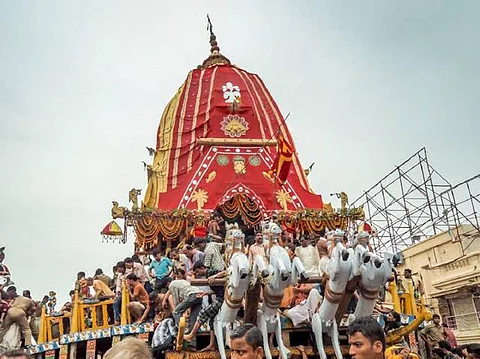
The magnificent chariots—Nandighosha, Taladhwaja, and Darpadalana—are annually reconstructed by hereditary artisansusing time-honoured techniques. The magnificent chariots—Nandighosha, Taladhwaja, and Darpadalana—are annually reconstructed by hereditary artisans using time-honoured techniques. The magnificent chariots—Nandighosha, Taladhwaja, and Darpadalana—Hereditary artisans annually reconstruct the magnificent chariots—Nandighosha, Taladhwaja, and Darpadalana—using time-honoured techniques. by hereditary artisans using time-honoured techniques. Their creation is itself a celebration of India's indigenous craftsmanship and cultural continuity. Symbolically, they inspire enduring human virtues: Nandighosha – wisdom to guide decisions. Taladhwaja – Strength to uphold righteousness. Darpadalana—Compassion to nurture harmony. These virtues remain as relevant today as they were centuries ago.
Humility: The Crown
of Leadership
One of Rath Yatra's most remarkable rituals is Chhera Pahanra, in which the Gajapati Maharaja of Puri ceremonially sweeps the chariots with a golden broom. The ritual conveys a timeless lesson: genuine leadership blossoms through humility and service rather than privilege. The Bhagavad Gita (5.18) teaches: "Vidya-Vinaya-Sampanne Brahma?e Gavi Hastini; Suni Caiva Svapake Ca Pa??ita? Sama-Darsina." "The truly wise perceive all beings (a Brahmin, a cow, an elephant, a dog, and a dog-eater) with equal vision." This ritual beautifully demonstrates that humility is the true ornament of leadership.
The Rope That Unites Humanity
Perhaps the most moving spectacle of Rath Yatra is the collective pulling of the sacred chariots. Thousands of hands work together in perfect harmony, demonstrating that great journeys are achieved through cooperation rather than competition. In perfect harmony, thousands of hands work together, demonstrating that cooperation, not competition, accomplishes extraordinary journeys. In perfect harmony, thousands of hands work together, demonstrating that cooperation, not competition, accomplishes outstanding journeys. through cooperation rather than competition. The celebrated maxim (Maha Upanishad, 6.71) declares: "Aya Nija Paro Veti Gaana Laghucetasam; Udaracaritana Tu Vasudhaiva Ku?umbakam." "The narrow-minded distinguish between 'mine' and 'others'; the noble regard the whole world as one family." In today's interconnected world, this timeless ideal of Vasudhaiva Kutumbakam has become more relevant than ever.
Lessons for a Changing World
In today's world, marked by technological progress alongside rising stress, conflict, and environmental concerns, Rath Yatra offers enduring wisdom. It teaches that peace begins within, equality strengthens society, humility enriches leadership, and cooperation builds resilient communities.
The worldwide celebration of Rath Yatra in cities such as London, New York, Sydney, Johannesburg, and Singapore illustrates that Jagannath's message has become a bridge between cultures, fostering dialogue, mutual respect, and shared humanity.
The Inner Rath Yatra
Beyond the vibrant colours, sacred chants, and majestic chariots lies a quieter invitation—to undertake an inward pilgrimage. Raj Yoga meditation encourages individuals to cultivate elevated thoughts, inner silence, and awareness of the soul's intrinsic qualities of peace, love, and joy. In this reflective sense, each day can become a personal Rath Yatra, where the "chariot" of life is guided by wisdom, self-discipline, and compassion.
The Bhagavad Gita (6.5) inspires this inward ascent: “Uddhared Atmanatmana? Natmanam Avasadayet; Atmaiva Hy Atmano Bandhur Atmaiva Ripur Atmana?" – "Let one uplift oneself through one's own higher Self." The true Rath Yatra therefore unfolds daily whenever thoughts move from negativity toward divinity.
Rath Yatra is far more than a magnificent religious procession; it is a living celebration of humanity's highest ideals. It reminds us that the Divine reaches out with unconditional compassion, that true greatness is rooted in humility, and that lasting harmony grows from recognizing the dignity of every soul.
Viewed through the reflective lens of Brahma Kumaris philosophy, the festival also inspires an inward journey of self-transformation through soul-consciousness and Raj Yoga meditation—an interpretation that complements, rather than replaces, the rich traditional significance of Jagannath worship. The Brihadaranyaka Upanishad (1.4.14) beautifully encapsulates the spirit of Rath Yatra: "Sarve Bhavantu Sukhina?, Sarve Santu Niramaya?; Sarve Bhadrai Pasyantu, Ma Kascid Du khabhagbhavet." "May all be happy; may all be healthy; may all behold auspiciousness; may none suffer."
As the sacred wheels of Lord Jagannath's chariot continue to roll through the streets of Puri and the hearts of millions across the world, they carry an immortal message: when humanity advances together with faith, wisdom, humility, and compassion, every journey becomes sacred, every heart becomes a temple, and every step leads toward a more peaceful and harmonious world.
