
- Home
- Live Blog
- Breaking News
- Top Headlines
- Cities
- NE News
- Sentinel Media
- Sports
- Education
- Jobs
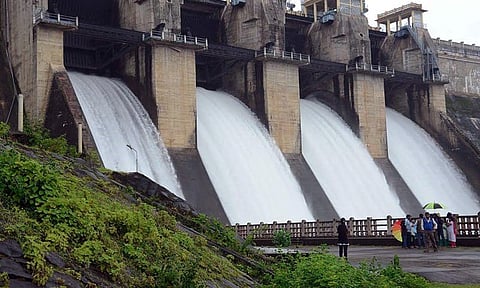
A talk delivered in Guwahati by Assam’s globally renowned hydrologist and river-scientist Prof Nayan Sharma last Friday has once again brought to focus the issue of dams on the rivers in the North-eastern region, especially in the wake of large-scale protests arising out of fear that these dams – more particularly the Lower Subansiri dam – are live water-bombs that would wipe out a major part of the civilization in the Brahmaputra Valley. Prof Sharma is a known supporter of dams, for which he has been often accused by a section of the anti-dam activists as a desh-drohi – a traitor! But then, carefully examining what he spoke in Guwahati on Friday, one finds that either he has so long not been successful in explaining to those concerned about the potential dangers of the dams, or that the leaders of the anti-dam organizations have not been able to follow what he has been trying to say.
What Prof Sharma said on Friday are as follows: (i) No dam has ever collapsed anywhere in the world due to earthquakes; he gave particular examples of dams in Japan which had a few years ago experienced a tremor measuring 9 on the Richter Scale, as also of the Tehri Dam in Uttarakhand; (ii) Civilized countries construct dams with multiple purposes – for harnessing hydro-electric power, flood-cushioning, facilitating irrigation and providing drinking water; (iii) Advanced countries were constructing dams that have piano key weir design integrated in, and old dams have been re-done by converting a portion of it to piano key weir; (iv) Civilized nations give top priority to the ecological protection of the catchments as well as the downstream areas of rivers on which dams are built; and (v) China, our upper riparian neighbour on the Brahmaputra, has deployed latest technology in sharp contrast to vintage ideas that our planners have stuck to.
Prof Sharma’s deliberations, presented before a learned audience that comprised mostly leading and senior engineers and technocrats of the state, thus also made it clear that our existing dam projects have been all constructed with the kind of engineering that are considered obsolete elsewhere in the world. It has also become clear that our existing dam projects – all of which are more sources of worry and sorrow than of happiness and progress – have been designed only to produce power and nothing else. There is no doubt that the environmental and ecological issues have never been taken into account while designing and implementing these single-purpose dams where the sole intention is to only produce power. Issues like top-soil erosion, forest cover degradation, earth-cutting, etc have never been taken into account in the upstream catchments, while those related to the downstream issues have been blatantly ignored or sidelined. These include all the four dam projects in question – Ranganadi, Doyang, Karbi-Langpi and, of course Lower Subansiri, the last being the most dreaded.
What however was encouraging and optimistic in his presentation was the fact there are enough possibilities of “correcting” the wrongs in all the four dams in question. Going by the Professor who has executed close to 100 consultancy projects and conducted ten major national and international river research schemes, all four dams must be, and can be, converted into multi-purpose projects so that all the issues raised by the critics of dams can be addressed.
Films mirror society
Media, it is said is an outcome of society and thus so inseparable from it. Pundits have often described media as the mirror of the society. This means, whatever is seen or shown in the media of a particular country or place is nothing but reflection of the society to which they belongs and to which they cater. Newspapers and television news channels report what goes on in the society that they cater to. Likewise, creative writers who write fiction and poetry too largely reflect the society to which they belong. Theatre too is the same; in olden times it focused more on gods and goddesses because societies were largely governed by religious norms. In the past more than one hundred years – since December 1895, when the Lumiere‘ Brothers first showed their short films in Paris – cinema has come to stay as one of the strongest medium of entertainment, in the process, again, becoming one of the most important mirrors of society. In India, films starting with our very own Pramathesh Chandra Barua’s Devdas (1935) to Bimal Roy’s Do Bigha Zamin (1953) and Satyajit Ray’s Pather Pachali (1955) to again our very own Rima Das’ Village Rockstars (2017) – have all largely reflected or shown our very own society, our very own country and people. While pure entertainment like the Bollywood blockbusters too are part of our society in that they finally reflect our follies and foibles along with the kind of sometimes cheap, sometimes pure and wholesome entertainment that our society seek. Two such films that have been shown in the on-going 2nd Guwahati International Film Festival stand out in seriously and sincerely reflecting our society. Both are Assamese films – Jahnu Barua’s Bhoga Khiriki (Broken Window) and Bidyut Kotoky’s Xoixobote Dhemalite (Rainbow Fields) – where, coincidentally, the story-line is woven around violence, militancy and insurgency that have dangerously affected Assam and her people. While Barua’s film also assert the universal fact that women are the worst victims of any act of violence – ULFA being one such perpetrator, as also exploitation within the immediate family, Kotoky’s film recalls the violence of the Assam movement – Nellie and all – that had left indelible scars in minds of young children who grew up amid them. Both films are well-crafted documentation of the horrible times Assam has passed through, and is still struggling to get rid of. The people, including leaders and self-styled leaders, should see these films in order to see themselves, and also see for themselves what harm they have done to themselves and the society they belong to.